
Words of Encouragement

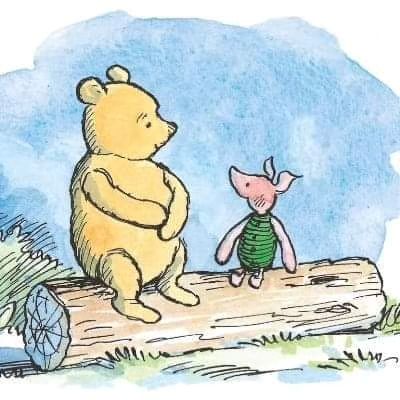
“Piglet?” said Pooh.
“Yes?” said Piglet.

“I’m scared,” said Pooh.
For a moment, there was silence.

“Would you like to talk about it?” asked Piglet, when Pooh didn’t appear to be saying anything further.

“I’m just so scared,” blurted out Pooh.

“So anxious. Because I don’t feel like things are getting any better. If anything, I feel like they might be getting worse. People are angry, because they’re so scared, and they’re turning on one another, and there seems to be no clear plan out of here, and I worry about my friends and the people I love, and I wish SO much that I could give them all a hug, and oh, Piglet! I am so scared, and I cannot tell you how much I wish it wasn’t so.”

Piglet was thoughtful, as he looked out at the blue of the skies, peeping between the branches of the trees in the Hundred Acre Wood, and listened to his friend.

“I’m here,” he said, simply. “I hear you, Pooh. And I’m here.”

For a moment, Pooh was perplexed.

“But… aren’t you going to tell me not to be so silly? That I should stop getting myself into a state and pull myself together? That it’s hard for everyone right now?”

“No,” said Piglet, quite decisively. “No, I am very much not going to do any of those things.”

“But-” said Pooh.

“I can’t change the world right now,” continued Piglet. “And I am not going to patronise you with platitudes about how everything will be okay, because I don’t know that.

“What I can do, though, Pooh, is that I can make sure that you know that I am here. And that I will always be here, to listen; and to support you; and for you to know that you are heard.

“I can’t make those Anxious Feelings go away, not really.

“But I can promise you that, all the time I have breath left in my body…you won’t ever need to feel those Anxious Feelings alone.”

And it was a strange thing, because even as Piglet said that, Pooh could feel some of those Anxious Feelings start to loosen their grip on him; could feel one or two of them start to slither away into the forest, cowed by his friend, who sat there stolidly next to him.

Pooh thought he had never been more grateful to have Piglet in his life.

[source]

1 comments

Viruses Of The Mind

From Infidel753:

Viruses are the simplest of all living things. Indeed, it’s questionable whether they should be considered “living” at all. A virus does not eat, breathe, digest, or perform any other of the organic functions of such true organisms as animals, plants, or bacteria. It consists of a string of DNA (or, in the case of retroviruses, RNA) within a protein shell. It cannot even reproduce without a host cell to parasitically exploit. Once inside the host cell, the virus DNA insinuates itself into the cell’s own DNA, and diverts the functioning of the cell’s internal machinery to produce copies of the virus. A virus is not so much a living thing as a packet of pure information—including instructions for replicating itself, and for modifying the behavior of the host organism in ways which will spread the virus (coughing, sneezing, etc).

Computer “viruses” work in much the same way and are thus aptly named. A computer virus is not even a material object but a series of electronic codes—again, it is a packet of pure information, usually including instructions which force the host computer to create new copies of the virus and spread them to other computers, just as a conventional virus uses a living host cell.

DNA and the systems which transcribe it, and electronic computers, are both information-processing systems. Viruses are parasites, entities composed of information rather than flesh and blood, which exploit such systems. As with conventional parasitism, this process usually inflicts substantial harmful effects upon the host cell or host computer, whose internal systems are perverted away from their normal functions to serve the aim of virus replication and spread.

The human mind is also an information-processing system. And it too has its viruses.

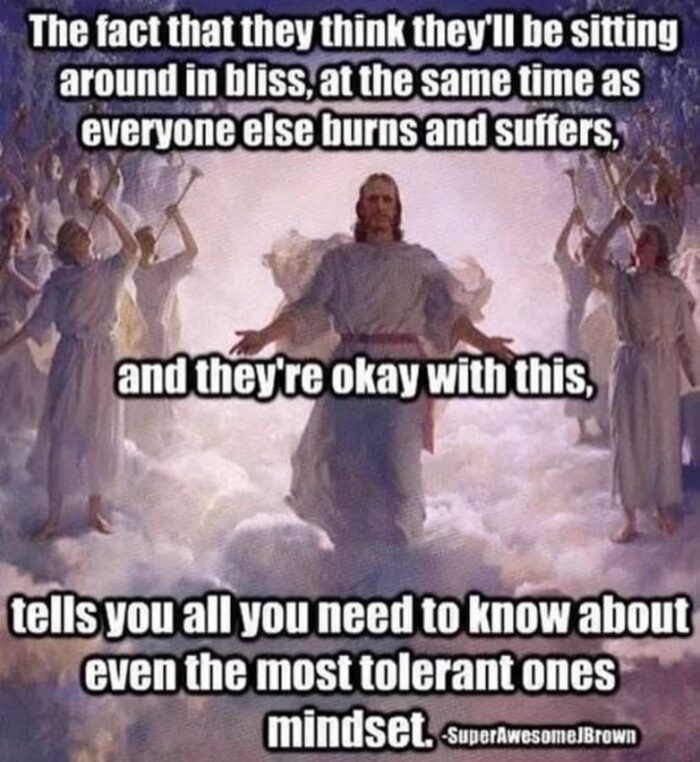
Consider religion, especially proselytizing religion. When this virus infects a human mind, it perverts the workings of that mind away from its normal function as part of that human’s system for maintaining a happy, satisfying life. Healthy sexual feelings are re-interpreted as “sin”. Irrational beliefs and bizarre, self-sacrificing behavior develop as the instructions from the invading ideological virus override natural mental processes. Like a cell which ruins itself by creating countless copies of the virus that infected it, and spreading them to other cells, the human whose mind is “infected” with a proselytizing religion often becomes fanatically dedicated to spreading the infection to others, even at the expense of his own safety and well-being. He becomes a host, a toolfor the information parasite, serving the purpose of its spread rather than the advancement of his own natural desires.

Several such mind-viruses—Christianity, Islam, fascism, Marxism—have evolved and spread successfully. Some human minds afflicted with these information parasites develop only mild cases (natural immunity due to better education or higher intelligence, perhaps), while others soon progress to the full-blown “fanatic” stage in which the virus is most effectively spread.

A broad education, including knowledge of science and critical thinking and exposure to a wide range of ideas, is the best “vaccine” we have against such mental viruses. Another defense is social environments hostile to their spread — the equivalent of public sanitation, which discourages the spread of conventional diseases. In this case, the protective social environment is one of cultural pluralism. Exposure to a wide range of cultures and ideas tends to render a human mind less susceptible to being completely taken over by any single idea (even if the variegated idea systems are all religious ones, the effect can still work). This does not mean that multiple cultures must be physically present. Japan is very mono-cultural by Western standards, but its people are constantly exposed to other cultures via the media, film and TV, the internet, etc.

Over the last couple of centuries, improved hygiene, vaccines, and other medical innovations have massively reduced the threat posed by infectious disease — to the point where diseases like AIDS or covid, which probably would have passed literally unnoticed any time before 1800, now register to us as major threats because the epidemic diseases that once routinely killed 10% to 20% of whole populations at a time are mostly under control or even effectively extinct. Rising levels of religious non-belief in Europe, the US, Latin America, and even the Middle East show that we’re making similar progress against mind-viruses. It is still hard to imagine a world without religion, but a few generations ago it would have been hard to imagine a world without smallpox. We can do this.

0 comments

From Inverse, originally published in 2018:

A CALENDAR WHERE EVERY MONTH IS 28 DAYS WOULD ACTUALLY MAKE A TON OF SENSE

Wednesday marks the last day of February, the shortest month in the Gregorian calendar. It doesn’t have to be this way, according to some advocates who propose a calendar where every year is 13 months and every month is 28 days. It sounds like a drastic change to a calendar that’s been in use since 1582, but dig a little deeper and the idea makes a lot of sense.

The idea is simple. Each month has four, seven-day weeks, making a total of 28 days. There are 13 months in a year, totaling 364 days, with a new month in between June and July called “Sol” to mark the summer solstice. The leftover day is a special Year Day, with two such days every four years.

The idea was first proposed by British railway worker Moses B. Cotsworth, who devised it in 1902 as a way of making his job easier. George Eastman, head of Kodak, used the calendar in his company from 1924 to 1989, but employees didn’t live their lives by the strange structure and stuck to Gregorian outside of work. A proposal put forth to the League of Nations attracted a great deal of interest, but that too fell by the wayside as World War II disbanded the league.

The design has a number of advantages. It means the 8th is always a Sunday no matter the month, and the same applies to every other day. Holidays like Thanksgiving wouldn’t move around the calendar anymore. Monthly and quarterly data becomes easier to compare, with both measurements an equal number of days. It also means never checking when the month ends.


The idea has since occasionally come up in fiction. The Simpsons lampooned the idea during a Treehouse of Horror Halloween special, where a particularly spooky segment takes place on the 13th day of the 13th month. Marge explains that the school calendars were misprinted, and Homer can be heard complaining about the “lousy Smarch weather.”

The Simpsons episode actually raises one of the downsides of the calendar. It would mean having a 13th month every year, and also means every month would contain a Friday the 13th. It may sound like a small detail to some, but don’t forget that Microsoft never released a version 13 of Office, and data from 2015 showed 574 Manhattan condos lack a 13th floor. Don’t underestimate the power of superstition.

1 comments