0 comments

Shitposting since 2005
0 comments
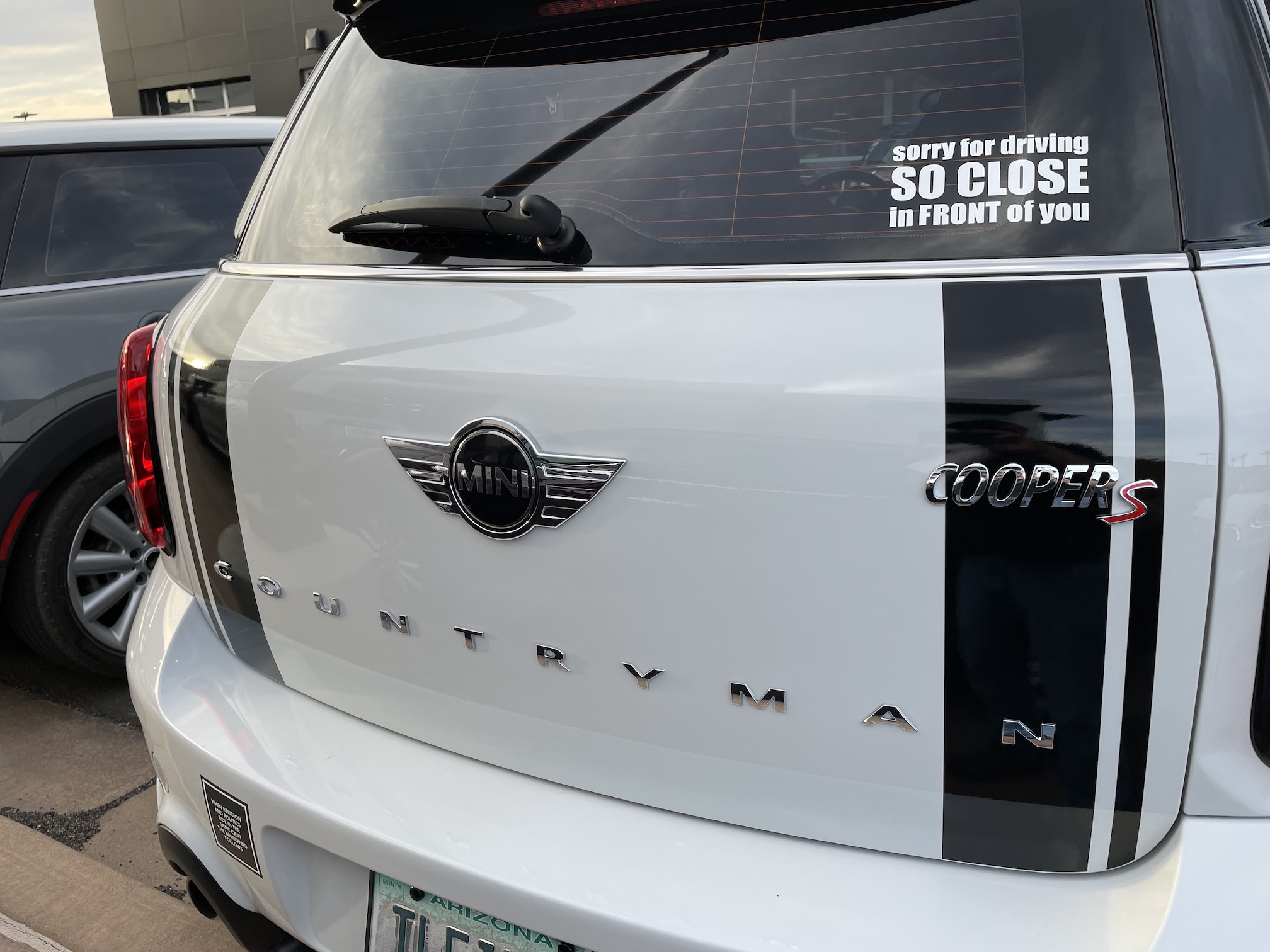
If you guessed that the stripes are backwards, you win!
As you may (or may not) remember, Rabbit got his “bonnet” stripes back in August of last year. At the time I was kind of torn as to whether or not I wanted to do the “boot” stripes as well, but ultimately decided to put it off because I wasn’t sure of the aesthetics and the cost was 150% of the front stripes. (It’s the labor of removing the badging.)
Since we have a little “extra” cash these days—thanks to our former landlord literally burning us out of house and home—I decided to revisit the rear stripes. I’d seen a few around town and online and the look really grew on me. So about a week and a half ago I took Rabbit in to get his butt done. (This is normally a one-day job.)
That afternoon I got a call from my service rep informing me that the vinyl shop had discovered that one of the stripes had a pretty bad kink in it and they’d need to get another one—and the soonest that could happen was the following Monday.
So I did some internal grumbling because I didn’t exactly relish the thought of two additional days in the loaner, but as Ben often says, “It was what it was.”
The car was ready late Monday afternoon, and I picked it up literally ten minutes before the shop closed. I walked outside and snapped the quick picture you see above.
Something seemed off, but I couldn’t put my finger on it.
While I was stopped on the way home, I looked at the photo and then looked at the hood stripes. They’d applied the rear stripes backward! The narrow stripes were supposed to be inside the wide stripes as they’d done (correctly) months ago on the hood!
I called the next morning and was told to bring the car back in “for them to inspect.”
Tuesday morning I arrived and the guy who does nothing more than check you in when you arrived walked around the back and I saw him shaking his head.
“Have you ever seen this?” I asked.
He replied that no, this was a new one.
By the time I was fully checked in, every one of the service advisors had taken a gander and they were—to use a perfect word the Brits have for situations like this—gobsmacked.
And oh yeah…when they’d sent the car out to be washed, it came back without the antenna. (They normally put it somewhere in the car, but it was nowhere to be found.)
So my advisor said they’d take care of it all and put me in another loaner.
The car was ready for pickup yesterday, so at lunch I drove down to retrieve ol’ Rabbit.
The stripes were correct (braise the baby cheebus!), but the antenna—that the service advisor said had been replaced before sending it out to be washed—was missing!
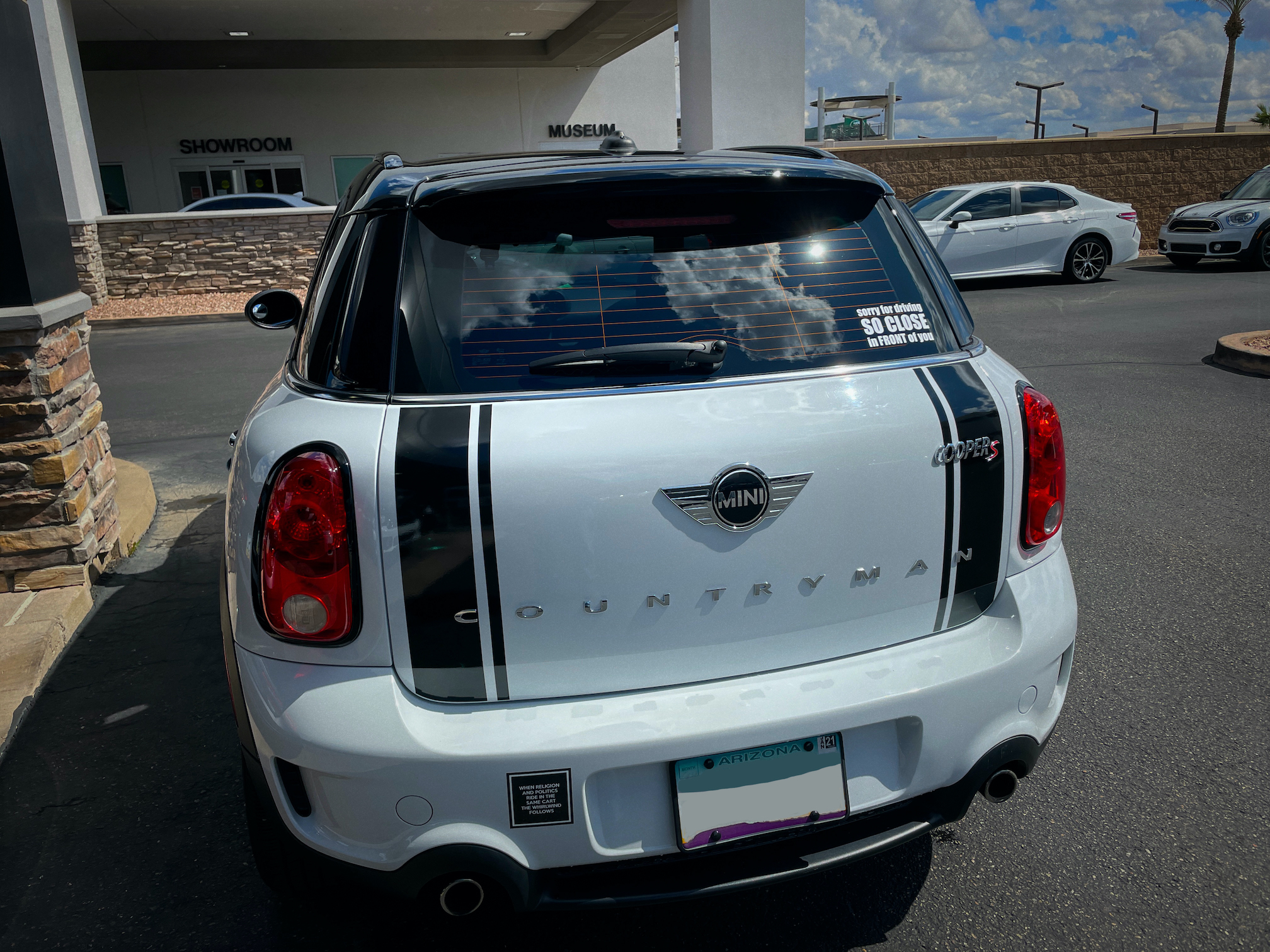
To their credit, they walked over to the parts department and returned with another brand new stubby antenna like had been on the car prior to this fiasco and screwed it in.
Apparently both the car wash and the vinyl shops are not a direct part of this MINI dealership; they’re entities under the umbrella of the parent corporation and this was not the first time antennas had gone missing…
So after more than a week for a task that should’ve taken a day, Rabbit has his rear strips. Was it worth it? Do they bring me joy? I may not go that far, but I am quite pleased with the final product.
0 comments
Stop laughing. I can be generous.

I rediscovered these items in notebooks that I almost did not retrieve after the fire. I’m glad I did. I foolishly let go of many things that I now wish—if I’d been in a better headspace—I’d kept.
I don’t know if any of my dear readers have a want or need, but I created some high quality scans of them and they are available for your downloading pleasure.
Brochure
Operating Instructions
Service Manual
0 comments

0 comments

0 comments



Assuming he doesn’t shave, how is Jensen Ackles not a furball? The man exudes hairy beast vibes, so I was sorely disappointed the first time I saw him take his shirt off.
2 comments
How small is this guy’s dick? ?pic.twitter.com/DOdjcofX96
— Mister Race Bannon (@MrRaceBannon) March 9, 2021
Can’t wait until he drives under a high-tension power line!
0 comments









0 comments

0 comments

0 comments

0 comments
…that Ray Bradbury’s The Illustrated Man is his favorite book.



I don’t get face tattoos. Everything else, yes. But not faces.
1 comments
…and magical, this year any scene with Bilquis (whom I did not care for previously) just gives me chills.
0 comments


And speaking of Mr. Whittle, the third season of American Gods has recaptured a lot of the magic that was lost in Season 2. I almost didn’t even bother watching this year, but I’ve been pleasantly surprised. The story is still all over the place and I miss several of the characters that are just gone, but my (pardon the pun) gods, the cinematography…
Truly magical.
0 comments
0 comments

I can feel Bill Gates’ our alien overlords’ nanobots swarming through my bloodstream, but it’s been two days and I’m still waiting for my 5G antennas to start sprouting. I wonder if my reception will be good enough with just those, or if I’ll still need a tinfoil hat…
There is a welt at the injection site that forms “666,” so I’m not giving up hope just yet.
0 comments

0 comments

0 comments

0 comments

0 comments

0 comments

0 comments
0 comments
So, what would the sky look like if Arcturus, Sirius, Alpha Centauri, Vega or Polaris replaced our Sun?

If Arcturus were put in place of the Sun it might look something like this at sunset, which would last over 50 minutes to set, cause it’s, you know, some 25 times larger than our Sun.

White-hot Sirius A would blaze in our daytime sky. 1.75 times the size of the #Sun and 26 times as luminous, we’d all be fried if Sirius stood where the Sun is.

This is AlphaCentauri , comprised of three stars, two stars slightly more massive and luminous than the Sun located roughly, 4.4 light years away. The third star (to the left) is Proxima Centauri, a dim red dwarf and third member of the system.

The star Vega—25 light years from Earth—rotates so rapidly it’s oval shaped instead of spherical. Vega measures 2.7 times the Sun’s diameter along its equator and is 36 times brighter than the Sun. The sight would make you go blind quickly. Earth would also be roasted in the heat.

Polaris, also known as the North Star is a supergiant 2,500 more luminous than the Sun and 45 times its size. What an eyeful we Earthlings would have if Polaris were our sun. Wouldn’t have eyes to enjoy it though. Rigel, the left foot of the constellation Orion, would provide a similar view. with the same results. In order for Rigel to provide a planet the same degree of light and heat as we receive on Earth, the planet would need an orbit so large it would take 2000 years to complete one revolution around the star.
0 comments

0 comments

0 comments