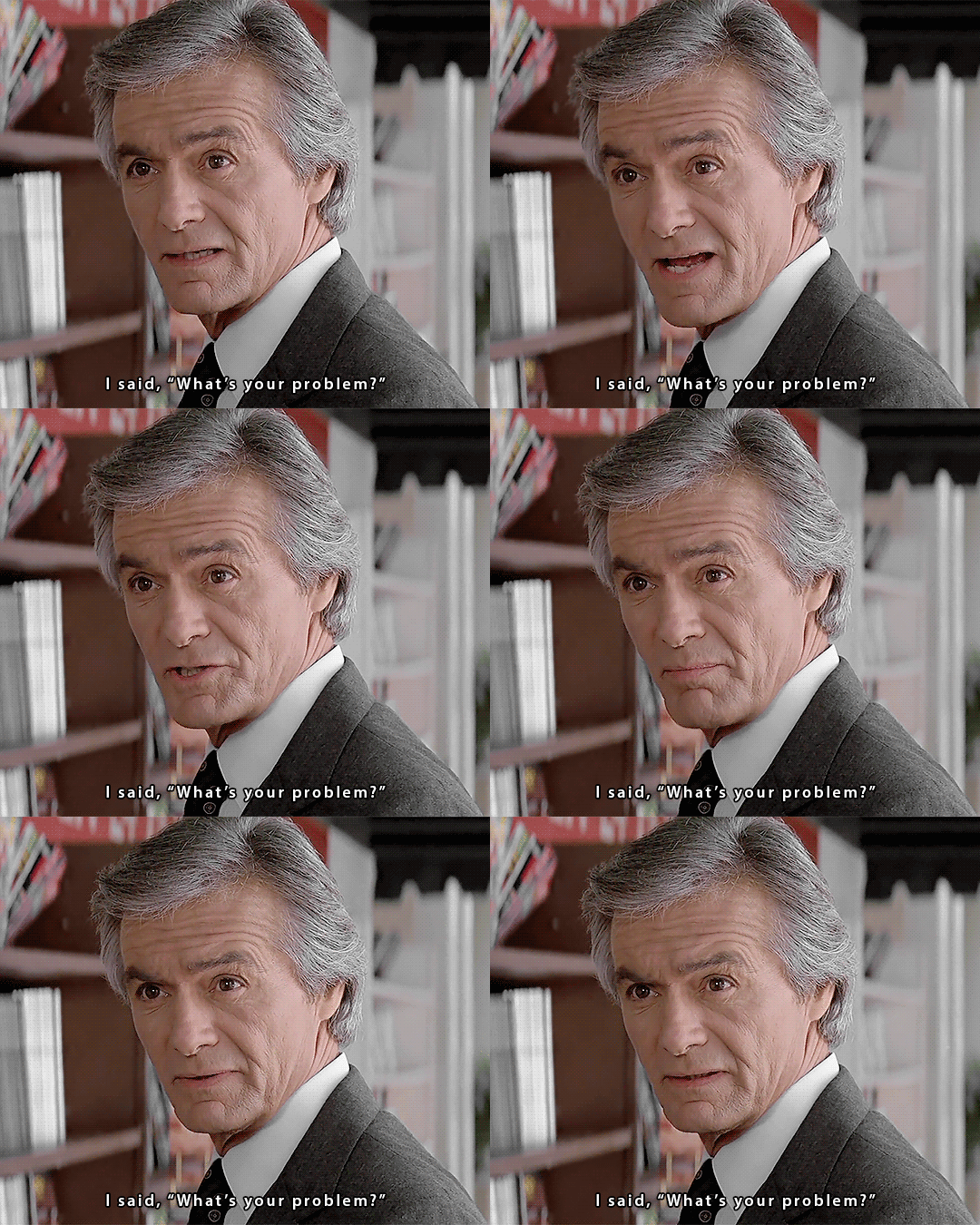

Simultaneously Fascinating and Disturbing

On the recommendation of a friend, the other night Ben and I took a break from our usual evening diet of Supernatural and Criminal Minds and fired up the Amazon Prime machine to watch Vivarium. Naturally, while we were watching we went to IMDB and did some sleuthing. The reviews were evenly split between, “What the hell did I just watch?” and “Absolute Genius.” It was one of those films with little middle ground where audience opinion was concerned. Admittedly, when all was said and done, I found myself in that middle ground. I was simultaneously fascinated and disturbed by the story told.

I found the following article about the film on Screen Rant, and I have to admit it tracks pretty closely with my interpretation of what we’d seen:

The story of suburban hell told in Vivarium takes on a far darker and bolder topic as its ending unfolds. Director Lorcan Finnegan’s sci-fi thriller tells the story of a young couple stuck in a seemingly perfect suburban neighborhood that quickly reveals itself to be a nightmare of societal demands. Vivarium centers on gardener Tom (Jesse Eisenberg) and kindergarten teacher Gemma (Imogen Poots), a happy young unmarried couple who are seeking to make their first step onto the property ladder. This leads them to visit a deeply strange estate agent named Martin (Jonathan Aris), who makes lavish promises of the beauty and perfection of a newly built development named Yonder, and coaxes them into taking a tour of one of its properties.


Yonder is comprised of seemingly endless rows of wholly identical homes and roads that always lead back to the same place. After Martin vanishes, Tom and Gemma try to leave by end up going round in circles, forcing them to stay in the Yonder property he showed to them.

Their various attempts to leave end in failure, and in frustration, Tom decides to burn down the house. The next morning, it’s still there, seemingly rebuilt overnight, and now there is a box with a baby waiting for them. Attached is a note: “Raise the child and be released.”

As the days pass, the nameless child (played by Senan Jennings) rapidly grows in size and has an eerie adult-like voice that perfectly mimics both Tom and Gemma. He screams like a banshee until he is fed. He refuses to leave Tom and Gemma alone for a second and he copies their every move, except for moments when he watches the TV, which only shows strange psychedelic patterns. As Tom and Gemma find themselves forced into the role of parents for this unsettling creature, their health begins to worsen and they find themselves trapped in a mundane yet hellish daily cycle of the same old routine – one they can seemingly never escape from.


What Happens In Vivarium’s Ending


Tom and Gemma interact with the child in different ways. Tom instantly hates him and tries to harm him several times, but Gemma always intervenes. Occasionally, Gemma will try to talk to the boy and treat him in a kind manner, hoping that he can give them some answers about their situation—or, at the very least, become a normal kid. Tom eventually becomes obsessed with digging a hole in their garden, which further exacerbates the growing gap between him and Gemma and pushes her more towards the child. One day the boy vanishes, only to return with a strange book full of indecipherable symbols. Gemma plays a game to get him to reveal where he’s been, only for him to begin mutating into some form of monster.

More time passes and suddenly the boy has grown into a full-blown adult. Both Gemma and Tom have grown weaker, although Tom still digs his hole from morning until night. The boy starts disappearing every day and Gemma’s attempts to follow him prove fruitless. Eventually, Tom’s hole yields a discovery of a corpse in a body bag. His own health rapidly worsens and he eventually dies in Gemma’s arms. At that moment, having said that it’s time for Tom to be “released,” the boy returns to them with a body bag. Shocked and disgusted, Gemma finally becomes furious enough to attack the boy with a pickaxe, but he escapes by pulling up the pavement like a rug and escaping into an Escher-esque underground.

Gemma follows and discovers the seemingly endless parallel worlds where couples like her and Tom are stuck in near-identical situations, each raising an otherworldly child. Every single one of them is miserable. One man has even died by suicide in the bathtub. Spat back into her world, Gemma also dies, with the boy by her side. He dumps the bodies in the hole that Tom dug, fills it back in, and then leaves Yonder to return to the real estate office. There, Martin is old and on the verge of death (though only a year has passed). He passes on his name badge to the boy and then dies, leaving the new Martin to take his place. A new couple walks into his office, and the cycle begins anew.

The Boy’s Identity And Yonder’s Purpose


Though it’s never made explicit in Vivarium‘s ending, the most obvious interpretation of Yonder and the strange boy that Tom and Gemma are forced to raise is an alien abduction story. The film opens with a shot of a newly hatched cuckoo pushing other baby birds out of the nest. This is a phenomenon in nature known as brood parasitism, in which some birds will lay their eggs in a stranger’s nest in order to trick the other bird into raising their young. In Vivarium‘s opening, the cuckoo eventually becomes so large that when its unwitting adoptive parent returns to feed it, the cuckoo looks like it’s about to consume the adult bird’s head—foreshadowing the movie’s ending.

Vivarium takes the behavior of the cuckoo and reimagines it as an alien or extradimensional species that has invaded Earth and forces humans to raise its offspring by trapping them together in a “nest” (in this case, the house at No. 9 in Yonder). Just as some female cuckoos are able to lay eggs that resemble the eggs of the bird species whose nest they are left in, the boy’s species is able to imitate humans closely, but not perfectly. Tom and Gemma notice something is off about Martin as soon as they arrive in the real estate office and observe his strange behavior, and the boy’s voice definitely doesn’t sound like a normal human child.

Compounding the alien abduction theory is the strange alien language that appears in the boy’s book and the patterns that appear on the TV, which are clearly communicating to him. At one point Gemma asks the boy to imitate the person who gave him the book and he starts to transform, with bulging growths on his neck. Later, after she attacks him with the pickaxe, he gets down on all fours and scuttles like an animal – all of which points to him being an alien species in disguise. The impossible space that Gemma stumbles into when she tries to chase the boy at the end of the movie definitely seems like an alien construct, as does the impossible space of Yonder itself.

Based on Vivarium‘s ending, it seems that these aliens age rapidly, growing to adulthood within a year (the boy looks about six years old after just three months) and declining from middle age to old age within the same space of time. They sustain themselves by trapping human couples in Yonder and forcing them to raise their weird children, and when a new “Martin” reaches adulthood, he replaces the old one. The aliens do not appear to form any kind of emotional attachments to their adoptive parents, and do not grieve for them when they die.

The Real Meaning Of Vivarium’s Ending


There have been plenty of stories in pop culture about the hell of suburbia, and Vivarium is not shy about wearing those influences on its sleeve. The Blue Velvet comparisons are easy to make and the film is also reminiscent of classic episodes of The Twilight Zone and the works of Yorgos Lanthimos, especially Dogtooth. At its heart, this is a familiar story about the smothering confines of the supposedly ideal life that has been commodified for the masses. The white picket fence dream remains a potent force in society, and it’s one that’s become ever more unattainable to the younger generations, making the forced fantasy all the crueler.

Tom and Gemma are literally stuck in this heteronormative structure of what a couple is “supposed to do” as they get older. Against their will, they have been forced into the suburban life, a home they despise, a routine they grow resentful of, and a child neither of them wanted. They are now stuck on a path for life that is both mundane and horrifying – one that ends in their deaths, with their bodies left to rot on the grounds of the house they hated. They aren’t alone in this nightmare either, as the parallel worlds of Yonder reveal. This is the world that awaits us all, or at the very least, the white heterosexual middle-class couples to whom this fantasy is primarily sold to.

Interestingly, Tom and Gemma never ask out loud why they have been trapped in the world of Yonder and its restrictive rules. (Nor do they ever try to gain access to any of the other houses in Yonder.) They just get on with it because they have to. This is partly what makes Vivarium so fascinating: It is keenly aware of the smothering expectations placed upon people to adhere to societal norms, even as they become more unattainable and less desired by younger generations. Nowadays, we are less tied up by such conventions and it’s far more normal for people, whatever gender they are, to remain unmarried, child-free, or off the property ladder, whether it be through choice or financial restrictions. Still, even today, it is that image of the happy suburban white couple with children and a mortgage that dominates the world and is deemed the default mode of life. Tom and Gemma were not picked to become a new part of Yonder for any other reason than because they were there, and that makes their fate all the more terrifying. It could happen to anyone.

The most interesting and arguably the boldest aspect of Vivarium is in how it takes on the concept of parenthood. Here, to be a parent is to be forced into a one-sided parasitic relationship that will sap you of your very life essence. It is to be miserable and unfulfilled, to commit to something that will never make you happy or yield vaguely satisfying results. Tom and Gemma did not want a child but the society of Yonder demanded it, and the boy who grows in years as the days pass is unnerving, lacks imagination, and is utterly helpless without them. It’s a blunt metaphor for the realities of parenting, but most stories end such narratives in a happy way, revealing how it was all worth it in the end.

Vivarium doesn’t do that. This is a film with the sheer guts to position the act of being parents as potentially the worst thing one could do with their lives, a mistake they will regret until they die. That remains one of society’s last true taboos and Vivarium pulls no punches with it. Even when Gemma shares tender moments with the boy, she absolutely refuses to let him call her his mother. Her dying words to the now-grown boy are just that: “I am not your f***ing mother.” It’s a final act of defiance in the face of a world that took everything from her, and one that verbalizes countless people’s lives, both within Yonder and in the real world.

It’s clear that Finnegan’s latest feature found bits of inspiration from many projects in the realm of sci-fi and suspense, especially Black Mirror and The Twilight Zone, but ultimately, Vivarium is a wholly original production that offers plenty for viewers to take away. It relishes in its beautifully bizarre fever dream of a story and is all the more successful because of it. Not only that, it provides a relevant social commentary that sticks the landing in the end. Although its eerie originality may not be for everyone, Vivarium will certainly be quick to find a strong, loyal audience.

0 comments

Downsizing

Except for one year—1993—I’ve owned a freshwater aquarium in one form or another since I was a child. About three weeks ago I made a decision that I had been questioning up until last night. No, I didn’t get rid of my tank altogether; I downsized from a 29-gallon to a 17.

This 17-gallon, all-glass tank which had a built-in filtration system in the back had captured my eye on my last trip to The Ocean Floor.  Faced with an upcoming semi-annual “big clean” teardown of my existing tank, I decided it was time to pull the plug and downsize.

The moment I got it home, I had buyer’s remorse. I hadn’t realized exactly how much smaller it was. Still, I was determined to make it work. My old all glass 29-gallon tank was just getting too damn heavy to haul outside every six months to clean. (I could’ve gone with a new acrylic tank of the same size and a fraction of the weight—which I’ve owned in the past with great success—but the front of the acrylics always end up bowing out after a few years and they scratch so damn easily.)

After getting the 17 set up and the few remaining fish I had transferred into it, I knew I’d made a grave mistake. The 4-year-old red tail shark that I had raised from a tiny 2-inch juvenile to a 5-inch behemoth was definitely unhappy in the new surroundings.

After stewing over this for a week, I decided that if I wanted to keep the tank (and frankly there was no returning it at this point) I needed to let go of the shark. I transferred him into a big plastic bag and took him back to the Ocean Floor (where I’d purchased him initially), knowing that even if they didn’t give me any money for the beast, at least he would end up going to a good home.

Turns out that once they saw him, I did get a store credit, which allowed me to buy a few smaller fish that are quite happy in these surroundings. The only problem remaining was that the water had gotten kind of cloudy and the tank was growing brown algae like crazy. A few days ago I decided what  I needed to do was tear the tank down, install the under-gravel filter from my old tank, and start fresh. (It had been my experience over the years that either an under-gravel or an external filter didn’t work well enough on their own, but in combination guaranteed crystal clear water.)

I was not looking forward to this, despite the tank’s much smaller size.

While I was out a few days ago getting anti-algae solution, I picked up a box of carbon filter media and when I got home threw one of the packs in the rear filter, hoping this would at least help somewhat with the water issue. To be honest I wasn’t expecting much.

But then something happened. I don’t know if it was the added filter pack or if the tank’s nitrogen cycle finally kicked in, but since yesterday morning the water (even without an under-gravel filter) has been crystal clear. I’m taking a wait and see approach at this point, hoping that no further intervention will be required beyond normal maintenance until I do the “big” clean six months from now.


1 comments

Feel Good Music

I have a feeling it’s going to be a Herb Alpert and post-mindless-stuff-and-nekkid-menz sort of day, because I need a break from the awful that’s assaulting me everywhere online for the last several days.

3 comments

Just Because

This image has always appealed to me. Unfortunately I can’t find a high-resolution copy worth printing and framing.

Many years ago I had a past life regression.  The vision that came to me was stepping off an egg-shaped shuttlecraft into a deserted field of waist-high grass. In the distance there was a single tree, and beyond that, rolling, forested hills. I was part of a galactic survey team and we’d just touched down on a previously unmapped planet. It was my first surface recon mission and what struck me was how green everything was—because apparently wherever I’d called home the vegetation wasn’t green. I was dressed in some sort of white leather-like suit with a simple breathing apparatus attached to my face. As far as I could tell, I was human (or at least very human-like). I didn’t actually see my face at any point, but I had two arms, two legs, and five fingers on each hand. I got nothing more from the regression than that, but it kind of shook me nonetheless.

I interpret this picture as the crew of just such a mission aboard their main starship.

0 comments

Quote of the Day

If Iranian hackers want to pull off some big-dick energy shit, they should wipe out US Student Loan debt. Poof! Make it disappear. If the debt disappears, the US will lose this debt as leverage to recruit for the military.” ~ Unknown

0 comments

Thank You, John!

Back in November of 2018, about six months after acquiring a set of the classic Technics Micro Series components, I wrote of my frustration in locating the special connector that came with the preamp back in 1979 that was used to elegantly connect the preamp with the power amp and the tuner. It was, of course, possible to use regular RCA connector cables, but it was messy in comparison.

Back in 2007 when I sold my last set of Micro Series components to my buddy John, the set included one of these connectors. (If I ever thought I’d own another set of these components, I would’ve held onto it, knowing even then how rare these things were, but I was enamored of the behemoth Kenwood receiver I’d acquired a couple years earlier and could never see myself getting rid of it.)

A year ago John casually mentioned that he wasn’t using the tuner any more—much less the connector, so I immediately asked if I could buy the connector back from him.

“Sure,” he said. “If I knew where it was.”

He had recently moved to a new condo and much of his “junk” as he called it, was still in boxes. I asked him every few months if he’d run across it, but he was still unpacking and hadn’t seen it.

Then out of the blue last week I got a text from him that said, “Found it,” and a picture:

I asked how much he wanted for this piece of Unobtainium and he replied, “Just cover the shipping.”

It arrived today, and I am one happy guy.

Before
After

Elegant. (I consider Technics the Apple of its day.)

1 comments

Understanding the Cost of Covid

I was listening to the news this week and one of the anchors said that we needed to put the 137,000 people dead in four months into a context people can understand.

He said to imagine those 137,000 dead people were airline passengers. Losing 137,000 people in four months would be equivalent to 50 planes a week crashing, for four months, with all on board dying.

50 PLANE CRASHES A WEEK. For four months. All on board, DEAD. He said if planes were falling out of the sky at a rate of 50 per week, not only would people be horrified, but they would expect something to be done. The government wouldn’t be shrugging their shoulders and acting like it was no big deal.

I thought this was a great way to put it. No one would or could ignore that. No one would call it a hoax. No one would question the “science”. No one would ignore it for four months. People would want answers and they would be afraid to get on a plane until something was done.

Planes are crashing around us and no one is taking it seriously.

0 comments