
It Feels Good To Fix Stuff
As you know, a couple weeks ago I acquired a really nice vintage Yamaha CDX-930 single-disc CD player. It—like most players of the era now do—had some drawer issues. Initially I replaced the drawer belt with a slightly smaller one I had on hand. I kept the old belt “just in case,” listening to that little voice in my head for once.
It turns out using a belt that’s too small is just as bad as using one that’s too loose. This belt also proved problematic, so I set about finding the specific belt for this model, something that was easier said than done. Finally I located one from West Coast Belts (a highly recommended place in the audio repair community) and ordered it.
It arrived last week, and the moment I took it out of the package I knew it wasn’t going to work. Yeah, it was the right diameter, but it was substantially thinner than the original (probably 0.5mm vs. 1.5mm) belt. After cleaning the two pulleys in the unit (something I’d failed to do initially), I went ahead and put it in. As I suspected, it still wasn’t what was needed for proper operation. The drawer opened normally, but it still struggled to close.
I went back online and after a lot of searching, located another supplier—in Portugal, no less—who supposedly had the correct size and thickness of belt I needed. I ordered one. That belt currently seems to be visiting every major European capital before heading across the Atlantic, so I have no idea when it’s going to arrive.
I was thinking about this last night and thought I’d try an old trick often used in the YouTube CD repair videos I’ve watched: placing the original belt in boiling water for 5 minutes and then plunging it immediately into cold water to cause the rubber’s “memory” to return to its original size and shape.
Surprisingly this worked—to a degree. It didn’t return the belt to a perfect circle, but the kink in this 45 year old belt was definitely diminished. Once again I took the unit apart and this time put the “rejuvenated” old belt back in, taking care to locate the remaining “kinked” part of the belt on the large pulley vs. the small motor spindle pulley so that it would have an opportunity to spread out and relax a bit more.
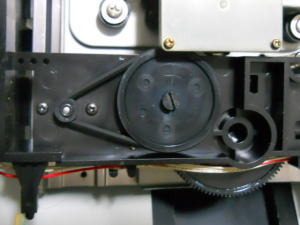
Everything worked perfectly. How long this will last is anyone’s guess—just like they caution in the videos—but at least for now it’s working smoothly, and hopefully the new belt coming from Europe will be the correct configuration.
0 comments