
Brian has some ideas:
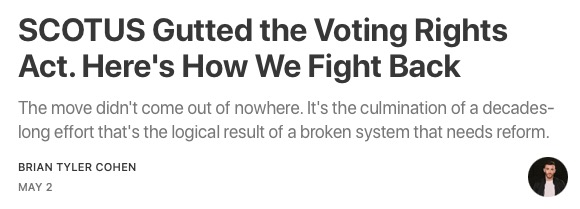
When I saw this week that the Supreme Court had taken a hatchet to the Voting Rights Act, I was – depressingly – not surprised. Because of course they would. This conservative court has by now pretty much declared their fealty to Trump over the Constitution. So the ruling was – in my opinion – a foregone conclusion.
The reality is that this is just going to keep happening until we’re left with a hollowed out shell of a democracy. Even in an ideal scenario, where Democrats have full control of government and can finally pass a new Voting Rights Act, the Roberts Supreme Court will always be waiting in the wings with a machete to break down whatever Democrats build up.
But there is a solution. This is the clearest way I can explain it, in this excerpt from my book:
To restore democracy, to restore integrity to the judicial system, we urgently need to reform the Supreme Court. Those reforms need to be based on principle, not politics, to have any legitimacy or public support. The first order of a filibuster-free Congress should be reform of the Supreme Court. Not the second or the third or the fourth, or it will be too late to save the republic and our independent judiciary. If any subsequent reforms are to stand a chance at surviving, we cannot leave in place a rogue branch of government with the power to strike down anything that doesn’t comport with its far-right ideology.
The first reform should be to expand the Court, in line with the principles that determined the number of justices in the early years of the republic. The first Supreme Court had six justices, reflecting the six federal court circuits. The Court grew to seven justices in 1807, after a seventh circuit was added. It grew again to nine after two new circuits were added in 1837. Today there are thirteen federal court circuits but only nine Supreme Court justices. The Court should reflect the size of the country and the scope of its legal challenges, as it did more than a century ago.
The second reform should be to limit the term of new justices to eight years, allowing newly elected presidents to choose their own nominees regularly. This would reduce the opportunities for the kind of procedural delays that stymied Obama’s appointment of a justice in his final year in office. The regular flow of new appointments would help remove the national drama from each nomination by diluting the novelty of each new appointment. Once again, there is widespread public support for term limits for Supreme Court justices: 75 percent of Americans agree with term limits, according to a PRRI survey in 2025.
The third reform should be to establish an enforceable code of conduct, with a Supreme Court panel mandated to investigate allegations of wrongdoing and impropriety. The panel should have the power to force the recusal of justices in cases where they have personal ties and even force the removal of justices in cases of conduct unworthy of the Supreme Court. Public polling suggests that there is huge support for such reforms as well: 76 percent of Americans are in favor of a binding code of conduct, according to a USA Today poll in 2024.
The final reform should be to retire any justice over the age of seventy from the Supreme Court, regardless of who appointed them. The Constitution says that judges “shall hold their Offices during good Behaviour,” which has been interpreted as lifetime appointments. That is one way to interpret the phrase but by no means the only one. A retired Supreme Court justice could be moved to a lower court and still stay within a reasonable interpretation of the constitutional language.
In fact, there’s widespread public support for retiring all public officials over a certain age, and there’s a surprising degree of consensus on what that age should be. As many as 79 percent of Americans favor age limits for elected officials, and 74 percent favor them for Supreme Court justices, according to Pew Research Center. Polling by the Benenson Strategy Group showed that a clear majority, 63 percent of Democrats and 55 percent of Republicans, support an upper age limit of seventy for anyone to be sworn in as president. (The Constitution does not set any age range for the Supreme Court but does state that the presidency has a lower age limit of thirty-five.)
Mandatory retirement at seventy years of age would lead to four immediate vacancies on the Supreme Court: three conservatives and one liberal. Clarence Thomas and Samuel Alito would leave, along with Chief Justice John Roberts. So would Sonia Sotomayor, appointed by Barack Obama. All three Trump judges would remain, along with one Obama and one Biden appointee.
Ever since Franklin D. Roosevelt tried and failed to expand the Supreme Court, Washington has shied away from reforming the highest court in the land. However, FDR’s plan was the product of another political era, almost a century ago. The Court had struck down several pieces of his New Deal plan to revive the economy from the depths of the Great Depression. FDR also proposed to retire judges at age seventy, but if they refused to leave, he would be free to add an additional justice, potentially expanding the Court to fifteen. Congress defeated his plan, but FDR ultimately prevailed; within five years, seven of the nine justices were his own appointees.
Today’s Supreme Court has weakened itself by its political activism, repeatedly disregarding the Constitution and its code of conduct. It is populated by older justices at a time when the American people are yearning to reform the status quo. If we want to revive our democracy, we need to revive our Supreme Court. If that seems extreme, consider an alternative that is already upon us: a Court that undermines the very Constitution it’s supposed to uphold.
This week’s ruling was not a one-off. It’s the logical endpoint of a decades-long effort to disenfranchise minority voters and keep minority representation to an absolute minimum.
The three longest-serving conservative justices on the court right now have a combined 75 years on the bench. This is their pet project. They own it. And the other three conservatives, all Trump appointees, are comparatively young and spry. Gorsuch doesn’t even have a full decade under his belt. Without court expansion, we’re stuck with this right wing majority for another couple of decades at least.
We need to normalize ourselves to the idea of court expansion, so that when we have power, we don’t waste our time negotiating what we should be doing, but rather spend our time doing it.
0 Comments
0 comments