Update

Finally, something good has come from working at  ██████. And ironically, it may provide me just the ticket I need to get out of that hellhole.


Last week I—and four of my coworkers—spent three intensive days in offsite, company-paid Mac OS X training. Exactly why this was provided is not exactly clear to me since only directors and above have Macs which limits their penetration into the company, but I believe it has to do with the fact that we currently had only three Apple-certified techs on staff and if they’re all out for whatever reason and someone with a with an “O” in their title has Mac problems, the whining can be deafening. Or maybe it’s simply because the company finally upgraded to Mavericks (just in time for Yosemite!) and they figured we all needed a rounded education.

In any case, it was an enlightening three days. I can’t honestly say I learned a lot of things I didn’t already know, but what I did learn was very worthwhile, and if nothing else, further confirmed my love for the Apple ecosystem.

██████ is also paying for the first attempt at passing the certification test. I’m a little nervous about testing because—as I’ve written about before—I do horribly at these technical tests, but luckily we still have Ben’s old MacBook and I was able to wipe and and recreate the training environment on it without problems (actually part of the training itself).

Fortunately I can retake the test as many times as necessary to pass—at $250 a pop, but still it would be nice if I could pass it the first time on their dime.

Ben and I are both on vacation next week. Sadly, for a multitude of reasons we aren’t heading east to visit Erik again as originally planned, but counting the three days of training, the time away from ██████ comes to a total of 12 glorious days; almost half a month—and even without a road trip, it will not be wasted.

I intend to double-down on getting this training material committed to memory so I can feel comfortable going into the test. When I pass and get that certification, it will definitely look good on my resume, even if I don’t end up working for a company that uses Macs.

In addition to me studying, we’re also planning on spending a day at Rocky Mountain National Park and another day at the Denver Botanic Gardens to see the Chihuly exhibit. There will also be a few movies thrown in, and just a general exhalation from not having to be at the frat house.


At the Risk of Dating Myself…

…whenever I hear this

I am transported back to 1977 and a warm, sun-dappled autumn afternoon in my dorm room in Kaibab-Huachuca Hall at the University of Arizona.

The 12″ 45 rpm single was pressed on red vinyl and when it was new, smelled of strawberries.

And from there the trip down memory lane invariably leads to these:

“And you thought it was over…no, no, no…”

This one wasn’t pressed on colored vinyl (at least not the copy I had), but to this day I swear it smelled of poppers when it was first opened.

The cut Violation was the soundtrack for the first time I slow danced with another guy. I was so disappointed that I could never find a translucent pink vinyl copy of the record all the DJs seemed to have—until nearly 30 years later. And it was only a few short years ago that my friend Kevin (of The Lisp fame) provided me with a definitive translation of all the lesbian making out that was going on in the song.

It was the summer of “I Feel Love,” but eventually all my favorite cuts from the album were on the A-Side.

Still one of my all-time favorite records. Rumor at the time was the costumes cost thousands. I find that very hard to believe now.

Do You Live in a Blast Zone?

Wow. Just wow.

I stumbled across this today and while I normally don’t reblog stuff word-for-word, this bears repeating.

Did you know there are more than 25 million people at risk due to unsafe tanker cars carrying highly-flammable oil on railways near homes and schools? It’s time to get these dangerous cars off the tracks and protect our communities!

Find out if you are in the oil train Blast Zone here and sign the petition demanding that Congress stand up to Big Oil (yeah, I know…fat chance that will ever happen) and get unsafe oil cars off the rails.

Perfect

perfect

adjective |ˈpərfikt|

having all the required or desirable elements, qualities, or characteristics; as good as it is possible to be: she strove to be the perfect wife | life certainly isn’t perfect at the moment.• free from any flaw or defect in condition or quality; faultless: the equipment was in perfect condition.

The Limits of Corporate Citizenship: Why Walgreen Shouldn’t Be Allowed to Influence U.S. Politics If It Becomes Swiss

robertreich:
Dozens of big U.S. corporations are considering leaving the United States in order to reduce their tax bills.

But they’ll be leaving the country only on paper. They’ll still do as much business in the U.S. as they were doing before.

The only difference is they’ll no longer be “American,” and won’t have to pay U.S. taxes on the profits they make.

Okay. But if they’re no longer American citizens, they should no longer be able to spend a penny influencing American politics.

Some background: We’ve been hearing for years from CEOs that American corporations are suffering under a larger tax burden than their foreign competitors. This is mostly rubbish.

It’s true that the official corporate tax rate of 39.1 percent, including state and local taxes, is the highest among members of the Organization for Economic Cooperation and Development.

But the effective rate – what corporations actually pay after all deductions, tax credits, and other maneuvers – is far lower.

Last year, the Government Accountability Office, examined corporate tax returns in detail and found that in 2010, profitable corporations headquartered in the United States paid an effective federal tax rate of 13 percent on their worldwide income, 17 percent including state and local taxes. Some pay no taxes at all.

One tax dodge often used by multi-national companies is to squirrel their earnings abroad in foreign subsidiaries located in countries where taxes are lower. The subsidiary merely charges the U.S. parent inflated costs, and gets repaid in extra-fat profits.

Becoming a foreign company is the extreme form of this dodge. It’s a bigger accounting gimmick. The American company merges with a foreign competitor headquartered in another nation where taxes are lower, and reincorporates there.

This “expatriate” tax dodge (its official name is a “tax inversion”) is now at the early stages but is likely to spread rapidly because it pushes every American competitor to make the same move or suffer a competitive disadvantage.

For example, Walgreen, the largest drugstore chain in the United States with more than 8,700 drugstores spread across the nation, is on the verge of moving its corporate headquarters to Switzerland as part of a merger with Alliance Boots, the European drugstore chain.

Founded in Chicago in 1901, with current headquarters in the nearby suburb of Deerfield, Walgreen is about as American as apple pie — or your Main Street druggist.

Even if it becomes a Swiss corporation, Walgreen will remain your Main Street druggist. It just won’t pay nearly as much in U.S. taxes.

Which means the rest of us will have to make up the difference. Walgreen’s morph into a Swiss corporation will cost you and me and every other American taxpayer about $4 billion over five years, according to an analysis by Americans for Tax Fairness.

The tax dodge likewise means more money for Walgreen’s investors and top executives. Which is why its large investors – including Goldman Sachs — have been pushing for it.

Some Walgreen customers have complained. A few activists have rallied outside the firm’s Chicago headquarters.

But hey, this is the way the global capitalist game played. Anything to boost the bottom line.

Yet it doesn’t have to be the way American democracy is played.

Even if there’s no way to stop U.S. corporations from shedding their U.S. identities and becoming foreign corporations, there’s no reason they should retain the privileges of U.S. citizenship.

By treaty, the U.S. government can’t (and shouldn’t) discriminate against foreign corporations offering as good if not better deals than American companies offer. So if Walgreen as a Swiss company continues to fill Medicaid and Medicare payments as well as, say, CVS, it’s likely that Walgreen will continue to earn almost a quarter of its $72 billion annual revenues directly from the U.S. government.

But as a foreign corporation, Walgreen should no longer have any say over the size of those payments, what drugs they cover, or how they’re administered.

In fact, Walgreen should no longer have any say about how the U.S. government does anything.

In 2010 it lobbied for and got a special provision in the Dodd-Frank Act, limiting the fees banks are allowed to charge merchants for credit-card transactions — resulting in a huge saving for Walgreen. If it becomes a Swiss citizen, the days of special provisions should be over.

The Supreme Court’s “Citizens United” decision may have opened the floodgates to American corporate money in U.S. politics, but not to foreign corporate money in U.S. politics.

The Court didn’t turn foreign corporations into American citizens, entitled to seek to influence U.S. law and regulations.

Since the 2010 election cycle, Walgreen’s Political Action Committee has spent $991,030on federal elections. If it becomes a Swiss corporation, it shouldn’t be able to spend a penny more.

Walgreen is free to become Swiss but it should no longer be free to influence U.S. politics.

It may still be the Main Street druggist, but if it’s no longer American it shouldn’t be considered a citizen on Main Street.

Who’s That Boy?

I’m sure I’m not the only one whose eye this cub has caught…

But the question is…

Is this the same guy, or merely separated at birth?

And what the hell is he doing in this commercial? Has he moved on from puppets something a little warmer and fuzzier?

Worth Repeating

In light of the recent Hobby Lobby ruling, I think this excerpt from Robert Boston’s book Taking Liberties: Why Religious Freedom Doesn’t Give You the Right to Tell Other People What to Do bears repeating:

Certain words should not be tossed around lightly. Persecution is one of those words.

Religious Right leaders and their followers often claim that they are being persecuted in the United States. They should watch their words carefully. Their claims are offensive; they don’t know the first thing about persecution.

One doesn’t have to look far to find examples of real religious persecution in the world. In some countries, people can be imprisoned, beaten, or even killed because of what they believe. Certain religious groups are illegal and denied the right to meet. This is real persecution. By contrast, being offended because a clerk in a discount store said “Happy Holidays” instead of “Merry Christmas” pales. Only the most confused mind would equate the two.

Far from being persecuted, houses of worship and the religious denominations that sponsor them enjoy great liberty in America. Their activities are subjected to very little government regulation. They are often exempt from laws that other groups must follow. The government bends over backward to avoid interfering in the internal matters of religious groups and does so only in the most extreme cases.

What the Religious Right labels “persecution” is something else entirely: it is the natural pushback that occurs when any one sectarian group goes too far in trying to control the lives of others. Americans are more than happy to allow religious organizations to tend to their own matters and make their own decisions about internal governance. When those religious groups overstep their bounds and demand that people who don’t even subscribe to their beliefs follow their rigid theology, that is another matter entirely.

Before I delve into this a little more, it would be helpful to step back and take a look at the state of religious liberty in the United States today. Far from being persecuted, I would assert that religion’s position is one of extreme privilege.

Consider the following points:

  • Religious groups enjoy complete tax exemption, a very powerful and sought-after benefit.
  • Unlike secular nonprofit groups, houses of worship are not required to apply for tax-exempt status. They receive it by mere dint of their existence. Houses of worship are assumed to be tax exempt as soon as they form. This exemption is rarely examined again and is revoked only in cases of extreme fraud (such as someone claiming that the entity he or she has formed is a church when it’s really a for-profit business).
  • Houses of worship are free from the mandatory reporting obligations that are imposed on secular nonprofit groups. For example, secular groups that are tax-exempt must fill out a detailed financial form and submit it to the Internal Revenue Service (IRS) every year. This document, called a  Form 990, must be made available for public inspection. Houses of worship and ministries are not required to fill out and submit these forms.
  • Religious entities are not required to report their wealth to any government agency. The question often comes up about how much money houses of worship raise every year or what the value of the land they hold is. There is no way of knowing this because they are not required to tell anyone.
  • The IRS has the power to audit individuals and secular groups at the merest suspicion of wrongdoing or financial irregularities. Houses of worship, by contrast, are very difficult for the IRS to audit. This is so because Congress passed a special law governing church audits that requires the IRS to show heightened scrutiny before initiating such procedures. In addition, church audits must be approved by highly placed IRS officials.
  • Religious groups enjoy a loud and robust public voice. They own television and radio stations all over the country (all tax exempt, by the way). They own publishing arms, and they maintain various outreach sites on the Internet. The ability of religious groups to proselytize and spread their theology is limited only by the imaginations of their leaders.
  • Across the country, religious groups own a network of hospitals, secondary schools, colleges, social-service agencies, and other entities that often enjoy a cozy relationship with the government. Many of these institutions are subsidized directly with tax funds—even though they may promote religion. In recent years, religious groups that sponsor charitable services have seen themselves open to a host of new taxpayer assistance through the so-called faith-based initiative.
  • Religious groups are often exempt from laws that secular organizations must follow. A house of worship or a ministry can fire employees at will if those workers violate (or are merely suspected or accused of violating) some tenet of the faith. A religious school, for example, could fire a woman who becomes pregnant out of wedlock. A corporation or a secular nonprofit would not be able to do this.
  • In many cases, religious groups are freed from following even basic laws designed to promote health, safety, and general welfare. Houses of worship are routinely exempted from laws designed to improve access to facilities for those with disabilities, for example. In some states, daycare centers and other facilities sponsored by religious groups are wholly exempt from routine inspection laws.

  • Many religious groups engage in extensive lobbying on Capitol Hill and in the state capitals. Under federal law, there is virtually no regulation of their lobbying activities. Federal law exempts from oversight “a church, its integrated auxiliary, or a convention or association of churches that is exempt from filing a Federal income tax return.” This means that, unlike other groups, religious organizations are not required to report the money they spend attempting to influence legislation or to register their lobbyists. In rare cases, some states have tried to impose minimal regulations, such as public financial-disclosure reports, on houses of worship. The religious groups often fight such laws and call them an infringement of their religious-liberty rights.
  • Many legislators are quick to placate religious groups and the clergy. The results of their lobbying campaigns are often successful. In the 1990s, when some religious groups began to complain about experiencing difficulties with zoning issues and the ability to build houses of worship where they pleased, Congress was quick to pass a special law called the Religious Land Use and Institutionalized Persons Act. This law essentially trumps local zoning regulations with a federal fiat—even though, for many years, zoning had been considered a matter best handled by local officials.
  • Religious groups are often treated with special deference in cases of suspected law breaking. Anyone who doubts this need not look beyond the experience of the Roman Catholic Church during the pedophilia scandal. A secular corporation that engaged in such a massive cover-up and acts of deception would have found its top leaders behind bars. Yet in that scandal, only a handful of relatively low-level clergy were held accountable.

I have created this list not necessarily to criticize or call for changing these policies (although some of them are overdue for scrutiny) but to make the point that the leaders of religious organizations have very little reason to complain. Their position is an exalted one. They are well regarded by lawmakers, and their institutions are not only tax supported in some cases but are also beyond the reach of secular law. What they are experiencing is not persecution; it is preferential status.

Source


Torches and Pitchforks

You know things are getting bad when one of the 0.01 Percent sounds a warning call to his fellow plutocrats:

Here’s what I say to you: You’re living in a dream world. What everyone wants to believe is that when things reach a tipping point and go from being merely crappy for the masses to dangerous and socially destabilizing, that we’re somehow going to know about that shift ahead of time. Any student of history knows that’s not the way it happens. Revolutions, like bankruptcies, come gradually, and then suddenly. One day, somebody sets himself on fire, then thousands of people are in the streets, and before you know it, the country is burning. And then there’s no time for us to get to the airport and jump on our Gulfstream Vs and fly to New Zealand. That’s the way it always happens. If inequality keeps rising as it has been, eventually it will happen. We will not be able to predict when, and it will be terrible—for everybody. But especially for us.

Read the entire article here.

A Trip Down Memory Lane (NSFW)

Imagine if you will January 1977, the beginning of the second semester of my first year at college. I’d just come out and after that announcement freaked my dorm mate out to such an extent he felt he had to move out, I had the room to myself.

One morning I decided it was time to explore this whole new world, so I stopped at a bookstore (no, not that kind of bookstore) just west of campus and bought my first Playgirl. SO risqué, right? Well, being the young horny guy I was, just thumbing through the pages got me so riled up I couldn’t even make it back to my dorm room before I had to rub one out.

I stopped at the College of Architecture building and scurried upstairs to one of the lesser-used restrooms, thinking this would afford me a bit of privacy.

Wouldn’t you know, about halfway through my stroking, some other guy came in and took up residence in the stall immediately adjacent to mine. (Even when I learned much later about the “hot” spots on campus, this was not one of them, so I doubt he was in there for any reason other than to relieve himself.)

Anyway, almost as soon as my neighbor had dropped is jeans to the floor and sat down, the magazine went flying out of my hands and landed, fully open, right under the divider between us. I immediately scooped it up, pulled up my pants and left so quickly I’m sure I created a vacuum in my wake.

This was the object of my attention. Funny how one’s tastes change over the years…

This.

From Salon.com:

Neither the film world nor the political world paid much attention to R. J. Cutler’s Showtime documentary “The World According to Dick Cheney,” released in the dim and distant days of March 2013, when we thought Cheney had departed public life for good. I suppose the general reaction was “Oh Jesus Christ, not that guy again!” Even the tone of Cutler’s film, built around 20 hours of interviews with the most “consequential” vice president in American history – Cheney’s word, but he’s probably right – was faintly elegiac. This guy changed the world, whatever you think of him, and it was time to capture his portrait before he sailed for the other shore.

Leaving aside the question of whether Dick Cheney can ever experience physical death – doesn’t the power of the One Ring more or less make you immortal? – he’s back. This week Cheney was in the news at the head of an army of neocon zombies, seemingly reanimated from the foreign-policy tomb of the Bush II administration, leading the ideological charge for yet more war in Iraq. Or rather, since even Dick Cheney cannot possibly believe that is likely, for the principle that all blame for the actual or impending Iraqi disaster should be assigned to the cut-and-run pussies of the current administration, and none at all to the one that lied its way into the whole catastrophic misadventure in the first place.

Watching the embarrassing video clip of Cheney, in his Wyoming rancher drag, as he and failed-candidate daughter Liz Cheney announce their hawkish new anti-Obama foreign-policy nonprofit, brought me back to a key moment in Cutler’s film. It’s really just a biographical footnote, midway through Cheney’s extraordinary rise from alcoholic semi-employment in Rock Springs, Wyoming, at age 23 to being Gerald Ford’s White House chief of staff at age 34, but it speaks volumes. As unlikely as this sounds, Cheney spent 1968, that watershed year in American political and cultural history, as a graduate student in political science at the University of Wisconsin, one of the most radicalized campuses in the country.

There was apparently a small group of conservative poli-sci types in Madison at that time, and I bet that wasn’t fun. Protests and demonstrations against American foreign policy and the Vietnam War were almost a weekly occurrence at Wisconsin during Cheney’s brief stint there. There was a student general strike in the fall of 1967, and another one in the spring of 1969. May of 1968 saw the first of two campus bombings that were presumably the work of the Weather Underground. This fervid atmosphere of chaos and dissent was unfamiliar and distressing to a crew-cut Young Republican from the Mountain West, and Cheney quietly says that the whole experience pushed him further to the right. It’s as close as he ever comes to a moment of self-revelation in “The World According to Dick Cheney,” unless you count his obvious man-crush on Donald Rumsfeld, his friend, mentor and ideological soulmate.

I think that’s important for several reasons. First of all, Cheney has seen the other side of American political life up close, and he hated it. More important still, like the other architects of the Bush administration’s disastrous foreign policy, he was trying to make up for what he saw as the sins of the past. Cheney and Paul Wolfowitz and Douglas Feith and Bill Kristol and the rest of those shameless clowns who were so profoundly wrong about the initial Iraq war (and everything else) are understandably eager to rewrite history such that they are its heroes and its misunderstood prophets. But the history that oppresses those guys, and the entire imperialist intelligentsia they represent, goes back a lot further than Saddam Hussein and 9/11. They’re still haunted by a different specter: the American empire’s Waterloo moment in Vietnam, more than 40 years ago, and the social discord it produced in places like Madison and Berkeley and Chicago and New York. For them, the entire Iraq conflict was almost a stand-in for the real thing, a delusional salve applied to an old psychic wound. Give them Marty McFly’s time-traveling DeLorean and they’d go whizzing right past Baghdad and head for Hanoi, circa 1969, with a thermonuclear device in tow.

I know exactly how irritating it is to be told that American politics keeps replaying the ideological wars of the 1960s, having been barraged with that rhetoric by veterans of the New Left for most of my life. It’s less and less accurate as time goes on, and the right’s persistent efforts to identify Barack Obama as a ’60s-style radical would be funny if they weren’t acutely painful. Whatever his flaws and merits, Obama was a small child during the 1960s, and one who largely grew up overseas. He genuinely was not molded by the politics of that era. But when it comes to the Bush-Cheney Iraq campaign, the entire enterprise was contaminated from the outset with post-Vietnam stress disorder. American conservatives of Cheney’s generation are caught in an evil and bloodthirsty variation on “Groundhog Day”: They’ll keep fighting and refighting Vietnam until they die, and it’s never going to turn out right.

Of course those who shaped policy and held the levers of power, like Cheney and Rumsfeld, deserve most of the blame for the recycled fiasco of Iraq, and for how it seems to be ending. But as Michael Moore has pointed out, we must also remember that a wide spectrum of so-called liberals and moderates contributed to war fever. As I see it, they too were infected with the same strain of PVSD, and embraced the Iraq war as a chance to repent for their un-American attitudes of yesteryear.

There were “liberal hawks” like Paul Berman or Christopher Hitchens, who had once been ferocious opponents of the Vietnam War. There were 29 Democratic senators, including onetime ’60s activists Hillary Clinton and John Kerry. There were supposedly sober and disinterested journalists, like the editors of the New York Times, the New Republic, the Atlantic and the New Yorker, who eagerly abdicated their roles as watchdogs of democracy and swallowed the Bush administration’s lies.

What all those people shared, I believe, was the conscious or unconscious belief that a foreign war with a plausible-sounding excuse, and one that ended with a clean victory, would be good for America and might restore the sense of national unity and purpose we putatively lost in the ’60s. If it sounds insane to contemplate ordering the deaths of thousands of people as a form of national therapy, you’re beginning to understand the true costs of PVSD, as well as the infantile and solipsistic character of American patriotism. If we see that today in its most diseased form with the renewed warmongering of Cheney, Feith, Kristol et al., the responsible-grownup version is still with us as well, in the pro-imperal windbaggery of Niall Ferguson or in Robert Kagan’s recent New Republic essay arguing that America should reassert itself as the dominant global superpower, despite the obvious fact that we’re broke, politically paralyzed and lack the stomach for any further overseas debacles.

The Iraq war was specifically conceived as an antidote to Vietnam – as a brief, low-intensity, high-impact military victory that would make us feel better about ourselves. Ultimately it became a distorted replica or parody of Vietnam instead, a set of familiar mistakes in a new setting. It was shockingly expensive, grotesquely mismanaged and politically divisive, and its biggest success lay in unifying and empowering a nationalist opposition and turning the civilian population of the invaded country against us. There was widespread surprise that it didn’t work; Cheney, Rumsfeld and their allies have more or less continued to insist that it did work and we just haven’t noticed.

We can debate whether Cheney and his neocon brain trust really believed their own moronic-utopian domino theory about bombing the entire Arab-Muslim world into a set of pseudo-democratic American satellite nations “floating on a sea of oil” (in Paul Wolfowitz’s phrase). I guess somebody must have believed it, but I see that as pure ideological superstructure out of the Leo Strauss playbook, or in plain English as hokum designed to draw the suckers into the tent. That prospect was about as realistic as all the virgins in Paradise that are promised to jihadist suicide bombers, or the Soviet leadership’s pronouncements that one day pure communism would conquer the earth and the state would wither away.

If we don’t quite know how the Iraq endgame will play out, it’s not pretty. The prospect of helicopters lifting embassy personnel off the roof, Saigon-style, does not seem terribly far away. Last week Obama announced that he would order military advisers into the country to pep up the Iraqi army, which seems to be collapsing before the Sunni insurgency. At least that’s an intriguing departure from the script: It’s like the beginning and the end of the Vietnam War at the same time! Obama must feel as if his presidency has been cursed by a malicious wizard; the principal foreign-policy pledge that got him elected, and that he more or less fulfilled, is unraveling as if by magic.

We know who the dark wizard is who cast that spell, but it’s the rest of us who granted him his power. Dick Cheney yearns to fight the Iraq war over again – or fight another and another in Iran or Syria or somewhere else – in the vain hope that things will turn out differently, America’s virility will be restored and his legacy redeemed. That’s not going to happen; rancher togs or not, the Cheney of 2014 is an old and broken man with a fading constituency. But that’s small comfort to the rest of us, not to mention the people of Iraq. He destroyed their nation, bankrupted ours and did his damnedest to transmit the toxic effects of Vietnam to a new generation. One day we’ll be free of that past, presumably, but that day has not come.

I Work in a Frat House

We all hate our jobs from time to time. I get that. But it seems that since our relocation to Denver three years ago I can’t—in the immortal words of the Rolling Stones—get no satisfaction.

Yeah, there were days at my last job in Phoenix where I just couldn’t deal with the stupid coming from the user base I supported. And there were often times edicts coming down from corporate that left even my Director shaking his head in disbelief.

But the difference there was that no matter how ridiculous the edicts or how stupid the user base, I was part of a team; an extended family as it were. It was one of those rare, kismet moments in time where a group of people came together and everything just worked. We were there for each other, and when someone left to move on to other position, it was like we were losing not just a co-worker, but also a member of our family.

It is no secret among the people who know me that I hate interviewing. I mean it is with a white-hot passion that I hate interviewing.

It hasn’t always been that way; back when I was in the architectural profession all I had to do was bring in a set of drawings I’d done from any previous project and it proved my competency to a potential employer. But in this PC Desktop Support role, I don’t have anything to physically unroll in an interview to show that I know my stuff. So it generally comes down to some kind of technical test that I invariably fail.

While I’ve been doing this sort of work full time now for close to seventeen years, there are still gaps in my knowledge.  There is always at least one question where I’m thrown some acronym and expected to explain what it is and what it does. While I may understand the meaning behind those three little letters and the functions they represent, I come off as an idiot because I don’t know what those letters stand for. Other times I get asked questions about something that may be under the purview of a desktop support role at that particular company, but is out of my skill set because everywhere else I’ve worked those particular functions were handled by a different team and completely walled off from my job function.

So after quitting my last job and being out of work for two months, I considered it a small miracle that I actually managed to pass one of these ridiculous tests—scoring 100%  and also providing all the right answers to questions about how I view customer service—and landed a 3-month contract for a Windows 7 rollout project at ██████.

It took a very short time to realize this was not somewhere I wanted to work as a permanent employee. The level of distrust and paranoia was palpable; everything from the turnstiles that recorded your every coming and going to the pervasive video cameras watching your every move.

C’mon people. It’s an entertainment company, not the fucking CIA.

As was written in a recent review of the company:

“Absurd tracking of hours and entry/exit , stingy benefits, bitter co-workers, ridiculous expectations of work level. The company has no commitment to employee career growth or to employees in general. A suggestion? Don’t apply the lowest common denominator treatment to all of your employees. Not everyone needs to be tracked like a delinquent high school child. Mandatory one hour lunches? Badge Reports? Fingerprint Readers? Seriously who wants to work in that environment?”

After one of the full-time techs quit, my supervisor started asking if I (or the other two contractors they’d hired for this project) were interested in coming on full time. I was as noncommittal as possible, not wanting to do anything to jeopardize the guaranteed three month employment this contract offered, but privately—or at least as privately as possible considering we were constantly being monitored in our workroom by not one, but two webcams—I told my fellow contractors, “Not only no, but hell no!”

As time passed, however, my stance started to soften. I kept telling myself that I wasn’t particularly impressed with how the company was run at my last job in Phoenix when I started as a contractor there either—but after a lot of cajoling by my supervisor, I ended up going perm and staying seven years!

So when we were coming down to the final few weeks I asked what kind of pay I might expect if I came on full time. My supervisor quoted me a figure that was in line with what I was expecting (I was making substantially less as a contractor), and went ahead and told her I’d be interested in applying for the open position.

She was thrilled. She said the guys in the department really liked me and she felt I would be a great addition to the team.

But I would still have to go through the interview process, as if I’d walked in off the street. Apparently none of the previous three months meant anything. What the fuck? The last two times I went contractor-to-hire there was none of that.

First I met with Human Resources, who confirmed the salary that my supervisor had quoted me. Then I had two take two personality/intelligence tests. (I guess the blonde bimbos in H.R. got a free pass on those.) I must have passed them, because I proceeded to the next step, interviewing with my supervisor’s boss and the head of the I.T. division that desktop support and several other groups fell under.

This entire process set off alarms, but the promise of health insurance and benefits was more important, and since we are only planning on being in Denver another two years I figured I could live through whatever unpleasantness came my way at this company.

Apparently I said all the right things in those two interviews as well, because several days later I was told they wanted to make me an offer. I should mention that this whole process was done very quietly because one of the other contractors—who my supervisor confided had a snowball’s chance in hell of actually getting the job—had also applied.

At that point the whole process seemed to grind to a halt. Half a dozen people had to sign off before the final offer could be made.

The day before my contract was to end, I got a sheepish call from H.R. asking that I come by. I knew something was up. Everyone finally signed off on my hiring, but they wouldn’t pay me what I had initially been told. “We can pay your contract rate plus an offset to cover your insurance.”

FUCK. ME.

“██████ really fought to get you that figure, but corporate refused to sign off on it.”

I was livid, but since that initial salary figure hadn’t been written down, I had no recourse other than to accept it or walk away with nothing and hope against all odds I found another job before my next set of bills came due.

If I had known when this process started that there was going to be a last minute bait-and-switch I never would’ve agreed; I would’ve spent all that time actively looking for another job!

My supervisor apologized profusely, telling me she herself had just learned of this turn of events and promised that things would be rectified after my 90 day review. I talked to Ben, and after hashing things out with him, swallowed my pride and signed the paperwork.

And things have only gone downhill since.

And that 90 day review? Never happened, and frankly at this point I don’t give a fuck.

All I can say is that everything you’ve heard about ██████ is true. It most certainly deserves its dubious honor of being named one of the top two worst places in the country to work.

Being sequestered off in that workroom, separate from the rest of the desktop support (or the much more utilitarian “PC Techs” that seems to match our janitorial position) didn’t really allow me to make an accurate assessment of my coworkers or the work environment itself.

Now, four months into this “permanent” gig, I tell people I work at a fucking frat house. My coworkers are a group of 30-50 year-old men who seem to have the emotional maturity of 12 year olds.

The entire department is one big peanut gallery; no one can say anything without some, off-the-cuff remark being hurled. Objects are thrown across the room. Frankly, I’m surprised the whole lot of them haven’t been hauled into H.R. because of the things I’ve overheard said—both among themselves and directly to our customers.

There’s one other gay guy in the department. Normally this would mean a fun working environment, but this man is a walking ball of anger management issues. He will fly off the handle if cords are not wrapped just so around monitors returned to stock. We live in mortal fear of his outbursts every time we place anything in or remove anything from the stock room.

Events that have been strictly voluntary everywhere else I’ve worked (potlucks, department lunches, company outings) are mandatory at ██████. And yes, people notice when you’re not there.

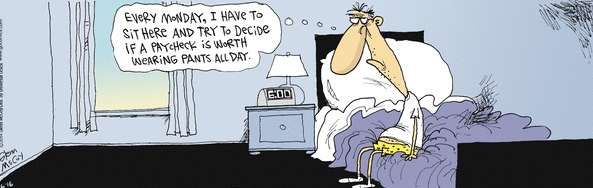
And did I mention the uniforms? Yes, uniforms. I have never worked anywhere as a desktop technician where I was expected to wear a uniform four days a week (surprisingly we do have company-wide casual Fridays). It consists of a 100% polyester black golf shirt and a cotton/poly blend black cargo pant, both of which are prominently emblazoned with the ██████ company logo. Classy.

Okay, I have to admit I knew about the clothing requirements going in, and I didn’t figure that would be an issue. But every morning when I put on those clothes I feel like a little piece of my soul drains away. There are only two other groups of employees who are expected to wear company supplied uniforms: the kitchen and janitorial staff. Tells me a lot about just how we’re viewed by management.

And the color choice? Apparently it wasn’t always basic black. At one time it was a white dress shirt and beige khakis. So why the change?

Well, I have nothing to back this up, but because our work area is absolutely plastered with WWE posters (straight men are weird), and the referees in the matches are dressed all in black I’m sure this had something to do with the color choice.

I only learned last Friday that as PC techs, we have ticket quotas. No one will tell you exactly how many tickets you’re supposed to close on a daily basis, but if one ticket took you an entire day to properly resolve, it will count against you—no matter what the issue was. In our weekly meeting this was pointed out, and a story was relayed how during the last purge (yes, they called it that), a tech was let go simply because he had the lowest numbers in the department. It didn’t matter if he was meeting these unspecified goals or not; he was viewed as the lowest performer and escorted from the building.

Is it wrong that I thought, “Please god, let there be another purge and may I find myself in that bottom tier?”

I’ve worked several other places during my career that I came to despise. The job immediately prior to this one comes to mind, as well as a help desk job at a law firm in San Francisco (not Orrick, Herrington, Sutcliffe, which I adored until they swapped out management), an architectural firm also in SF (not Hogg & Mythen, where I stayed eight years), and two architectural firms in Tucson (both where I was micromanaged into quitting). But never have I come to hate a job as much and as quickly as my current position. I dread going in each and every morning, and every night I come home angry and exhausted.

I’ve reactivated my profiles on all the job boards; hopefully through all the noise of the offshore Indian agencies begging me for resumes, something good will come from a local company and maybe once again I can find myself somewhere that I actually look forward to going to work…