Beautiful

This is what I envision of when I think “21st Century Desert House,” and it really makes me regret having left the architectural field fifteen years ago. From the firm ibarra rosano design architects of Tucson. We’d move back to AZ in a heartbeat if this were waiting for us. Absolutely stunning. (Click on any of the images to embiggen.)

Be sure and check out all their other work!

Perkins: Google Trying to "Destroy" Values with Gay Rights Initiative, Should Expect "Blow Back"

Ugh. Will it never stop?

So… the usual suspects are at it again, threatening a boycott of a gay-friendly company. I mean seriously…how do these people look themselves in the mirror each morning with so much hate festering in their shriveled little hearts?  And um…how exactly does a boycott of Google (a free service) work? Are they going to refuse to look stuff up on the Internet? Are they going to delete their free GMail accounts?

Not that the Bible-humping…er…thumping crowd was ever terribly bright to begin with, but seriously, they’re going to boycott an Internet search engine?  What’s next, a boycott of gifs? jpegs?

I’m actually kind of surprised Miss Perkins even knows the definition of blow back; at least not in any usage other than, “If I blow you, will you blow back?”

Some Thoughts About Boycotts

While I support them, I’m not sure that the threat of boycotts—whether they come from the left or the right—are really all that effective in changing the hearts and minds of whatever company is being targeted. I’m not sure that when I and a hundred of my closest friends say we’re not going to patronize Company X, it really makes any difference to the individuals running those companies—no matter how fervently we believe in the cause.

On the other hand, when millions of people join forces to boycott a company and said company sees its bottom line being affected over the course of one or two quarters, then it might examine how it’s doing business. But except in a few select instances, that rarely happens. (Someone please fact check that for me.)

That’s why I laugh when I hear organizations like OMM (One Misguided Mom), NOM (National Organization of Morons) or the AFA (American Family of Assholes) loudly proclaiming they’re going to boycott Starbucks, or General Mills, or whoever. They simply don’t have the numbers to affect corporate policy—especially when that company’s policy is inclusion, rather than exclusion.

If their members want to stop drinking Starbucks, fine. If they feel better about not eating Oreos, more power to them. From what I’ve seen of their membership they could stand to lose a few pounds anyway. (Not that I have room to talk.) But are they going to force their medieval views of what is right and wrong onto a company by those actions? Hardly.

(By the way, OMM, NOM, AFA and the rest of the alphabet soup of hate groups: good luck ripping Tickle-Me-Elmo out of your toddlers’ hands now that Jim Henson’s company has publicly come out in favor of equality. Your children will remember it forever and a part of them is going to hate you for the rest of their lives. But hey, you’re saving their immortal souls, so what difference does that  make, right?)

The same goes for the left and the call to boycott Chick-Fil-A.

I boycott Chick-Fil-A (and Walmart) because I personally feel better about myself for not continuing to enable the funding of bad corporate policies. Do I have any real expectation that this will affect how they do business? Hardly.

By all means boycott if you want. But do it because it makes you feel better as an individual, not because you think it’s going to change policy overnight. That being said, if enough people simply do what is right, it will eventually affect a company’s cash flow and the company will be forced to look at how they do business.

Thinking of Moving

The lease on our apartment is up the first of September. Even though the place is small, Ben and I had decided some time ago that if the rent increase was minimal we’d stay there for another year. If it went up substantially, we’d move elsewhere. We got our renewal offer the other day and they’re raising the rent $77 a month.

Why?

Because they can.

The last thing I want to do is pack everything up again, but we found a very nice place southeast of where we’re currently living that makes it worthwhile. For essentially what our increased rent would be, we’d be getting a brand new two bedroom place (we currently have a one bedroom, but want someplace that will accommodate out-of-town guests) that has all our current amenities, is literally a five minute walk from light rail and has hardwood floors.

The complex is about the same distance to Ben’s work that our current place is, but it’s a bit closer to mine, and will allow me to avoid I-25 entirely on my commute. As I mentioned earlier, it’s ridiculously close to a light rail station, and that will make my snow day commutes a breeze.

The only real worry I have is that the unit we want (the one with the hardwood floors) is the last one they currently have available. They have several others with a nearly identical layout—all brand new—but they’re on upper floors and are fully carpeted.

Fingers, toes, legs and eyes crossed that it will still be available when we’re actually allowed to reserve it…

You Knew This Was Coming, Right?

Especially after a few of today’s earlier posts…

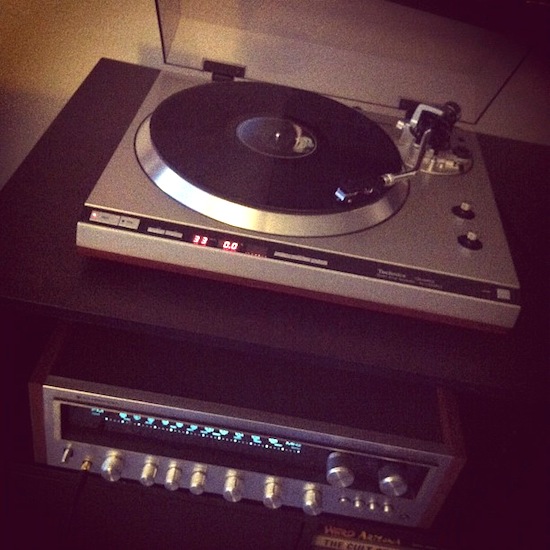
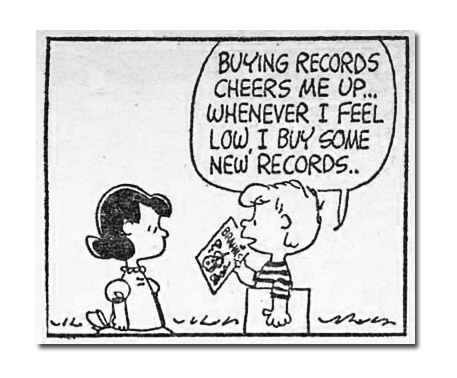
Don’t get me wrong, I luvs me my iPod somethin’ fierce. It literally holds my entire music collection (12,700 items and counting). But there is something wonderfully organic about the experience of listening to music on vinyl that digital will never be able to reproduce.

I’m so happy to have been able to live through the “big iron” period of audio equipment in the 1970s. It was truly something amazing.

I only wish my hearing was still as good as it was back then. Getting old sucks on so many levels.

I pulled a random record from the shelf tonight, ending up with Dead or Alive’s Rip It Up. It was a fun, but not completely satisfying experience, so I moved on to Fleetwood Mac’s Rumours, an album meant to be heard on vinyl—loud—through headphones.

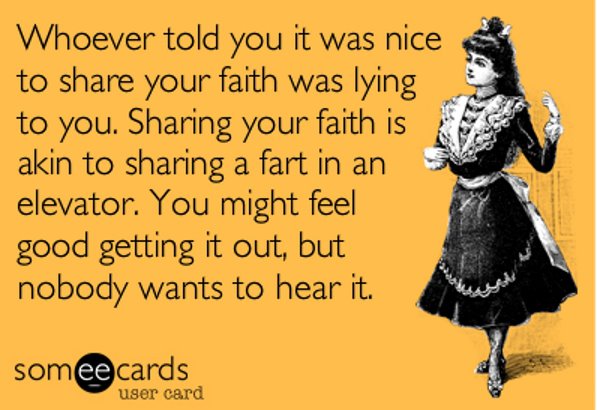
AFA Accuses Lady Gaga And Office Depot of Pushing “The Homosexual Agenda” On Children

SAVE THE CHILDREN! SAVE THE CHILDREN!

From Back2Stonewall:

The hateful religious extremists at the American Family Association are at it again.

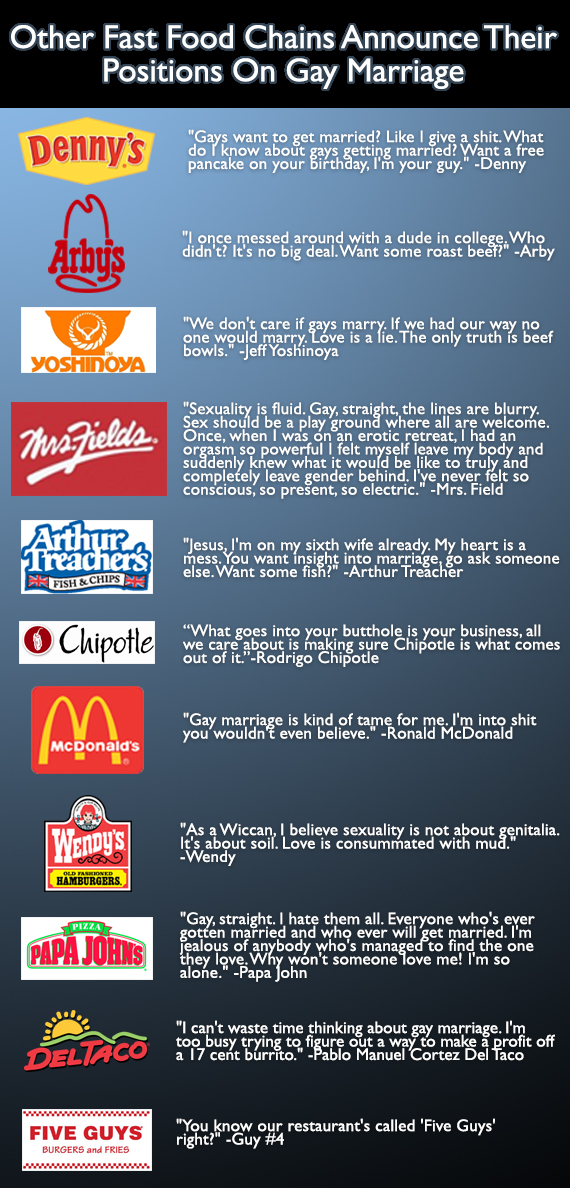
This time the AFA is accusing Lady Gaga of “pushing the homosexual agenda on children” and vowing to boycott Office Depot for partnering with Gaga’s “Born This Way Foundation”.

Office Depot is guaranteeing $1 million to help indoctrinate your children that they are born “gay.”

This week, Office Depot announced it is teaming up with recording artist Lady Gaga to push the homosexual agenda in public schools by encouraging our children to believe “gay” people are “Born This Way.”

To help spread the message, Office Depot and Gaga’s Born This Way Foundation have created several special, limited-edition products for back-to-school this year. Office Depot is donating 25% of the sale of each item back to the promotion of homosexuality, with a guaranteed payout of $1 million.

The truth is, there is zero credible evidence that people are born “gay.” Homosexuality is a poor and dangerous choice, and has been proven to lead to a litany of health hazards to not only the individuals but also society as a whole.

Office Depot is attempting to attract children to it by the deceiving title “Empowering Youth”. That is horribly irresponsible and will ultimately lead children to a higher chance of becoming victims to alcohol and drug abuse, depression and even suicide.

The AFA, an officially designated hate group alongside the KKK and Stormfront by the Southern Law Poverty Center has created a “stop or we’ll boycott you!”  letter for its members to send to Office Depot.

YOU (And by that I mean all of you PLEASE take 1 minute to do this)  can write to Office Depot to express your appreciation for their support of LGBT kids and the Lady’s Foundation  by sending  an email to their chief marketing officer: Robert.Moore@OfficeDepot.com

A Voice of Sanity

From Dave Holmes:

I’m reading the NYTimes’ coverage of the Aurora shootings, and this quote jumped out at me:

Luke O’Dell of the Rocky Mountain Gun Owners, a Colorado group on the other side of the debate over gun control, took a nearly opposite view. “Potentially, if there had been a law-abiding citizen who had been able to carry in the theater, it’s possible the death toll would have been less.”

It’s nothing I haven’t already read a hundred times on Facebook and Twitter in the last 24 hours, but there it is, in print, impossible to block or delete.

Okay. First of all, when Mr. O’Dell says such a thing, there is a zero percent chance that he is picturing anyone other than himself as this heat-packin’, justice-servin’, massacre-mitigatin’ motherfucker. And let’s just say for the sake of argument that his self-image is completely accurate. Let’s assume Mr. O’Dell would stay ice cold in the middle of that turmoil. Let’s say that in a pitch-dark, packed theater that has been thrown into chaos by unexpected gunfire- and that also has big-budget gunfire on the big screen, and pumping through the THX sound system- Mr. O’Dell would instantly know exactly where to shoot, would have an unobstructed line of fire, and would have perfect aim. Great, then! The theoretical you is so sanguine in the face of death, Mr. O’Dell! You are theoretically an American hero.

But what if there’s a third person who’s able to carry in the theater? And what if this person isn’t a justice machine like you think you are? What if this person doesn’t handle real-life bloodbaths like a professional to begin with, and on top of it, now there are two people shooting into a dark, crowded theater? Does he choose the right target? Does he hit that target?

And what if there’s a fourth person? What if she just got her gun that very day and hasn’t ever shot it? What if she wants to be a hero? Which of the three gunmen currently firing away in a dark room does she try to take out?

What if there’s a fifth person, and it’s one of these garbage people who brings an infant to a midnight screening of The Dark Knight Rises? He’s defending his family now, and there are four people who might murder his child. Which one does he aim for? Does the Baby-Bjorn affect his accuracy?

What if there’s a sixth person, who had a few drinks at the ESPN Zone before the show?

Or a seventh person? Or a tenth? Or a fiftieth?

Are you sure more guns would have made this situation better? Are you sure?

Let's Stop Pretending We Care

I’m sure this is going to spark more howls of outrage from my regular readers, but fuck it.  Until we address the underlying causes of gun violence in America (i.e. the lack of mental health care and the ridiculously easy availability of firearmss), it’s true.

From John Aravosis at AMERICAblog:

Americans do a great job of proclaiming our collective shock and outrage when some nut for the gazillionth time opens fire on a crowd of innocent bystanders at a movie theater, a college, a high school, a museum, or a post office, but at some point, if we aren’t going to do anything about it, maybe it’s time we stopped the charade of pretending we actually care.

How many times does someone have to drown in front of us, while we do nothing (and, instead, actually enable the death), before it’s time to conclude that perhaps we are part of the problem?

From EJ Dionne at the Moderate Voice:

For all the dysfunction in our political system, a healthy pattern usually takes hold when a terrible tragedy seizes the nation’s attention.

Anyone who dares to say that an event such as the massacre at a Colorado movie theater early Friday morning demands that we rethink our approach to the regulation of firearms is accused of “exploiting” the deaths of innocent people.

This is part of the gun lobby’s rote response, and the rest of us allow it to work every time. Their goal is to block any conversation about how our nation’s gun laws, the most permissive in the industrialized world, increase the likelihood of mass killings of this sort.

So let’s ask ourselves: Aren’t we all in danger of being complicit in throwing up our hands and allowing the gun lobby to write our gun laws? Awful things happen, we mourn them, and then we shrug. And that’s why they keep happening.

The Boomtown Rats wrote “I don’t like Mondays” in 1979, thirty-three years ago. Violence in America isn’t a recent problem. It’s been going on for a while now. And nothing serious is ever done about it because the gun lobby is ruthless, owns the Republican party, and preys on the Democrats usual fear of doing anything that isn’t agreeable to 100% of the American people.

So the next time some nut goes on a shooting spree with weapons the gun lobby made it easier for him to get – and he will – let’s stop pretending like we care, because as a nation we really don’t.

Amen,  John.

Seasons

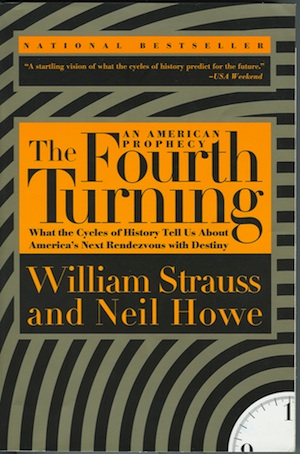
In the early months of 2002, I learned of a book called The Fourth Turning which proposed that history is not linear as we’ve been taught in the west, but rather cyclic—an idea that’s actually been the norm throughout much of history and is exemplified by the Mayan calendar. That’s not to say that specific events happen again and again, but the general “flavors” of history repeat like a well oiled machine. The radio interview I heard intrigued me enough that I added the book to my Amazon Wish List and then promptly forgot about it.

I was cleaning out the Wish List a couple weeks ago and rediscovered it. I went online to see if the Denver Library had the book. They did, so I checked it out. I’m slowly making my way through it, and a lot of what the authors have proposed is really resonating with me.

The world is descending into a global conflagration. Totalitarian leaders of nations that feel they have been humiliated by the US and its allies are becoming evermore vitriolic and threatening. An economic powerhouse is emerging in the Pacific rim. Americans are divided about how to respond. Some believe we need to aggressively get on to the world stage and bring tyranny to a halt. Others are appalled by our international adventurism and believe we should look for multilateral peaceful avenues of negotiation. They suspect the President of abusing his office and acting as an imperial president. They suspect he is taking liberties with our civil liberties and they suspect he is manipulating events behind the scenes to bring us into war. The president is deified by many and reviled by many more. Politicians are engulfed in rancorous arguments over divisive social issues as the economy is perceived to be stagnating. People worry about their economic future. Children are increasingly protected. Most institutions of society are weak and are struggling to regain health. Oh yeah. Did I mention I was writing about the 1930s?

William Strauss and Neil Howe wrote The Fourth Turning fifteen years ago, five years prior to 9/11. The authors make the case that there tends to be an eighty year cycle to our culture that is connected to a repeating sequence of four generational archetypes (Hero, Artist, Prophet, Nomad). Each generation consists of people born within roughly a twenty year period. As they go through the life cycle (child, young adult, middle age, elderhood) they tend to exhibit certain traits based on the table that was set for them by previous generations, just as they in turn set the table for the generations that follow. Therefore, approximately every twenty years the great bulk of one generation moves from occupying one life stage to the next older life stage. That kicks off the next in a sequence of twenty year eras called a “turning.” Each of the four turnings has a distinct feel and tends to exhibit certain characteristics. The four turnings together make up a saeculum.

A key dynamic in Strauss and Howe’s theory is the oscillation of crises. Each saeculum begins with a high sense of community and unity. Civic structures run effectively and efficiently. During the Second Turning a spiritual crisis emerges. The youth begin to feel that the social order is confining and stale. They become introspective as they search for deeper meaning. During the Third Turning there is a deepening and consolidating of the insights gained from introspection and spiritual quest. However, in the meantime, the cultural institutions are coming apart and the culture fragments. During the Fourth Turning a secular crisis emerges. It often (though I don’t think necessarily) culminates in an armed conflict. There is a struggle to develop a common ground on which to rebuild and rejuvenate cultural institutions for the future. After the crisis climaxes, a new saeculum is born. During the First Turning, gains in community cohesion are deepened and consolidated which eventually gives birth to a new spiritual crisis. And so the cycle goes.

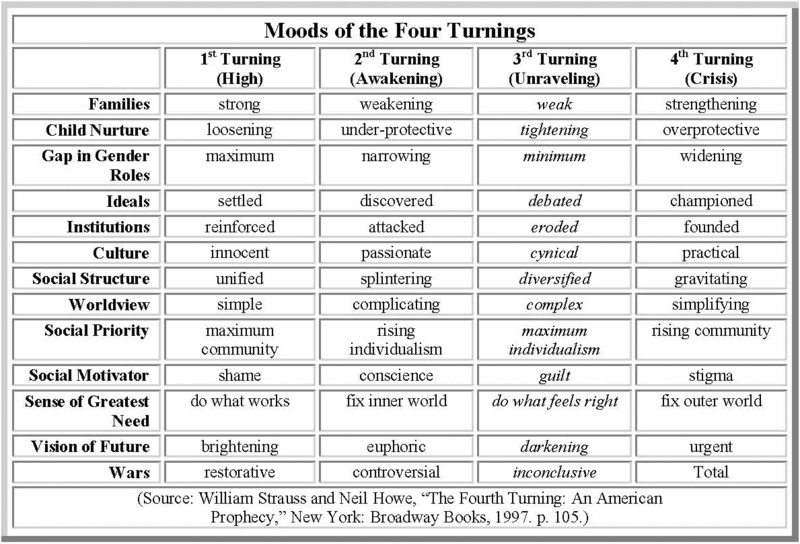
Many believe that 9/11 marked our transition into the Fourth Turning. The previous Fourth Turning began in 1929 with the onset of the Great Depression and climaxed with WWII. Many authors are drawing parallels between pre-war Europe and now. The subsequent First Turning (The High) ran from 1946-1964. The Second Turning (The Awakening) went from 1964-1984. The Third Turning (The Unraveling) ran from 1984-2001. We are now believed to be in the Fourth Turning (The Crisis) which will likely not play its way out until the early 2020s.

Because of the dynamics of the generations involved and the issues they face, there is a mood common to each of the turnings. In the table below, the Third Turning is italicized indicating the Turning that was current at the time the book was published in 1997.
This idea of cyclicity has also gotten me thinking about personal cycles. A human lifetime can also be divided into four “Turnings,” or as I prefer to call them, seasons, each roughly 20 years (more or less) in length. This explains why Ben and I sometimes see things so differently. He is in the “summer” of his life—full of growth, vibrancy and expansiveness. I, however, am in autumn, whereby I’m in more of a “gathering” mindset, seeking security and a sense of stability against my approaching winter. Yet (thankfully) somehow our relationship works.

Many lives also experience the archetypal Turnings, although perhaps at an accelerated pace. I know that in my own case, I entered a personal Fourth “Crisis” Turning when I received the cancer diagnosis in 2003.  It literally turned my life upside down (as Strauss and Howe describe what happens to our culture every 80 years or so), but it also forced me to abandon old, outmoded ways of thinking and strike out anew, resulting in some incredible creativity.  As I’ve written about before, the Crisis showed me exactly who and what was really important in my life; everything else was discarded. I moved through that period and came out the other side a changed—and I would like to think, better—man for the experience.

The authors’ description of the Fourth Turning explains so much of what I see happening in this country—as well as the general way people are feeling about life these days. We may be in for some very difficult times over the course of the next decade, but as a country we will come out better for it. That gives me hope.

And while I don’t mean to get all political, I certainly trust Barack Obama to navigate us through these rocky waters far more than any personality those on the right would have govern us.

I’m only about a quarter of the way into the book, but at this point I highly recommend finding a copy and drawing your own conclusions.