R.I.P.

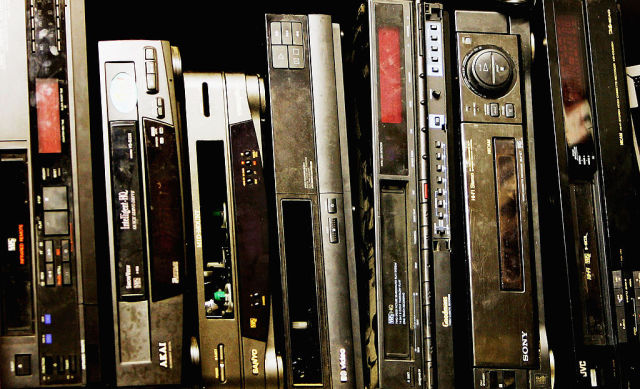
40 years after the first VHS video cassette recorder rolled off the production line, the last known company making the devices is ceasing production. According to Japanese newspaper Nikkei, Funai Electric, a Japanese consumer electronics company, will give up on the format by the end of the July after 30 years of production.

Declining sales, plus a difficulty in obtaining the necessary parts, prompted Funai Electric to cease production. While the Funai brand might not be well-known in the west, the company sold VCRs under the more familiar Sanyo brand in China and North America.

Funai Electric began production of VCRs in 1983 following the unsuccessful launch of its own CVC format in 1980. While CVC had its strengths—its quarter-inch tape made its machines smaller and lighter than VHS machines, which used half-inch tape—VHS and Betamax were strong competitors.

(Source)

0 comments

First World Problems

Life was earlier before we were surrounded by all this tech.

“Goddamnit! GET OFF MY LAWN!”

(I’m practicing…)

Anyhow, after discussing it with Ben, we decided that even though we still had a little over a year left on our contract with Cox, it was worth the cancellation fee to tell them to take their shitty television and unneeded telephone service and shove it up their corporate rectum. To that end, we had a visit from DirecTV on Friday, and we’re now enjoying basically the same service for substantially less than what we were paying Cox. We’re keeping Cox for internet because the alternative (DSL through Century Link) was simply unacceptable as far as speed was concerned.

The worst part of switching providers is that once again I am at a total loss for what is on any given channel. It seems that just when I get used to knowing where to find any given program we change providers—not to mention learning an entirely new interface. Last night I pulled out an index card that I’m now keeping handy to write down our most watched channels so I can just enter them directly in the future instead of aimlessly scrolling up and down the on-screen guide. (Ben told me there was a way to select favorite channels and save them, but the index card is faster.)

We kept Cox for internet, but returned their cable modem after buying our own. This was yet another first-world annoyance, because I arrived home on Friday to discover that even though Ben’s laptop was connecting just fine to the outside world, mine absolutely refused to. It would connect to our router, but it wasn’t getting beyond that—even though Ben was connecting the exact same way. Finally, after messing around for more than an hour and going through several reboots of both the router, modem, and laptop, we just decided to simply reset the router to factory settings and set the whole network up again from scratch. That apparently cleared out whatever goop was preventing it from connecting, and once again we had connectivity to the outside world.

But what we then neglected to take into consideration were all the sundry internet connected devices around the house, each of which also needed to be reset to join the new network.

Hopefully we won’t have to go through all this again for quite some time…

2 comments

The Island of Misfit Toys

Or, as I like to call it, “Tech of Yesteryear: Stuff I’ve Owned.”

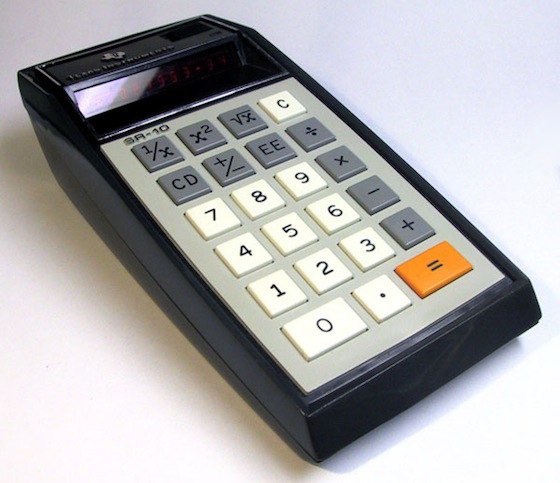
My first calculator, a Texas Instruments SR-10. Four functions plus square root, square and inverse!—$89 in 1974. I needed it for Chem/Physics.

My first 10-speed bike, a Schwinn Continental—$105 in 1972

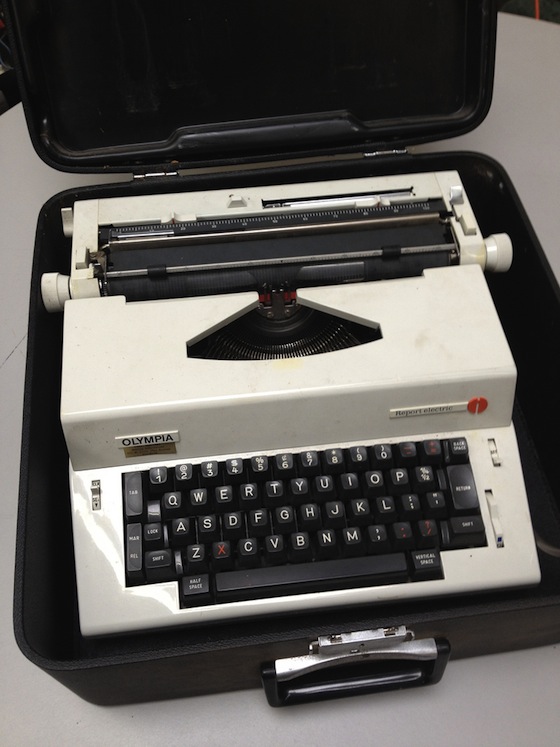
My first (and only) typewriter, an Olympia Report Electric SKE—price and date forgotten (1974?). Sold in a fit of perceived poverty in 1990.

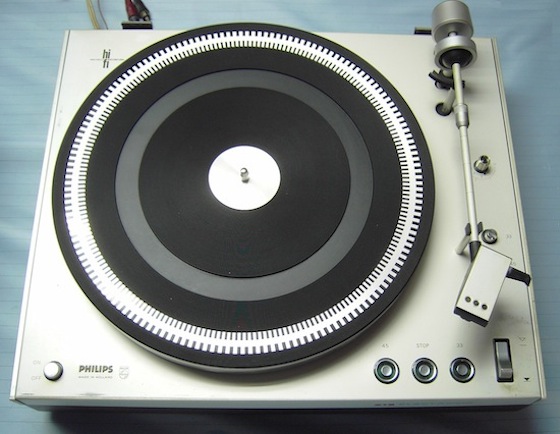
My first hi-fi turntable, a Philips GA-212—$200 in 1973. I had to have this particular one because it was touch control! Little did I know that when the bulbs under the touch controls burnt out, the controls stopped working altogether, necessitating a costly trip to a repair shop. It wasn’t like you could just go online and order replacements.

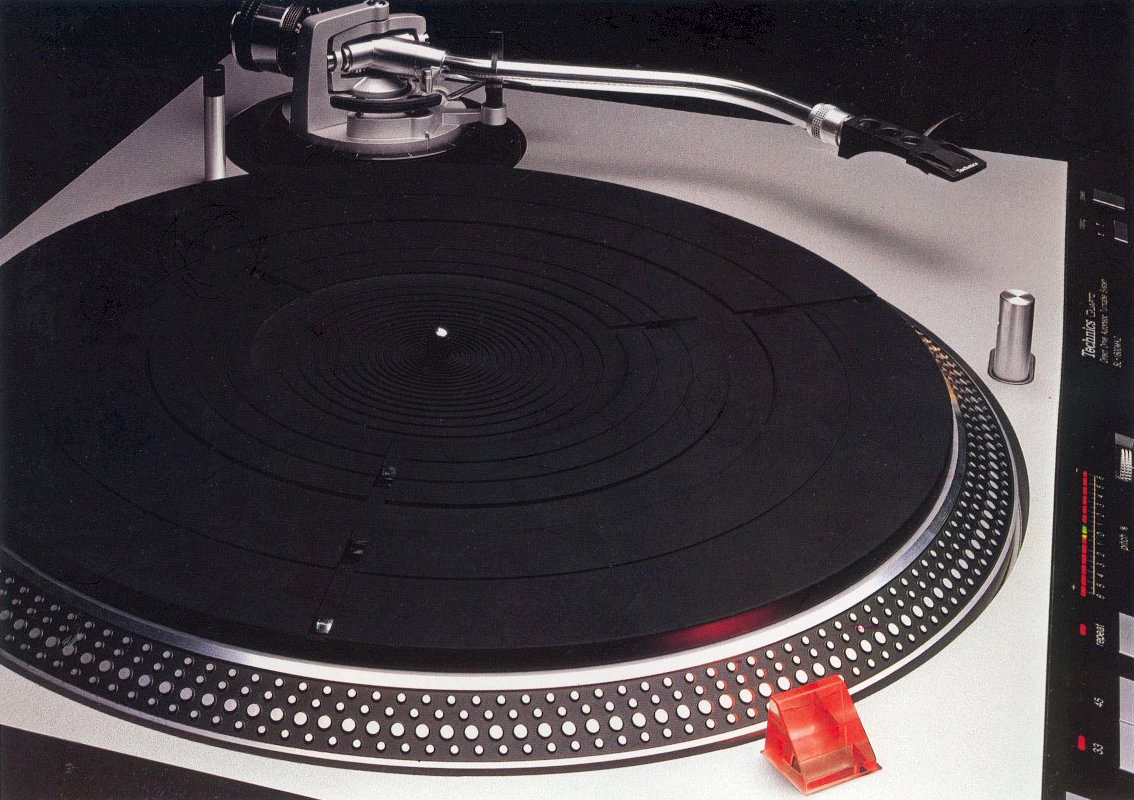
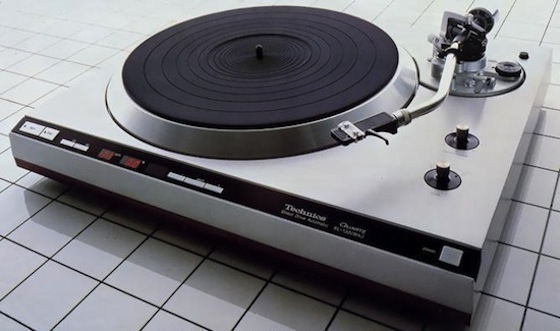
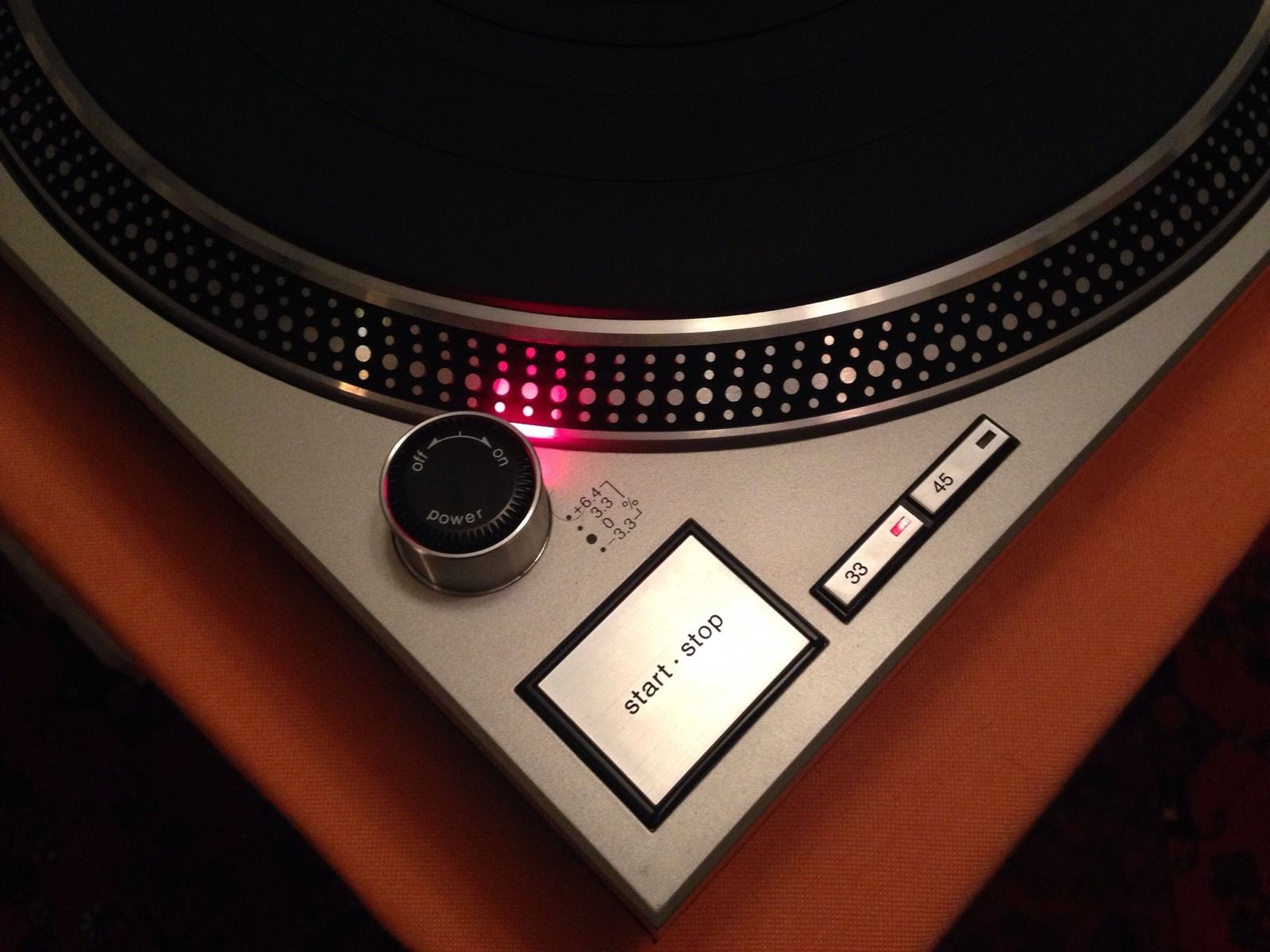
My first awesome, truly high-tech hi-fi turntable, a Technics SL-1300Mk2—$500 in 1978.  I took out a personal loan for this one. Of course it died within months of being paid for and then sat in a repair facility for months because the particular integrated circuit that had failed was on indefinite backorder. (Such is the life of an early adopter.) I finally retrieved it from the shop and shipped it back to Panasonic for repair. It was returned, and UPS left it with the neighbors’ unattended children, where they proceeded to destroy it. UPS and Panasonic wrote it off as “destroyed in shipment” and sent me refurbished unit. But it was never the same, so I sold it in 1980.

I replaced it in 2000 or thereabouts with a near-mint unit that came in the original packaging. The arm lift mechanism on this model was a notoriously bad design that self-destructed after about 5 years of use, so I had it professionally repaired by a friend back east (now, sadly deceased) and it’s worked beautifully ever since.

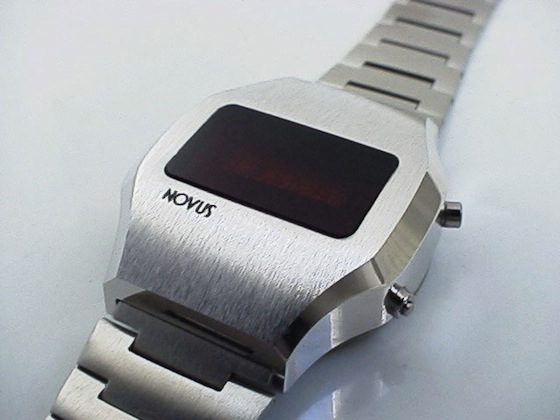
My first digital watch, a Novus—price unknown (but it wasn’t cheap) in 1976. It was a high school graduation present from my parents. Like all digital watches of the time, you had to hold down the button to make it illuminate and show you the time. It died sometime in the early 80s.

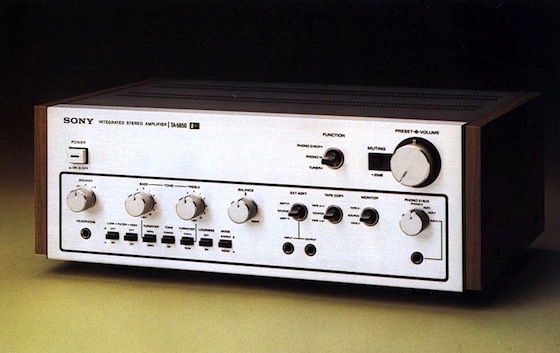
My first hi-fi amplifier, a Sony TA-5650—$550 in 1976.  I bought it for myself with money I received for my high school graduation.  Another piece of cutting edge tech that wasn’t quite ready for prime time, the 5650 had the very annoying habit of self-destructing every six months or so, necessitating a visit to the repair shop to have some diodes replaced  (to the tune of $75 a trip—quite a bit of money for the time). After the second or third time it happened, I decided to replace it, but nothing came close to the sweet, sweet sound the V-FETs produced, so I kept getting it fixed.

The last time it died, sometime in 1986, I replaced it with a rock-solid Yamaha amp and kissed it goodbye, leaving it in the laundry room of the apartment complex I was living in at the time. I did that because I just couldn’t bear to toss it in the dumpster.

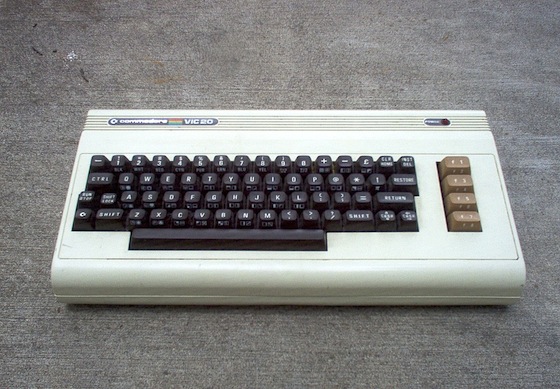
My first computer, a Commodore VIC-20—$200 in 1981. It hooked up to a television, and since Dennis (my first partner) and I couldn’t afford to buy the external cassette drive to save the programs we spent hours meticulously typing in BASIC, it was an ongoing lesson in frustration. But it did light a spark that eventually culminated in my current career.

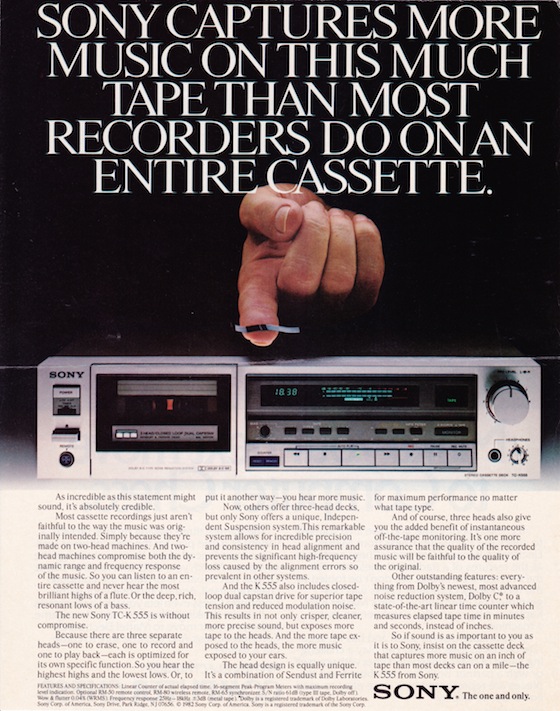
My first hi-fi cassette deck, a Sony TCK-555—$370 in 1984. I waited a long, long time to finally get a good cassette deck for my system. Little did I know that in only two short years they would start marching toward the graveyard of history.  It was a good—not great—deck, but it served me for several years before being replaced.

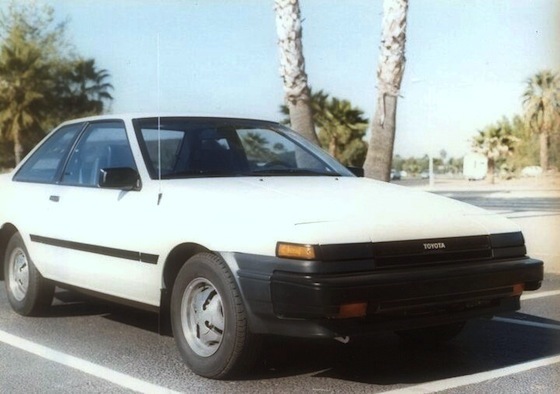
My first new car, a 1984 Toyota Corolla SR-5—$11,000 in 1984. Damn, I loved this car. I sold Dorothy in 1989 after deciding that owning a car in San Francisco was more trouble that it was worth. It was also reaching the point that it was needing some expensive repairs and I had no way of paying for them, so I had to say goodbye. It’s the one vehicle that still shows up regularly in my dreams, never having been sold, but merely put into storage all these years…

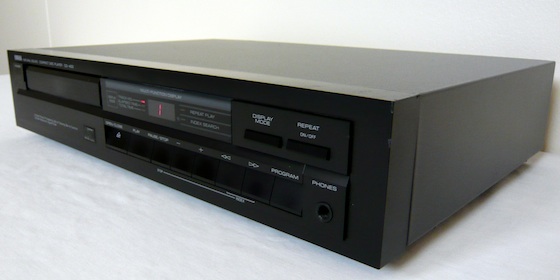
My first CD player, a Yamaha D-400—$360 in 1985. As I recall I blew my whole tax refund on this. I had wanted to get a Technics SL-P2 but it had been discontinued and I didn’t like anything in the Technics lineup that replaced it. I should’ve done more shopping before jumping on this one, however.  It sounded fantastic, but it could only display the track number or the time, but not both. Seriously, Yamaha? I replaced it in 1990.

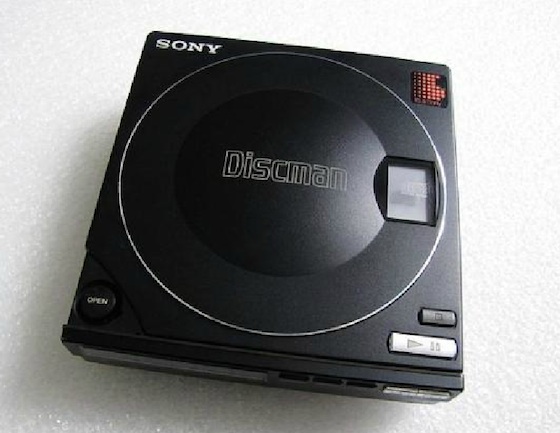
My first portable CD player, a Sony D100 Discman—$400 in 1987. This was Sony’s second-generation portable, and I loved this bit of tech. The only reason I eventually got rid of it was the headphone jack kept coming unsoldered from the main circuit board (one day after the warranty expired, typical of Sony products). It was an easy-enough fix to do myself, but I finally just got tired of dealing with it.

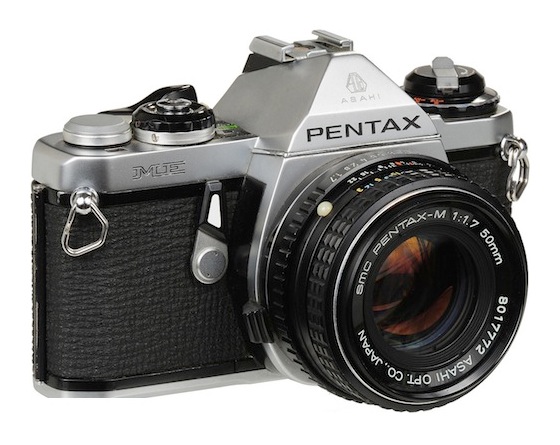
My first 35mm camera, the Pentax ME Super. I got this from my second partner in exchange for some money he owed me. I adored this camera. I won’t say my ratio of good photos to bad was excellent, but I remember it being decidedly better than all my subsequent years of digital. In my rush to go digital, I sold it to buy a new camera. WORST. DECISION. EVER.

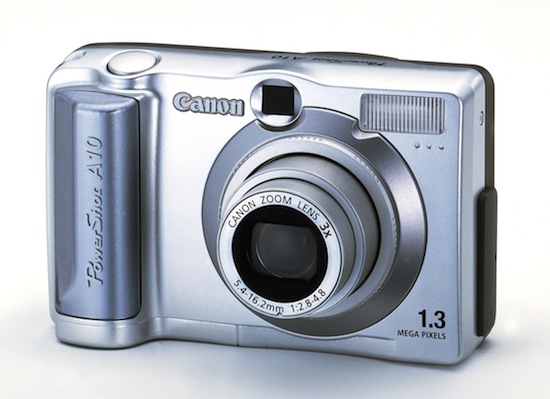
My first digital camera, the Canon A10—$125 (steeply discounted) in 2003. It ate batteries which severely limited its usefulness, picture quality was so-so, and it was a pain in the ass to actually get the photos off of it. I was so relieved when I finally got the funds together to replace it.

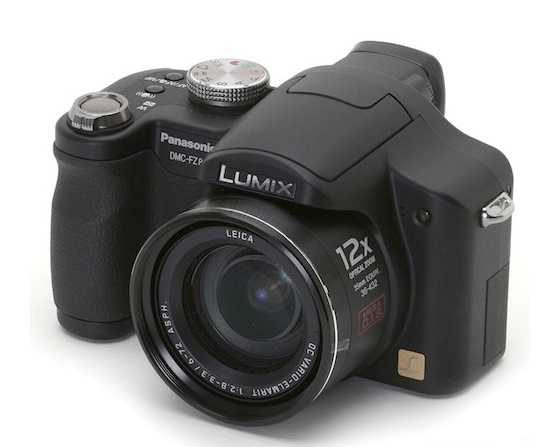
This was the camera I replaced the A10 with, a Panasonic DMC-FZ7. This camera went everywhere with me (including a road trip to Yellowstone), and together we got some stunning shots.  After a couple years, however, I tired of the all purple fringing showing up around bright areas in the photos and after replacing it with a Sony, sold it on eBay.

3 comments

Technics SL-1300Mk2 Service

I’m reposting this from my old blog, because I just found it on the WayBack Machine and had believed it was lost forever. I know my friend John is going to have some choice words for me for putting this out there again (like he did 8 years ago) because people will fuck things up if they attempt this on their own and aren’t very careful, but since he’s not repairing these tables anymore they won’t end up on his bench. Still…proceed AYOR.

Fully 99% of my usual readers can skip this whole post. It’s some serious geek shit and I’m posting it for those who happen to be looking for this info through Google or whatever.

A few days ago my buddy John sent me a new Shure V15 type IV cartridge for my turntable. Back in the day, this was the holy grail of many audiophiles, and while I’d never owned one myself, he assured me it would sound better than my current cartridge. It was his way of saying thanks for not bidding against him on an eBay auction for a particular piece of equipment that he knew I had my sights on.

Anyhow, the sound is beyond my wildest expectations, and even though it’s a long-discontinued item and I may never be able to find a replacement stylus for it when the time comes, I’m going to enjoy the hell out of it until then because it has reminded me that yes Virginia, vinyl does sound better than CD.

This sudden renewed appreciation for analog also prompted me to get off my sorry ass this morning and attend to some much needed—and horribly overdue—maintenance on my turntable.

Back in the late 70s when Technics introduced the first Mk2 line of turntables, they were in many respects the state of the art. The 1300Mk2, which in 1977 sold for $500 ($1800 in today’s dollars), was a beautiful piece of engineering—although not without some inherent design flaws that have reared their ugly heads as these tables have aged.

(To be perfectly fair, I’m sure the designers at Panasonic never thought about these issues, finding it ludicrous at the time to even think that these tables would still be in use thirty years after their introduction.)

First and foremost is the notorious arm lift problem. In most basic terms, Panasonic used a piece of plastic that was too thin, putting it in a location where it was continually subjected to intense stress. Needless to say, as the years wore on and the plastic lost its elasticity, the part eventually snapped. A replacement is naturally now unobtainable, but my friend Joel came up with a very creative—and lasting fix. (Thankfully he passed this knowledge onto his assistants before he died.)

If you’re ever looking to buy a 1300Mk2 or 1400Mk2 off eBay and the seller claims everything works just fine, don’t believe a word of it. If Joel or his successors haven’t fixed them, I guarantee they’re broken.

Two other common problems with tables of this vintage are that the lubricants used in various locations within the mechanism have dried out and have become sticky. This manifests as wonky buttons and the start/stop feature not working.

While fixing the arm lift problem isn’t something that should be attempted by anyone other than the good folks at The Turntable Factory (it’s buried deep within the mechanism and even I am scared to venture that far into the workings—although I have and understand the mechanics of it), if you’re comfortable with a few small tools, have a good eye and a bit of patience, it is possible for you to address the other problems.

The arm lift on my Mk2 was—naturally—repaired by Joel years ago, and I cleaned the dried goop off the the control buttons a while back, but for some reason I never addressed the solenoid spring issue and lately the start/stop has quit working.

Inspired by the new cartridge, here’s my How-To on fixing the start/stop issue:

You will need:

・a flat surface to work on
・good light
・a philips head screwdriver
・needle nose pliers
a towel
・something to hold a bunch of small screws
・rubbing alcohol and q-tips

Estimated time to complete: Approximately one hour. Longer if you’ve never torn one of these apart before.

Step 1

Disconnect the turntable from your receiver or amplifier and put it in your workspace.
Step 2

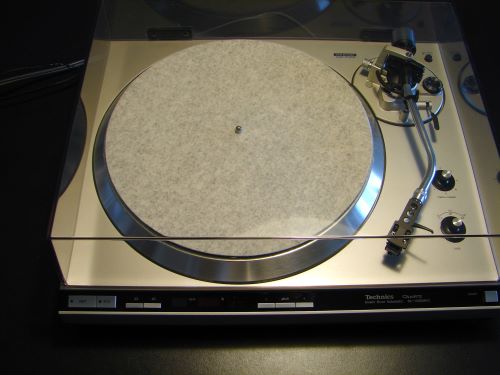
Open the dust cover and remove the cartridge, tonearm counterweight, slipmat and turntable platter. Make sure the manual arm lift lever is in the down position, and lock the tonearm down. Remove the six black screws holding the cover plate in place. Put the screws in a safe place.
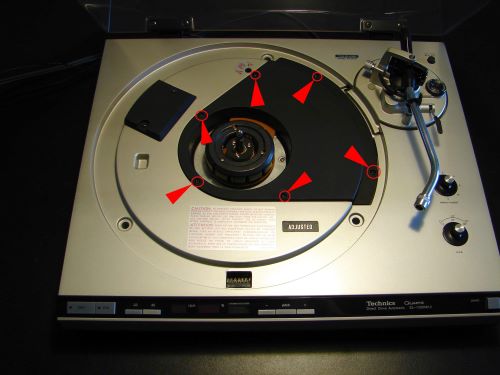
Remove the cover plate and put it aside.

Step 3

Carefully disconnect the five electrical connectors from the circuit board and motor beneath the cover plate. They all just pull straight off, but the one at the very back under the chassis and the small clear plastic connector immediately in front of it have a clip that holds them in place. If no one has ever worked on the table before, there may be a small plastic cable tie organizing the wires. You can safely discard this after removing it.
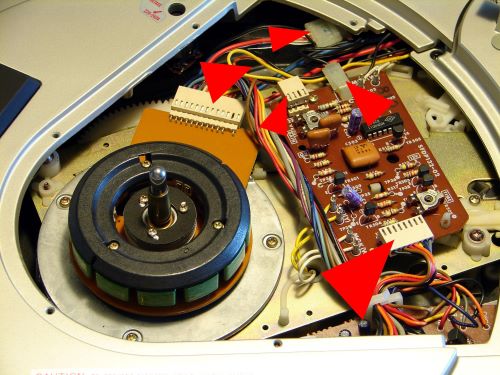
Step 4

Place a folded towel on your work surface. With the turntable dust cover still in place, carefully flip the entire assembly upside down so that the dustcover is resting on the towel. Using a philips head screwdriver, remove the seven screws holding the bottom trim/foot panel in place and put them in a safe place.
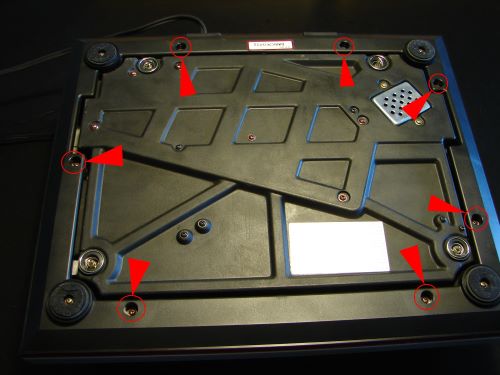
Remove the bottom trim/foot panel. Remove the four screws holding the floating subchassis in place.

Step 5

Holding the black subchassis in place, carefully flip the entire assembly back upright. Raise the dust cover, unlock the tonearm and raise the manual lift lever. Swing the tonearm toward the center.
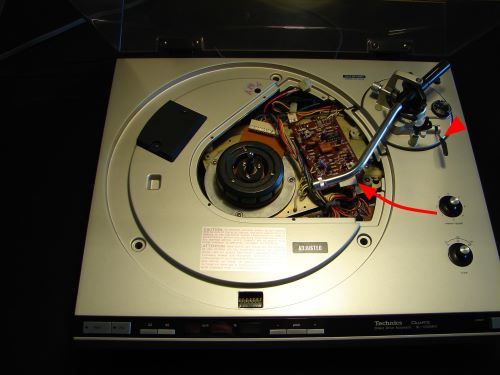
CAREFULLY lift the chassis (with the dust cover still attached) upward, taking care not to catch it on the tonearm. Set it aside.

Lower the manual arm lift lever and move the tonearm back to its rest position, locking it down.
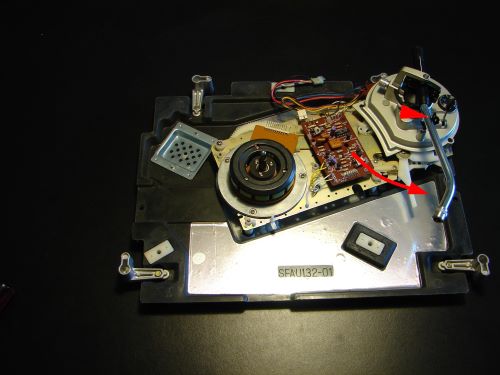
Step 6

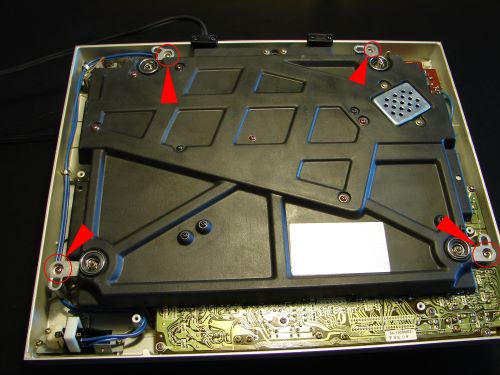
CAREFULLY turn the subchassis assembly upside down and place it on the towel. Remove the 8 screws that are marked in the photo below. Keep these separate, as they are not interchangeable and need to go back in their original locations.
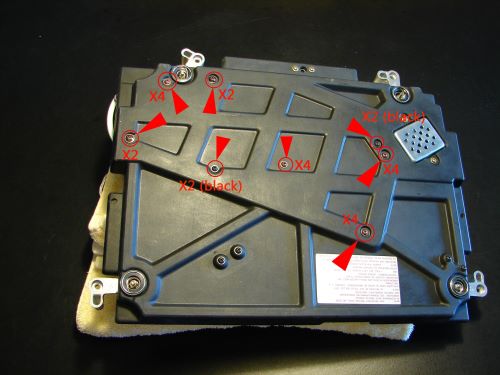
Lift up the black subchassis panel. Put this aside.

Identify the two solenoid locations on the bottom of the tonearm mechanism assembly.

Step 7

To remove Solenoid #1, gently hold back the three retaining clips with a finger and lift the assembly out of the retaining bracket. DO NOT FORCE anything, as the plastic has become brittle with age and if it breaks, you’re going to be royally fucked. (This is where the patience part comes in.)
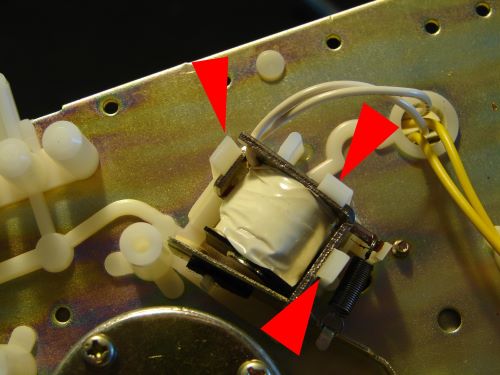
In my particular case, the felt pad attached to the flapper panel on the solenoid assembly was sticking against the white plastic bumper. This may or may not be present in all cases, but if so, dip a q-tip in rubbing alcohol and give the plastic part a good swapping to remove any residue
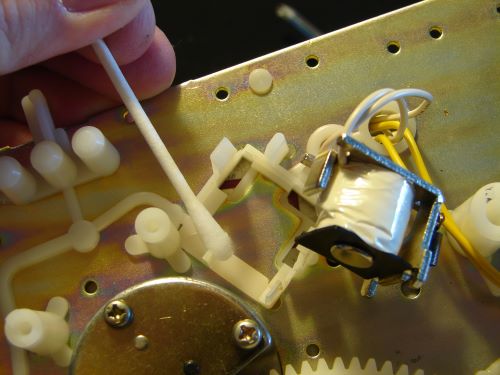
If you’ve removed the flapper, slide it back in place, first hooking the clip on the one edge into the spring and then slipping the two notches back in place on the solenoid.
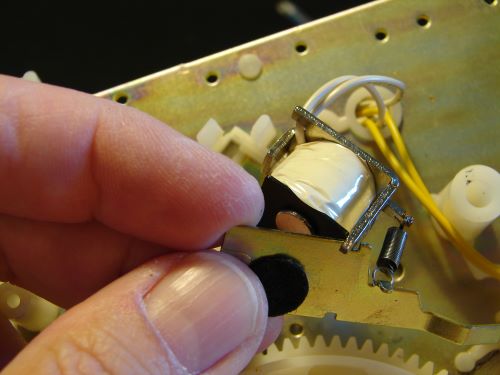
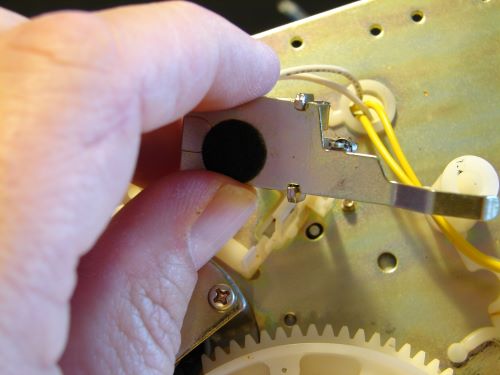
If there is any dried lubricant on the spring (in my case there wasn’t), clean it off with a q-tip dipped in rubbing alcohol.
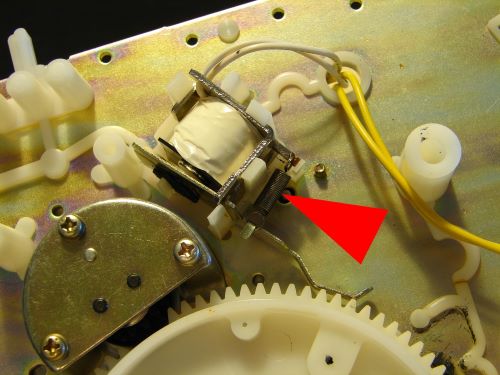
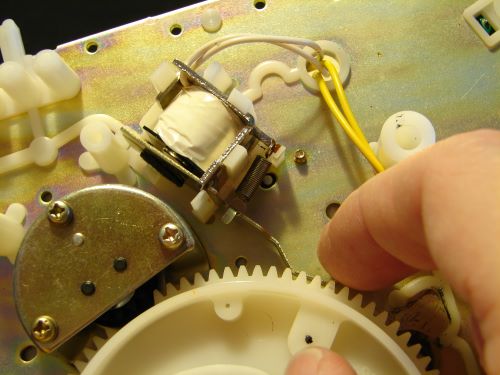
Gently push the solenoid assembly back in place until it snaps into place. Verify that the flapper moves freely by pushing it with your finger toward the large white gear.
Step 8

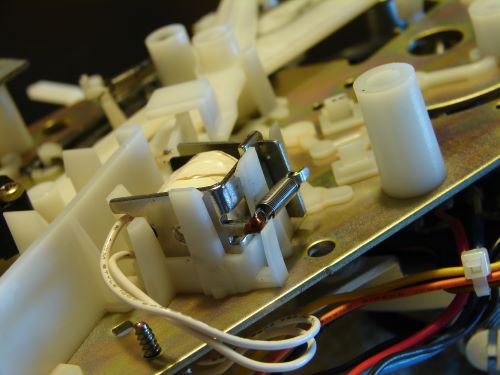
Solenoid #2 is the sucker that causes all of the start/stop problems, and as you can see from the photo, mine was covered with goop.
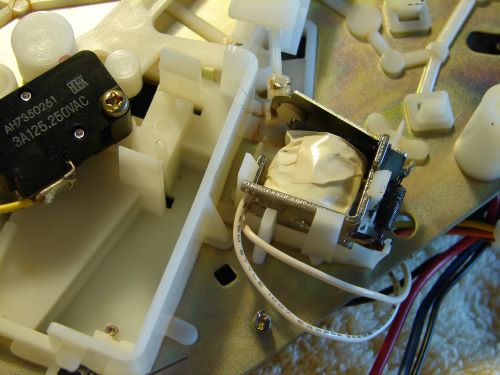
Before removing this solenoid, you’ll need to remove the control arm that it is attached to. CAREFULLY pull back the retaining clip and lift off the control arm.
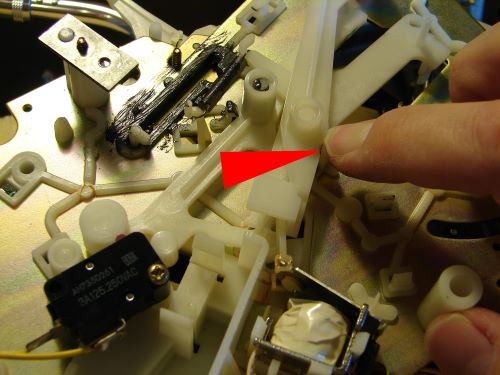
CAREFULLY pull back the three clips enough to release the the solenoid assembly and pull it out. This one may put up a little more of a fight than the other one. Be gentle.

Carefully remove the flapper assembly by turning it at a slight angle so that it slips out of the retaining clips on the solenoid. Unhook the flapper clip from the solenoid spring.

A gummed up solenoid spring is an unhappy solenoid spring.
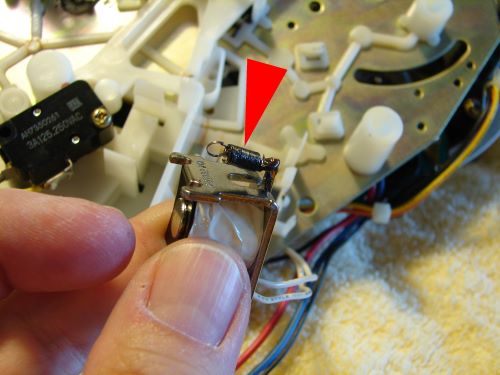
With a q-tip dipped in rubbing alcohol, clean the lubricant off the spring and the plastic parts.
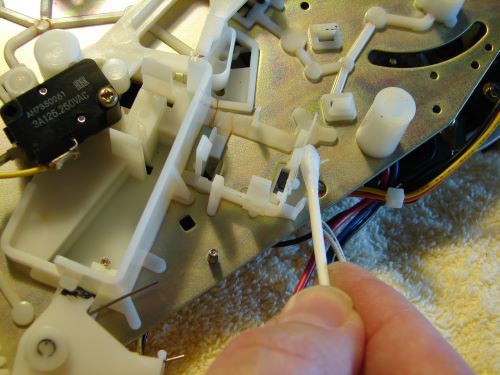
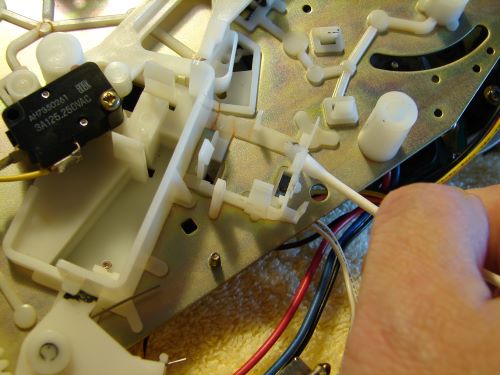
You may need to pull the spring to extend it a bit to make sure the alcohol gets in everywhere (a pair of needle-nose pliers is good for this) to get all the goop off. WHY Panasonic chose to lubricate this is quite beyond me. It’s not needed!

Reattach the flapper assembly by first clipping the end into the spring and then turning it at a slight angle so that it rests within the retaining clips on the solenoid assembly.
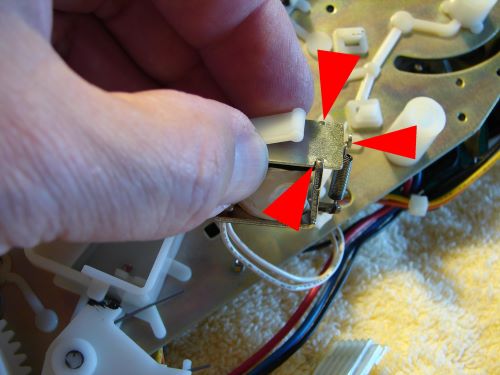
Push the solenoid back into the retaining clips until it snaps into place. Make sure the spring and flapper aren’t caught on anything.
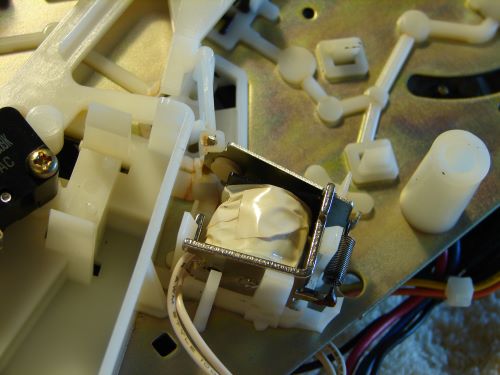
Reattach the swing arm by pushing it back into place until it clicks, taking care that the solenoid flapper meshes with the end of the arm properly.
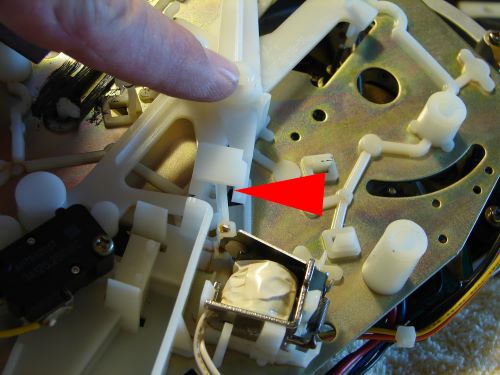
A clean solenoid spring is a happy solenoid spring!
Step 9
Reattach the black subchassis, taking care to align the tonearm mechanism properly and making sure that the proper screws are all returned to their proper locations. When that’s completed, turn the assembly back right side up.
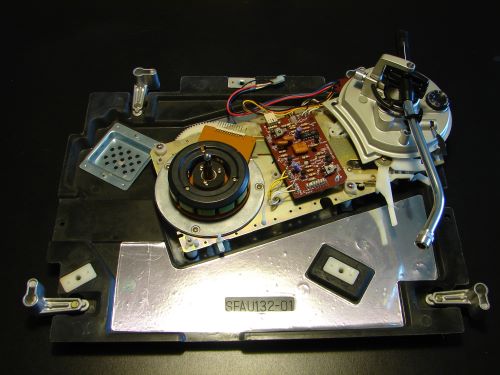
Release the tonearm lock. Raise the arm lift lever. Swing the arm toward the center.
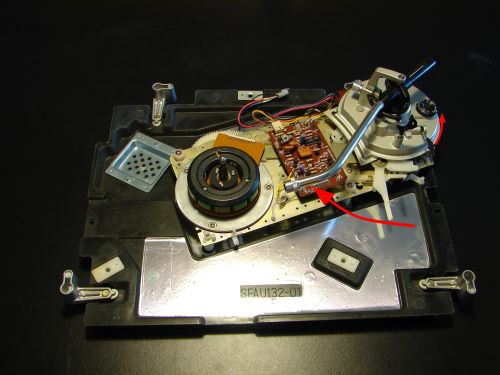
GENTLY lower the chassis and dustcover assembly back onto the floating suspension, taking care to clear the tonearm. If it’s in the proper location, you’ll know it because the tonearm base will be perfectly lined up in the round cutout on the chassis. If not, raise it slightly and move it a bit until it seats properly.

Swing the tonearm back to its rest position and lower the arm lift mechanism.
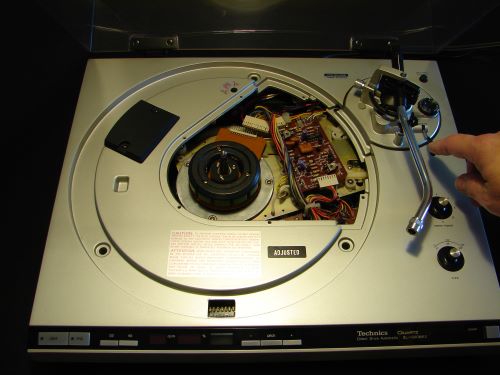
Lock the tonearm down.
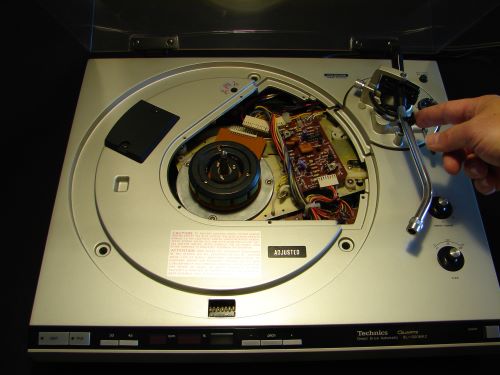
Step 10
Now’s the tricky part. With one hand firmly underneath the turntable on the subchassis and one on the center of the dustcover, turn the entire assembly upside down.

Reattach the subchassis to the main chassis using the four screws that were removed earlier.
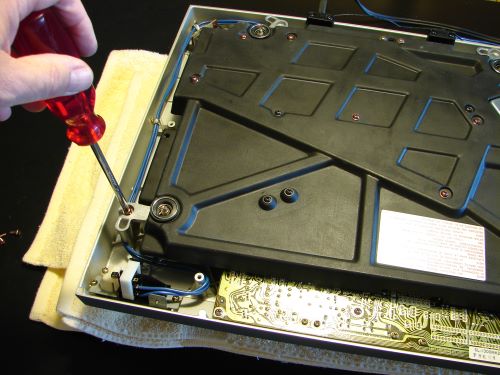
Reattach the bottom trim/foot panel using the 7 screws removed earlier.
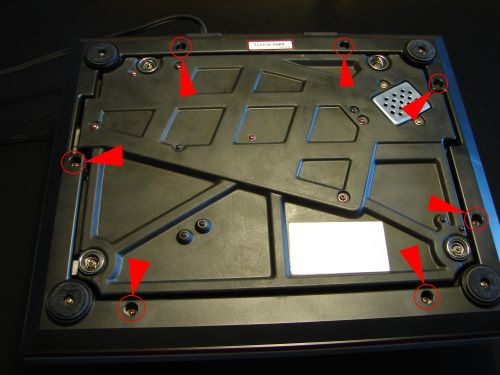
Turn the entire turntable right side up.
Reattach the electrical connections, making sure that the two clear plastic connector clips at the rear snap into place.
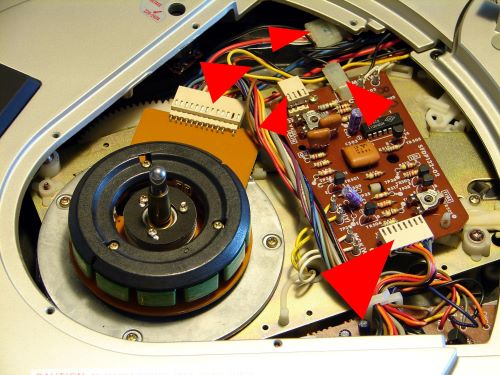
Replace the cover panel, taking care that it’s not pinching any of the wiring underneath. Reattach using the six black screws removed earlier.
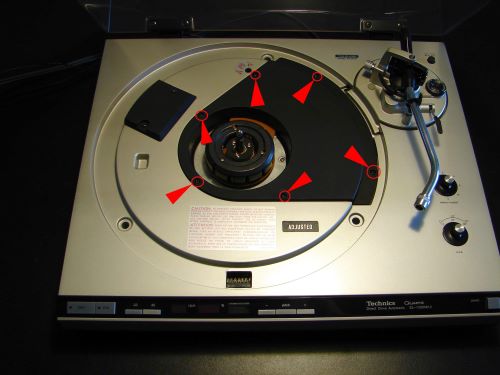
Replace the turntable platter and slipmat. Reattach the tonearm counterweight and cartridge, balance arm, and set tracking force.
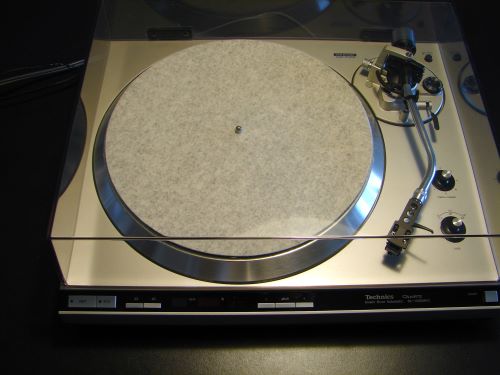
Plug back into your receiver, power up, and enjoy some vinyl!

0 comments

Turntable Geekiness

As you probably know from a previous post (not to mention the numerous “Vintage Audio Porn” posts since then), I’ve been obsessed with audio equipment since I was a teenager. This is one of those quirky obsessions that only other people who share it seem to understand. Thankfully, I still have a few of those quirky friends in my life with whom I can freely converse with.

So if you’re not one of those folks, you might wanna just move on to the pictures of the nekkid men elsewhere on the blog. Just sayin’.

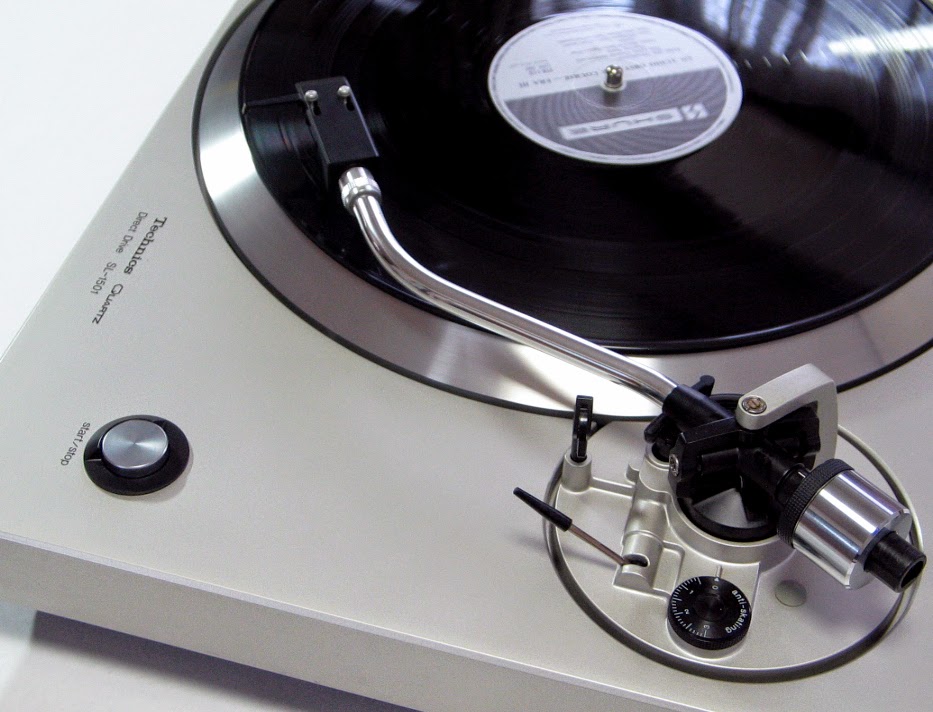
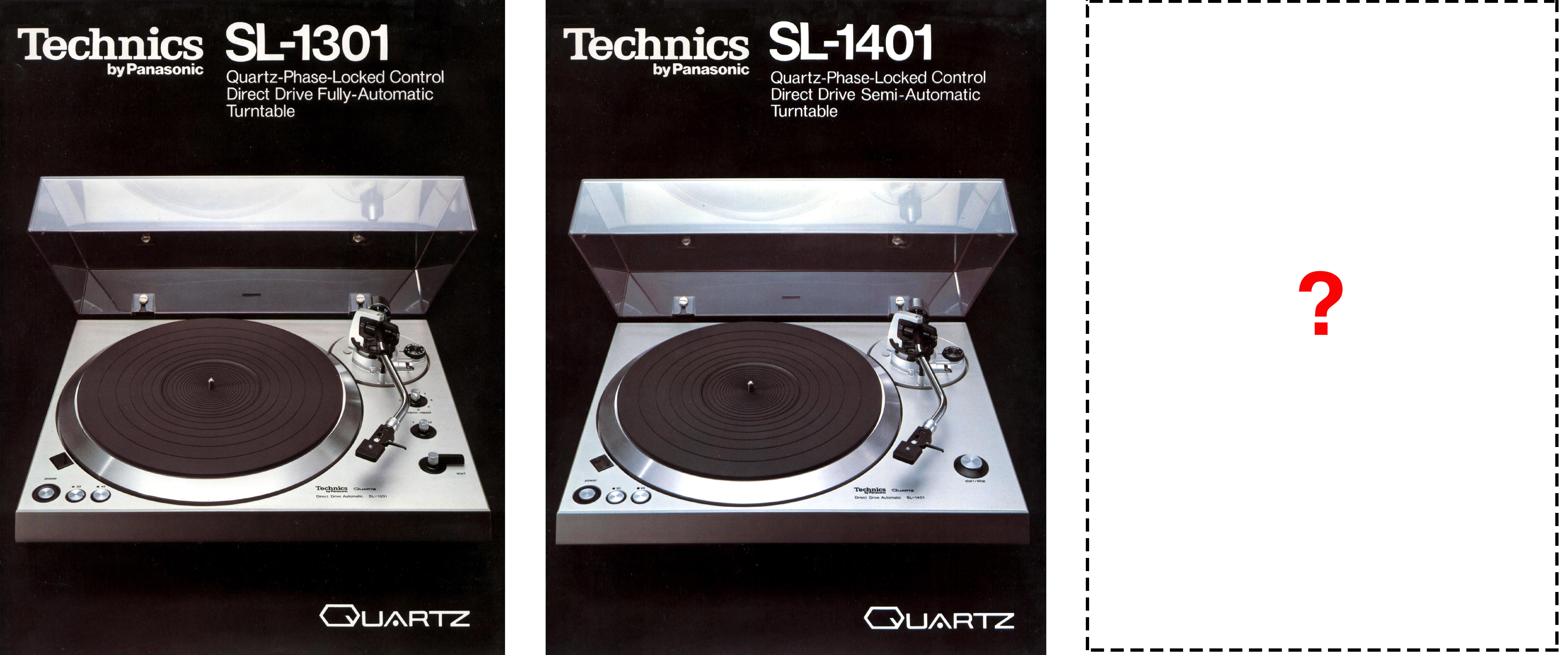
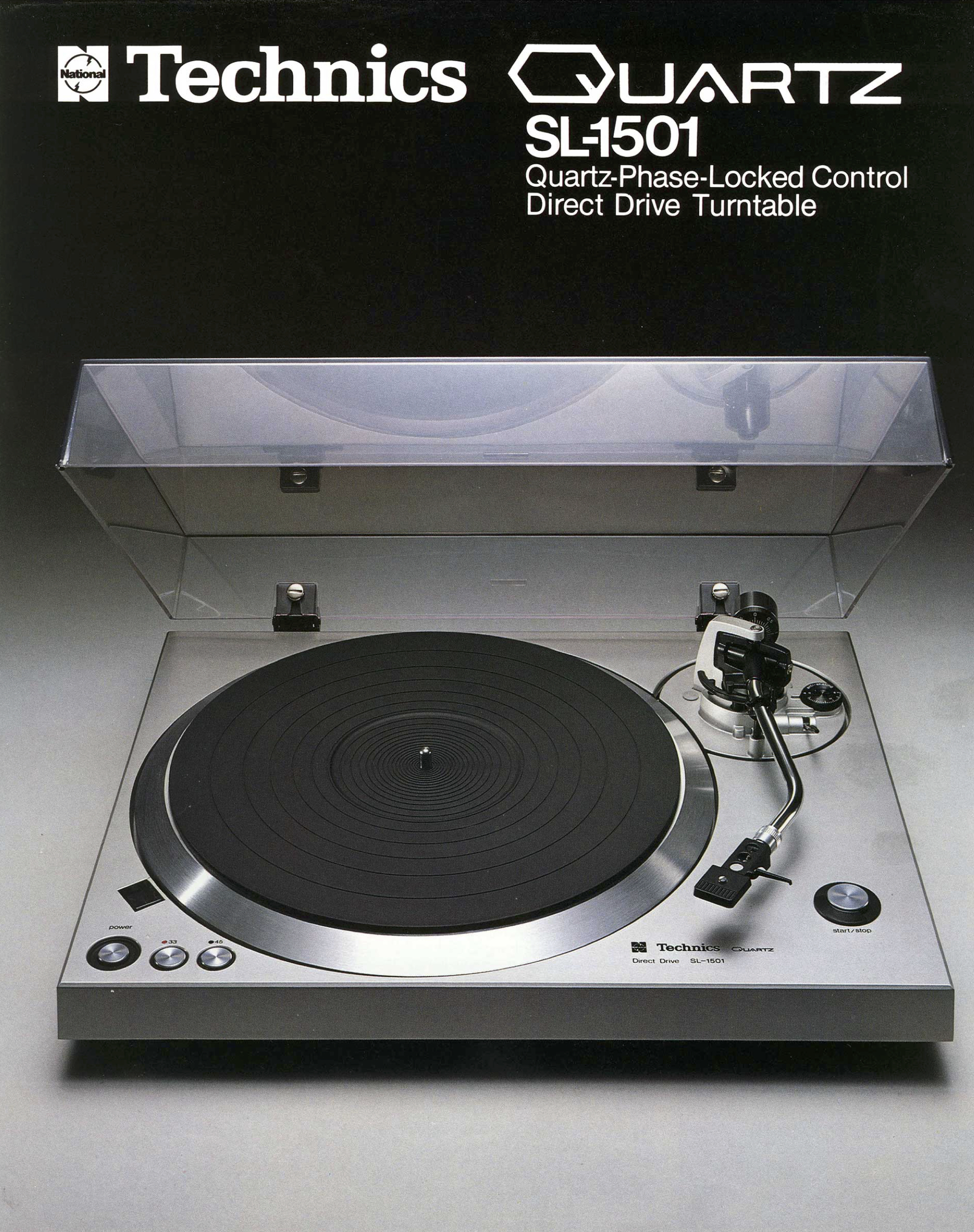
While I have a good grasp of most of the major players in the field (Pioneer, Sansui, etc.) during audio’s age of big iron, I pride myself most on my knowledge of the Technics brand and smugly thought I had uncovered and documented every piece of equipment they sold between 1974 and 1981 or so. Imagine my surprise then a few nights ago when I ran across this picture of a turntable whose existence I’d been totally unaware of—but whose seeming absence from the lineup I’d often pondered.

A bit of history… Starting in the mid 1970s, Technics pretty much without fail offered three varieties of any given turntable model they produced (there were specialized one-off models and whatnot, but they’re the exception rather than the rule): fully automatic, semi-automatic, and manual. With the fully automatic models you would start a record playing by moving a lever or pressing a button. The tonearm would move over to the edge of the record and slowly lower to start playing. At the end of the record, the arm would raise up, return to its rest, and the machine would either completely shut off or the turntable would stop rotating. With the semi-automatic models, you would have to manually lift the arm and place it at the beginning of the record to start, but at the end it would raise by itself and return to its rest. The fully manual models are self-explanatory: you did it all yourself (and are the type of decks preferred by DJs).

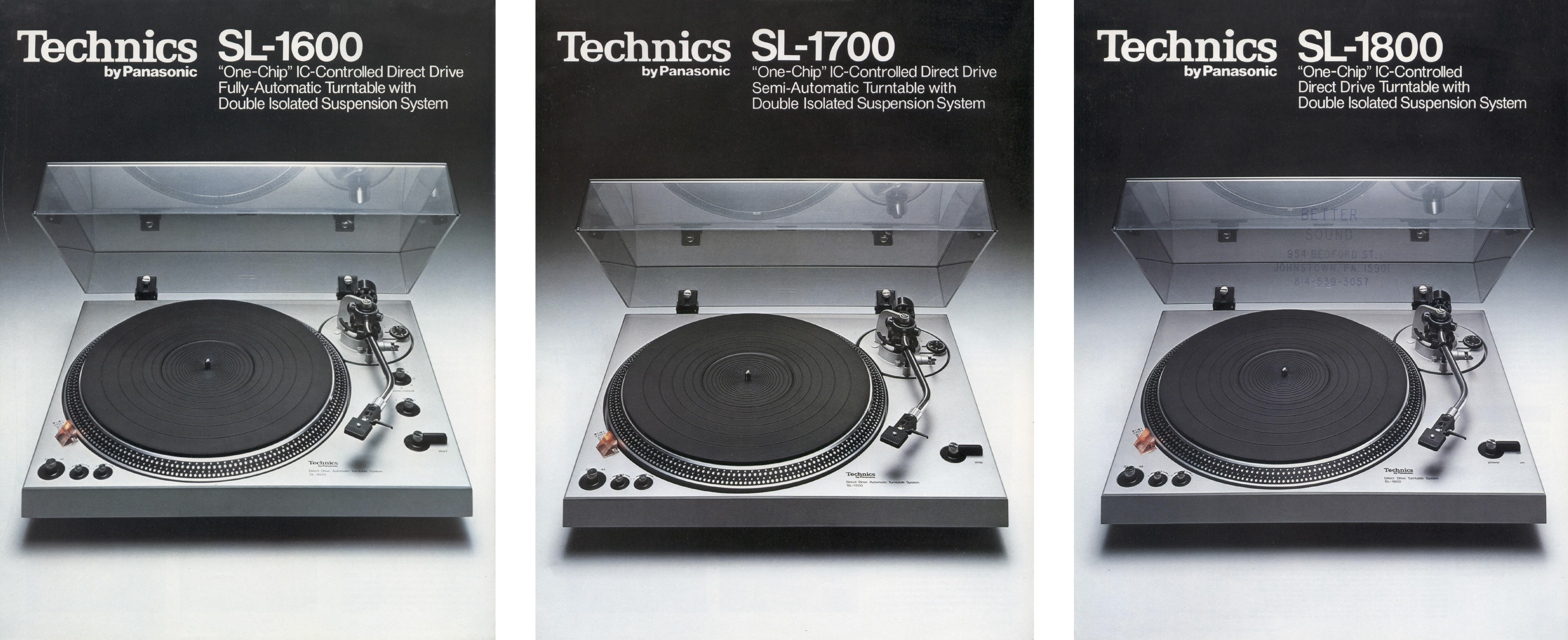
Technics’ triad numbering system for the various turntable lines was always linear: 1300, 1400, 1500 or 1600, 1700, 1800 (with the lower numbers of each series always being the fully automatic versions). They branched off on that a bit in later years, but it was consistent prior to that.


For all these years, the one glaring exception to this nomenclature was their “01” series.

The “01” series were strange critters to begin with, and I remember the first time I saw one in a store I had to do a double-take and say, WTF is that? Physically they were based on and closely resembled the 1600/1700/1800 series, obviously having used the same dies to cast the turntable bases, but their electronics and parts of the the tonearms (but not the tonearm mounts) came straight from the 1300Mk2/1400Mk2/1500Mk2. Likewise the turntable platters themselves resembled the Mk2 series with a brushed aluminum rim with the strobe dots on the underside, but the angle of the edge of the platters was identical to the 1600 series. And also like the Mk2 series, the 01s were also quartz-locked (using all but one of the same ICs)—something that the 1600 series was not. But the quartz difference between the 01 and the Mk2 series was that there was no pitch control, meaning that you were tied to an exact 33 or 45 rpm; and rendering them useless for DJ work. This explained in my mind why there was no manual version of these strange beasts, no 1501.

But as I discovered a few nights ago, there was a 1501 produced and sold—although apparently only in Japan. At first I didn’t believe it…was this a one-off machine? A custom logo screened on a repainted 1401?

No, it was an actual product. Further Googling presented me not only dozens of photos of these machines in the wild, but also the product brochure.

And now of course I want one. Only because of its rarity.

0 comments

Oh. My.

Technics is back in the turntable business!

From The Verge:

The legendary Technics SL-1200 turntable has been a mainstay of the DJ scene for decades now, but the tanklike direct-drive turntable has also long had a quiet reputation for sound quality as well. And for the 50th anniversary of the SL-1200, Technics is releasing two new “Grand Class” models aimed at audiophiles: the aluminum-cased SL-1200G and the magnesium limited anniversary edition SL-1200GAE, of which only 1,200 will be produced.

Apart from the case, the new models all have new “high-dampening tonearm” and a “three-layered turntable,” which are words that audiophiles who buy a limited edition magnesium record player are sure to be excited about. There’s also a new microprocessor controlled direct-drive system which eliminates something called “cogging,” a scourge so terrible that Technics devotes a full paragraph to it in the press release. Here is that paragraph. Behold its majesty:

Direct drive turntable systems have been beloved by HiFi enthusiasts since their birth in 1972. However, one problem that direct-drive systems have always faced was sound quality degradation caused by ‘cogging’, or tiny vibrations of the motor and rotational speed fluctuations. However, by combining the knowledge and expertise gained as the originator of direct-drive turntable systems with a newly developed coreless direct-drive motor without iron core, this ‘cogging’ can be eliminated. Any potential minute motor vibrations are suppressed even further by high-precision rotary positioning sensors guided by a microprocessor controlled system; a feature unique to the new Technics turntable.

Vinyl record sales have been booming lately, so it’s not at all surprising that Technics is capitalizing on the SL-1200’s mystique here—we’re actually expecting to see a few high-end turntables at CES 2016. No word on pricing, but expect these to be crazy expensive when the 1200GAE arrives in summer and the 1200G hits late in the year. (Also, 50 years’ worth of SL-1200s are also available on eBay and Craigslist in virtually every city in the world, if you’re that impatient.)

While there are certain aesthetic aspects of the design I don’t agree with, I still peed myself a little bit when I saw this today.

0 comments

“Daddy, What Was Life Like Before the Internet?”

That is a question I will never have to answer because Mike Huckabee’s chances of becoming the next President of the United States are far greater than me being a father—although not a Daddy (wink, wink)—at this stage in my life.

But it’s still a valid question. While science has proven that our perception of the passage of time changes as we get older, it still seems I had more free time than I knew what do with before the arrival of ubiquitous devices into my life. I remember pre-PC Revolution not having to make time to see a movie, or go to a mall, or go to the beach (the first casualty of life in San Francisco after a computer arrived in my apartment), or when I lived in Tucson, drive out to Reddington Pass, take a hike and expose my totally bare bits to nature.

You were expecting to see my exposed bits? Not a chance.

I used to paint, and while there were periods prior to devices that I went years without creating anything, the last time I picked up a brush was nearly eight years ago—and that’s rapidly closing in on a record. I’m not that concerned about that particular activity because my Muses have always been fickle bitches, but it seems I just can’t find time to do a lot of the other things I used to enjoy and always had time for—like wandering around downtown taking photos. That was something I did almost every weekend—if not more often—and now it seems to be a special occasion when I actually can get around to doing it.

And how did we live without Google and Wikipedia? It seems funny now, but once upon a time I was actually able to do my job with just the knowledge I had in my head. I also used to know what every single file in Windows (okay, it was version 3.1, but still) did. Now the whole tech field has become so…complicated…knowing everything about everything is simply no longer possible, and it seems a day doesn’t go by that I don’t have to refer to the Google for the solution some obscure problem (both Microsoft and Apple related).

Part of me really wants to just unplug, but on the other hand, so much of my life is wrapped up on these machines now it’s all but impossible unless I print out everything and keep hard copies. Do I know anyone’s phone numbers beyond Ben and my sister? Don’t be ridiculous. Do I know what I have scheduled for next week, or next month? Not a clue unless I bring it up. Some birthdays I remember, but I still need to double-check my phone when we’re out shopping to make sure I don’t neglect to buy cards. Do I know any of my bank account or credit card numbers? I used to possess that knowledge prior to being online, but now I can remember maybe the last four digits of one or two accounts. And now with all my ridiculously complicated passwords safely stored away in a secure vault program, do I even know more than a smattering of those? Ha ha! That’s funny!

I’ve always been interested in tech, so it’s no surprise I was a fish to water when this stuff first started arriving on the scene, but I wish I knew how to regain some of that free time that I used to enjoy without having to purposely carve it out.

1 comments

Beautiful


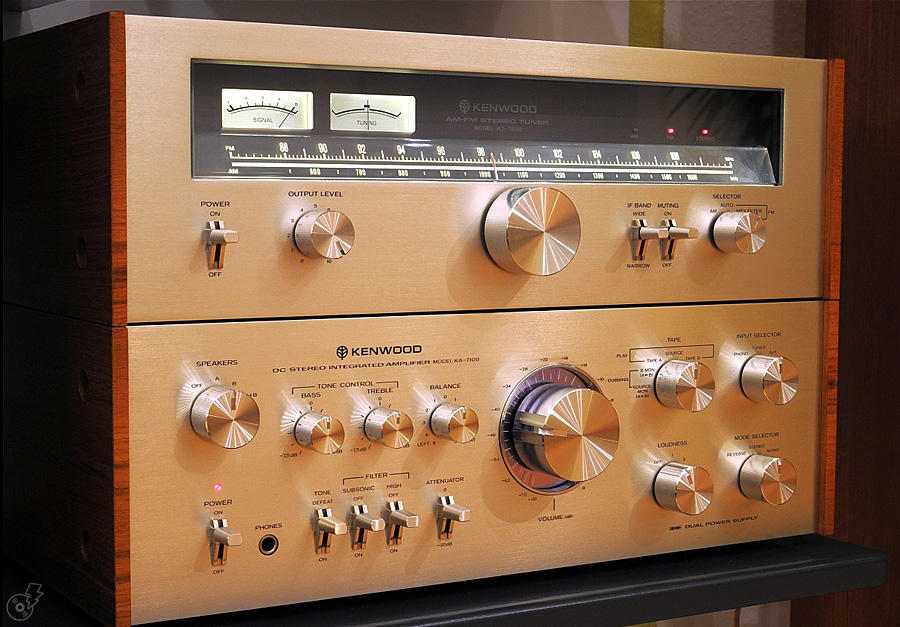
Entire generations will never know the joy of the “big iron” era of audio equipment. Pictured: Sony TAE-5450 preamp and TAN-8550 power amp. $1000 and $1300 respectively, in 1975 dollars.

Even now, finding people who have the requisite knowledge to keep this tech working are getting harder and harder to find.

0 comments

Why Can’t They Just Put it all on One Chip?

This was a question I initially posed to a friend of mine back in high school while we were discussing one of our favorite shared passions, audio equipment. Digital amplifiers were starting to appear on the scene, and I wondered aloud why all the circuitry couldn’t be shoved on a single slab of silicon and be done with it. My friend (who knew electronics on that level) said it was theoretically possible, but you wouldn’t be able to build an amplifier in the 80-100 watt per channel range we were currently enjoying because of the heat and power constraints. This was the age of “big iron” in audio, after all.

A few years later when I first started getting into personal computing I found myself asking the same question. Why can’t all this crap be put on a single chip, or at least on the main system board?

Why did I need separate plug-in cards to control hard drive? Why did I need a separate card to control the I/O functions? Why did I need a separate video card? WHY COULDN’T ALL THIS STUFF BE ON A SINGLE BOARD?

Well, for starters, at the time the technology just wasn’t there; we’re talking the 8088/286/386 era, after all.  The first few computers I owned (built from parts I’d gotten at computer fairs) had banks of discrete memory chips on the system boards and a 20 MEGAbyte drive was considered big! Good luck trying to troubleshoot a bad chip if you ended up with one. That’s why I was dancing in the streets when the first DIMMs started to appear. Imagine that: four (or however many) memory chips soldered to little circuit boards that just snapped into the system board!

As the years progressed, I was happy to see that I wasn’t the only one who had been wondering why all these discrete items couldn’t be made part of the system board, because slowly drive controllers and I/O found their way onto motherboards, and before long, even video was becoming a standard part of the build. You could still buy souped-up peripheral cards, but they were no longer a necessity to build a functioning system.

And now here we are in 2015:

Just look at what Apple’s done with the latest MacBook. We still aren’t to the point where everything is on a single chip, but we’re damn close. That tiny system board not only contains the CPU, memory, and controllers, but also the machine’s solid state “hard” drive.

Being the inveterate nerd that I am, I’ve always taken great pleasure in peeking at the guts inside my tech, and I have to admit, as we get closer and closer to the “everything on one chip” I used to dream about, a part of me is kind of disappointed there isn’t a whole lot left to look at when you pop the hood.

0 comments

For Posterity

With our society’s increasing reliance on digital storage, it occurred to me the other day that all the sounds and images we’re amassing and storing will—in all likelihood—be irrevocably lost to future generations because of the unstoppable pace of technological change that’s barreling down upon us. Not even the NSA itself will have access to the petabytes of data they’re amassing in fifty years unless it’s constantly refreshed and translated to the latest formats. And I seriously doubt anyone’s got time for that.

The ancients knew what they were doing. Stone tablets—barring their outright destruction—last for millennia. Paper can last for centuries if properly curated. Digital media…not so much. If “bit rot” alone doesn’t rob our descendants of our history, the mere fact that all the formats currently in use will no doubt be obsolete and unreadable in less than the span of a human lifetime.

This is already a becoming a problem. Have you ever tired to open a document created in the original version of WordPerfect? (Is WordPerfect even still a thing?) Yeah, a basic text editor can still pull out the important information, but the time required to remove the machine code and reformat that information into its original form is horrendous. I ran into this recently while trying to retrieve the Journals I’d written in the late 80s and early 90s.

Don’t even get me started on image formats or anything done in old desktop publishing programs. Anyone remember Ventura Publisher? Just try to open one of those documents. Good luck.

I guess what I’m trying to say is that in our rush to digitize the world and the ease it’s provided in recording the minutiae of our lives (anyone remember the limit of being able to record only 12, 24, or 36 images at a time on film?) we’re ultimately in danger of losing it altogether.

3 comments

Amen to That!

Rene mirrors all my feelings about Instagram. From iMore:

I’ve been using Instagram for a long time. I almost always post my photos to Instagram and then share from there to Facebook and Twitter. I use it enough that I’ve become somewhat inured to its common limitations — its rough edges and brick walls — most people run into every day. Hearing John Gruber discuss them with Ben Thompson on The Talk Show this week, however, made them all front-of-mind for me again. As such, here are five frustrations I currently have that I’d like to see Instagram tackle this year.

1. Higher resolution photos

Instagram launched at a time when the iPhone’s camera was three megapixels and the device’s top speeds were limited by 3G service. Now we have 8-megapixel iSight cameras and LTE radios. Yet Instagram’s native resolution on iOS remains 640-by-640. For viewing, that’s okay… in the same way listening to a low-bitrate MP3 music is “okay.” For appreciating, however, it’s disappointing.

On a modern iPhone, Instagram works with and even lets you save 2048-by-2048 images, but won’t display them on the service. Perhaps the company could upload the high-res image to the service if you have the connection to do so, then display scaling resolutions based on whatever device is viewing it, a la Dropbox’s Carousel (née Loom) or iCloud Photo Library. That way low-end, low-resolution devices are still “okay,” but high-end devices like the iPhone 6 Plus can view the high resolution — assuming they have the bandwidth to do so.

Storage and its associated costs would go up for Instagram, but they have Facebook money and infrastructure to lean on now. And for a service built on photos, a reasonable quality level should be table-stakes.

2. Instagram for iPad

Instagram debuted on the iPhone. Eventually it moved to Android and the web (ish). It added video and dabbled with messaging. What it didn’t move to, and what it didn’t add, was an iPad client. This thinking might have made sense when the iPad launched without a camera, but now that the iPad Air 2 has a very capable 8-megapixel iSight camera, it’s an obvious, gaping omission.

Given its 2048-by-1536 laminated Retina display with 264 pixels-per-inch, the iPad has the perfect screen for photos and videos. That means it has the perfect screen for enjoying high-resolution Instagram shots as well.

Mobile-first defines Instagram, to be sure, but iPads are mobile devices. Apple has sold hundreds of millions of them, so they’re also among the most popular mobile devices and the most popular mobile cameras. They are, in fact, the best cameras some of us have with us. It’s long past time iPads and iPad photography were treated as first-class citizens.

3. Non-destructive edits

Instagram has grown from a way to filter poor iPhone shots to a way to edit-to-perfection all the moments we want to share with the world. The app has a full range of tools, offering expanded filters, brightness, contrast, saturation, color, highlights and shadows, blur and sharpness, and more.

During the editing process you can move through all of them, tweaking and adjusting with impunity — non-destructively – until it’s exactly the way you want it. Once you post it, however, those edits are burned in forever.

Imagine instead, like the iOS 8 Photos app, all those edits were saved as a delta file and stored alongside the original image. What you see in the Instagram feed would be the same, but you could go back in and tweak an image again any time you wanted, alongside its caption or tags.

Again, it would require slightly more storage on the backend, but it would also allow for more time spent using Instagram — a plus in any company’s book.

4. Native regrams

If I like a tweet, I can retweet it. If I enjoy a Facebook post, I can share it. On Instagram… nothing. If I really want to re-broadcast something, I need to screenshot it, crop it, and post it either as my own photo with some caption attribution or use one of those ugly third party apps that stick a citation label on it.

At best, it’s awkward and unwieldy. At worst, it leads to shitpic degradation through repeated application of compression.

Right now, to discover great new Instgram accounts to follow, I have to leave my timeline and go squint through the middling Activity list Instagram provides. Native regrams would solve that problem, as well. And for anyone who thinks of regrams as clutter, an opt-out could easily be provided in the app’s settings screen.

5. Active Links

“See link in my profile” is a thing on Instagram because that’s the only place the app currently supports active links. If you type a link into a caption, it renders as plaintext. Tap on it, and it does nothing but laugh at you, silently.

By all means, keep links — and the spammers who would abuse them — out of the replies. But enable them in the original caption we add when uploading a photo. That way, I can not only share moments, I can share a way for other people to get more information and potentially share that moment as well.

Your most-wanted Instagram features?

Some people want a native Mac app as well, or channels so they can follow trends or events. Others want an easy way to re-download their own photos or multiple account support so they can post personally and for the job or hobby. Still others want better state-preservation so they don’t lose their place when they exit the app, or support for line breaks in comments.

But what do you want? If you were running product development for Instagram this year, what would be on your upcoming feature list?

1 comments

It’s Magic

Since one particular day back in 1979 when my friend Steve casually mentioned, “I was listening to so-and-so’s new album while I was in the shower today, and…” I have been incredibly jealous of the fact that he had his entire house wired for sound.

This was not common in 1979, but since he worked as a DJ at one of the popular gay clubs in Phoenix at the time, it also wasn’t particularly surprising.

It wasn’t until many, many years later while living in what was to be my last San Francisco apartment, that I was finally able to realize my dream of being able to have decent sound in the bathroom while I was showering.  I ran wires from my rig in the bedroom down the hall and into the bathroom, where they connected to some small Infinity satellite speakers I’d picked up. When all was said and done, I was admittedly kind of disappointed; it sounded great, but a lot of the anticipated thrill of doing this had disappeared during the intervening years and it got to the point that my downstairs neighbors were dropping so many snide comments about hearing 20 year old disco first thing in the morning I eventually took it all down.

When I moved back to Phoenix I wasn’t able to run the wires in a way that could be as easily hidden as they’d been in San Francisco, and an extended period of being out of work forced me to sell the gear I’d been using so I gave up on having hi-fi in the bathroom.

Fast forward to 2012 or thereabouts and the arrival of Bluetooth technology into my life.

Now I have a speaker smaller than a power strip that pumps out great sound from my iPhone at a moment’s notice. No running wires or having to mount anything on the wall. Tunes in the shower anytime I want.

It’s magic.

0 comments