
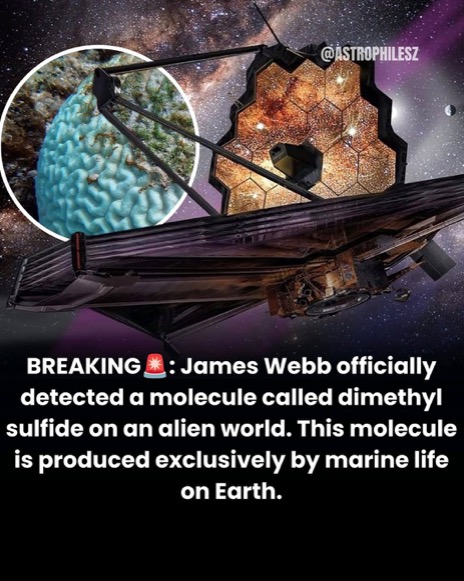
This could be one of the most intriguing clues in the search for life beyond Earth, but the evidence is not yet strong enough to call it a discovery of alien biology.
The planet is K2-18 b, located roughly 120 light-years away. Webb observations have revealed methane and carbon dioxide in its atmosphere, while researchers have also reported possible spectral signatures consistent with dimethyl sulfide, or DMS.
DMS is fascinating because on Earth, the overwhelming majority of it is associated with biological activity, particularly marine microorganisms such as phytoplankton. That makes it an interesting potential “biosignature”: a molecule whose presence might hint at life.
But there is an important distinction. Webb has not officially confirmed DMS beyond doubt, and DMS is not proven to be something that can only be produced by life under every possible planetary environment. The signal remains disputed, and scientists are investigating whether unfamiliar non-biological chemistry could create similar signatures.
K2-18 b itself is not unlike Earth. It is about 8.6 times Earth’s mass and orbits within its star’s habitable zone. But scientists have proposed that it could potentially be a “Hycean” world with a hydrogen-rich atmosphere and an ocean beneath, although that interpretation is also still being debated.
So we haven’t found alien life. But we may be reaching the point where telescopes can examine the atmospheres of worlds hundreds of trillions of kilometers away and search for chemistry that, here on Earth, is intimately connected with living organisms.
That alone is extraordinary.
[Source]
0 comments