
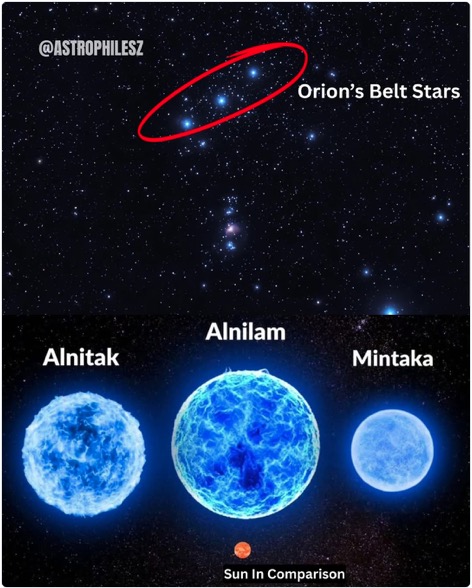
Those three bright points forming Orion’s Belt are Alnitak, Alnilam and Mintaka. They look like three neighboring stars from Earth, but they are enormous, hot stellar systems separated from us by hundreds to thousands of light-years.
All three are far hotter and more massive than the Sun. NASA describes the prominent Belt stars as blue supergiants, with older NASA educational estimates putting Alnitak and Mintaka at roughly 20 solar masses and Alnilam around 40 solar masses.
Their apparent alignment is mostly a matter of perspective. NASA places Alnitak at roughly 800 light-years away, Mintaka around 900 light-years away and Alnilam about 1,300 light-years away in one commonly cited set of estimates. They aren’t actually sitting side-by-side in space.
They’re also more complicated than three simple stars. Mintaka is a multiple-star system containing five stars, while Alnitak is itself a multiple system. What your eyes perceive as single points can therefore represent entire stellar systems.
These massive stars burn through their nuclear fuel much faster than the Sun. Stars this massive live comparatively short lives and are expected eventually to end through core-collapse supernovae, leaving behind neutron stars or black holes depending on their final masses.
The surrounding region is equally spectacular. Near Alnitak lie the famous Horsehead and Flame Nebulae, while below the Belt sits the Orion Nebula, one of the nearest major star-forming regions to Earth.
So when you find those three simple dots in the night sky, you’re looking toward some of the most massive stars visible to the naked eye—and into an enormous stellar nursery where new stars are still being born.
[source]
0 comments