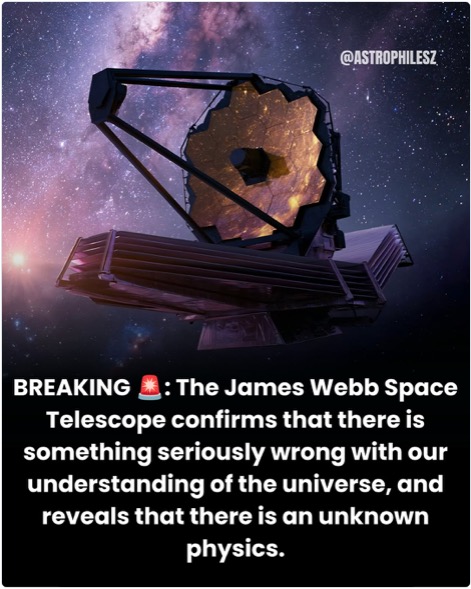
@astrophilesz: Astronomers used the James Webb and Hubble space telescopes together to confirm one of the most troubling conundrums in physics, that the universe appears to be expanding at different speeds depending on where you look. This is called the Hubble Tension. A study published in the Astrophysical Journal Letters used a triple check combining both telescopes to rule out the possibility of measurement error for good.
Lead author Adam Riess, who won the Nobel Prize in Physics for the 1998 discovery of dark energy, said that with measurement errors negated, what remains is the real possibility that we have misunderstood the universe.
Here is the contradiction in plain terms. Measurements from the local universe, taken using Cepheid variable stars, give one expansion rate. Measurements based on the cosmic microwave background, the afterglow of the Big Bang mapped by the Planck satellite, give a different rate entirely. The discrepancy holds steady no matter how the data is checked.
Researchers expanded the dataset to include 1,000 more Cepheid stars across five galaxies as far as 130 million light years away, and the disagreement remained exactly where it was.
A Nobel laureate physicist did not mince words about what this means. David Gross, a Nobel Prize winning physicist, said at a conference that this should not be called a tension or a problem. It should be called a crisis.
What makes this significant is what it is not. It is not a calibration error. It is not an instrument flaw. Two independent, repeatedly verified measurement methods are producing two different answers to the same fundamental question about how fast the universe is expanding. Cosmologists are now asking whether resolving this requires new physics altogether, something currently missing from the standard model of the universe.
The universe is not behaving the way our best equations say it should. Nobody currently knows why.
0 comments