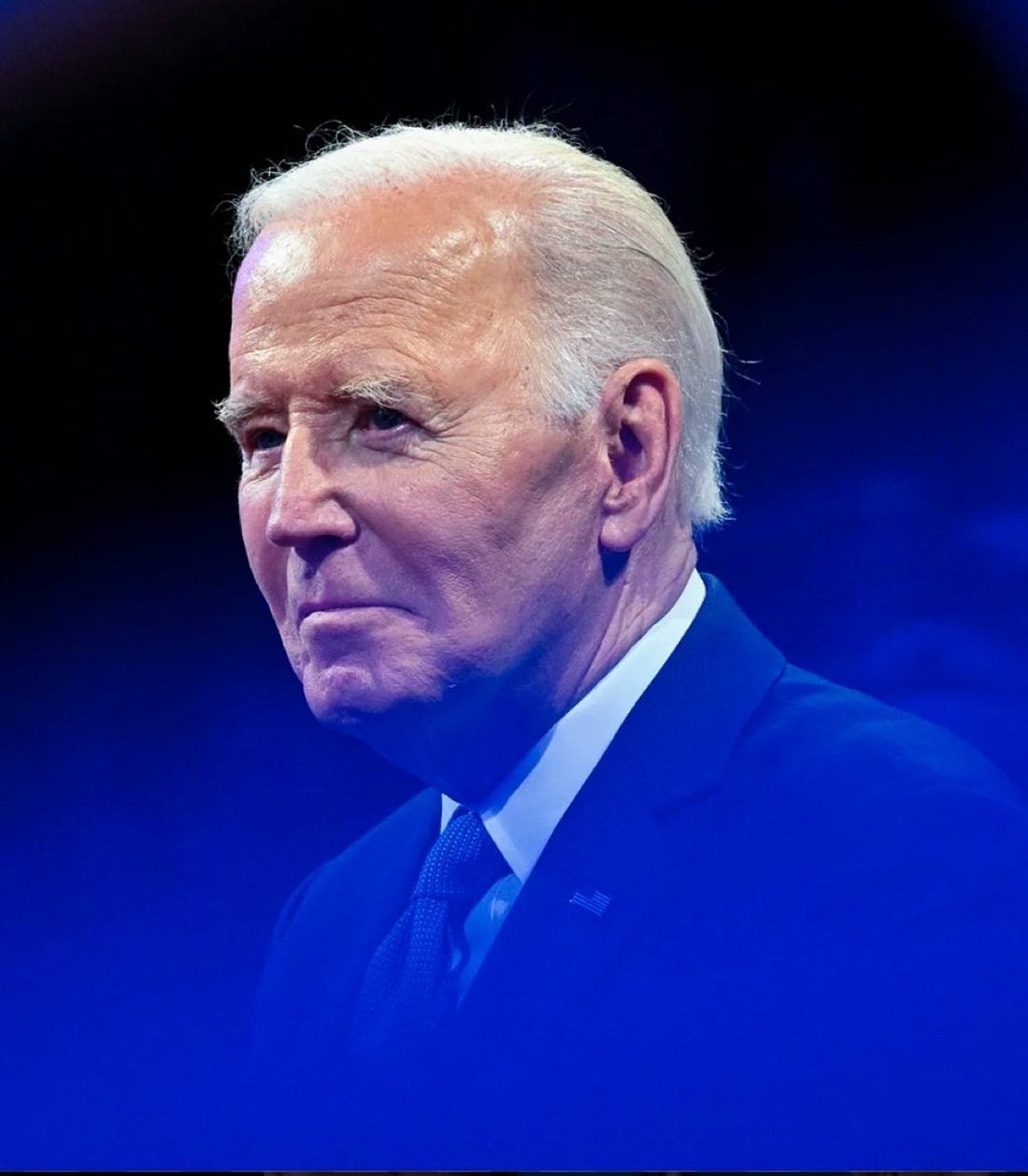
Anyone who knows me knows that I love Joe Biden to a fault.
I love him beyond politics, beyond policy, beyond whatever reasonable emotional distance we’re supposed to maintain from people we don’t actually know, because over the years Joe found his way into something much softer and more personal, perilously close to the place my father left behind when I lost him in 2011, an absence no one has ever filled and no one ever could, but one Joe has managed, without ever really knowing me, to make feel a little less empty.
And I haven’t wanted to think too hard about any of this.
I’ve seen the headlines. I’ve read the updates. I’ve known about the cancer, known that it’s stage IV. I’ve read the words metastatic and treatment and progression and let them pass through my eyes without allowing them all the way into my heart, because I’ve wanted to keep Joe exactly where I know him best: sharp as a tack, funny and warm and wonderfully loquacious, leaning in to hear somebody’s story, smiling behind those aviators, asking questions and remembering details and making the person standing in front of him feel, impossibly, like the rest of the room had been asked to wait outside.
I’ve wanted him preserved there, not in amber exactly, because Joe has never felt remotely still to me, but in that particular living light in which I was lucky enough to know him.
Then Hunter said his father’s cancer has metastasized into his bones and further, that he’s in a lot of pain, and the distance I’d been keeping from all of it disappeared.
God, those words.
I can barely bear them.
I don’t want to imagine the faint creak of a mattress as he shifts because one side aches more than the other, Jill beside him knowing from the movement what he will never need to say aloud, the small domestic choreography illness imposes on people who have loved each other long enough to recognize suffering by the way somebody reaches for the nightstand.
I don’t want something as ordinary as standing up or crossing a room or settling into a chair to exact a toll from him, and there is something uniquely excruciating about hearing all of this from his son, because underneath the medical language and presidential history and public concern is something painfully simple: a son is watching his dad suffer, and there isn’t enough love in the world to make the trade every child would make without hesitation.
Give it to me instead.
Whatever is hurting him, give it to me.
Let me carry it for a while.
And there is anger in that helplessness too, hot and irrational and completely uninterested in being reasoned with, because I understand perfectly well that cancer doesn’t conduct character interviews before choosing a body, that decency doesn’t confer immunity and goodness has never been some celestial insurance policy against suffering, but there is still a furious part of me looking at this kind, empathetic, deeply decent man who has already buried a wife, a baby daughter and a beloved son and asking the universe what the hell else it thinks it is entitled to take from him.
He watched Hunter struggle too, and, being Joe, spent years wishing he could take every ounce of it from his son and shoulder it himself.
He had every reason to let all that accumulated sorrow ossify around his heart until nothing else could get in, and somehow he did the opposite, somehow stayed soft and open and porous to other people’s pain, somehow took the most devastating chapters of his own life and used them to learn the language of somebody else’s grief.
Hasn’t he carried enough?
And even now, when the broken places belong to him, this is what Joe says:
“Cancer touches us all. Like so many of you, Jill and I have learned that we are strongest in the broken places. Thank you for lifting us up with love and support.”
God, that man.
We are strongest in the broken places.
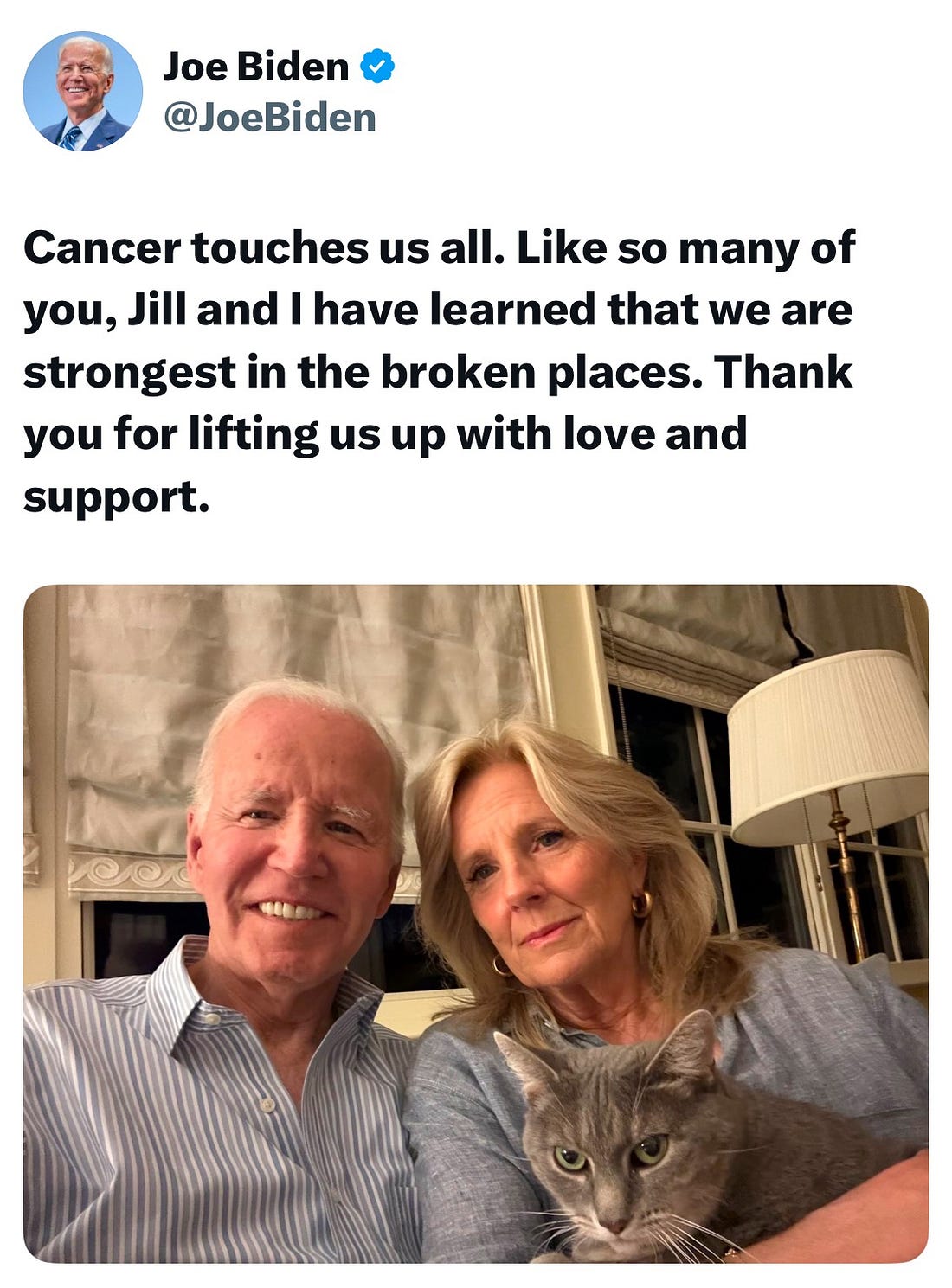
Of course that’s what Joe Biden would say, because he has proved it over and over again, turning the places where life wounded him most deeply into the very places from which he could reach another grieving person and say, without platitude or pretense, I know. I’ve been here too.
And now he’s thanking us for lifting him.
I saw a video of Joe outside an Italian restaurant recently, and God love him, he was moving slowly, slower than I’d ever seen him move, and with Hunter’s words now lodged somewhere I couldn’t dislodge them, I found myself watching him with that terrible hyperawareness that takes over when someone you love isn’t well, studying each step as though vigilance itself might protect him.
Does that hurt?
Is he tired?
How far is the car?
I wanted the sidewalk to become shorter, wanted someone else to hold the door, wanted the people around him to give him enough space to simply get where he was going without having to be anything to anybody for five damn minutes.
But someone called to him, and Joe turned, because of course he did.
There were folks waiting, and he reached for their hands and listened to their stories and looked into their faces, and when Joe Biden looks at somebody, he has this extraordinary way of making the rest of the world wait its turn.
That’s when I lost it, crying for the better part of an hour because even now, even when every step may be exacting a price none of us can see, somebody called his name and his instinct was still to turn toward them.
That is the thing about Joe Biden that has moved me for decades and still moves me now: he shows up, to Mass week after week, for his family, for the country he has spent nearly his entire adult life serving, for strangers standing on sidewalks and grieving parents and frightened children, with the same instinctive decency whether there is a camera pointed at him or not.
There really isn’t a public Joe Biden and a private Joe Biden. There is just Joe, the same warm, curious, talkative, deeply empathetic man whether he is standing in front of a bank of cameras, leaning over a rope line, sitting across a table, or pulling a crying loudmouthed woman from Jersey into a hug because he can see that she needs one.
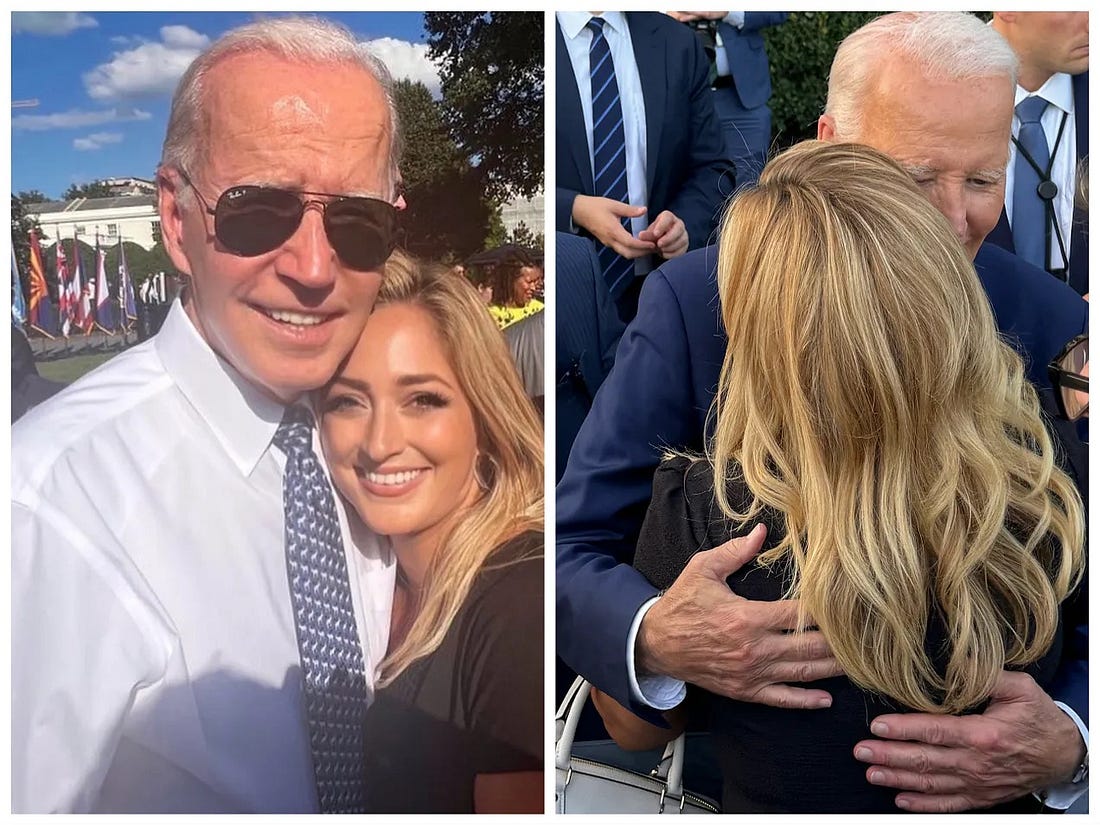
I know because the first two times I was lucky enough to meet him, I wound up crying in his arms, and each time he did exactly what Joe does when another human being is hurting: he pulled me close, made everything feel steadier for a moment, and left me feeling better than he found me.
My father taught me what it meant to feel safe because a good man simply existed somewhere in the world, what sacrifice looked like when it wasn’t a speech or a sentiment but a life, what service looked like when nobody was applauding, what love looked like when it showed up in grocery stores and doctors’ offices and school plays and all the million trillion ordinary places where a parent quietly constructs a childhood around the people depending on him.
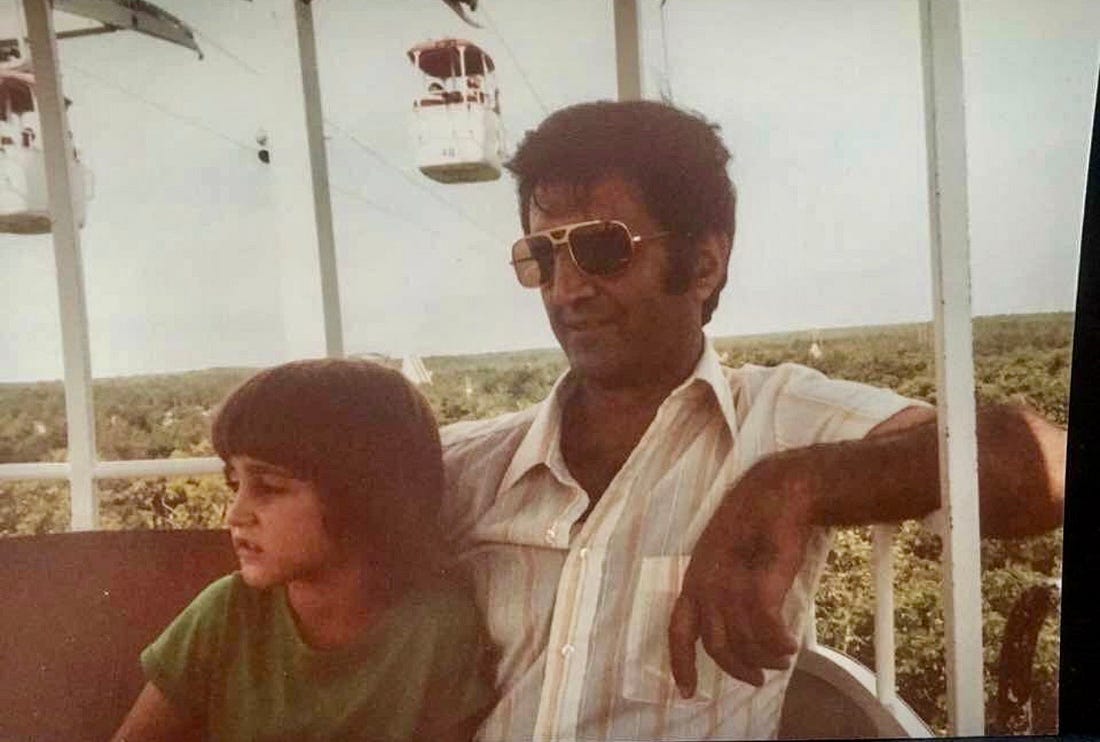
There are still moments, fifteen years later, when some little part of me forgets for half a heartbeat that I cannot go find my dad. I cannot get in the car and drive to him. I cannot call him. I cannot walk through a door and see his shoes on the floor or hear his voice from another room or ask him one stupid little question just to hear him answer. There is no place on this earth where he is still physically waiting for me.
And God, that still hurts in a way I do not know how to make smaller.
Joe never replaced my father. Nobody could, and nobody ever will. But grief is strange about resemblance, and sometimes another good man touches the exact place where the first good man left an absence, and for one fleeting second the ache changes temperature.
When I was lucky enough to have been invited into the Oval Office, which is a sentence I still have to pinch myself saying aloud, I got to tell Joe about my dad.
I was standing there in that room I had watched on television with my father when I was a little girl, close enough to see the photographs on the tables and the light coming through those windows, close enough to hear Joe without a microphone between us, and I told him about the teenage boy who came here from Lebanon believing in America, who spent fifty years serving it, who raised five children after our mother left, who taught me that when life knocks you flat you figure out what comes next and then you do it.
I told Joe that my father believed in the promise of this country, and through tears I told him that he embodied that promise too, and when my voice finally gave out and the tears took over, Joe pulled me into his arms for the third time.
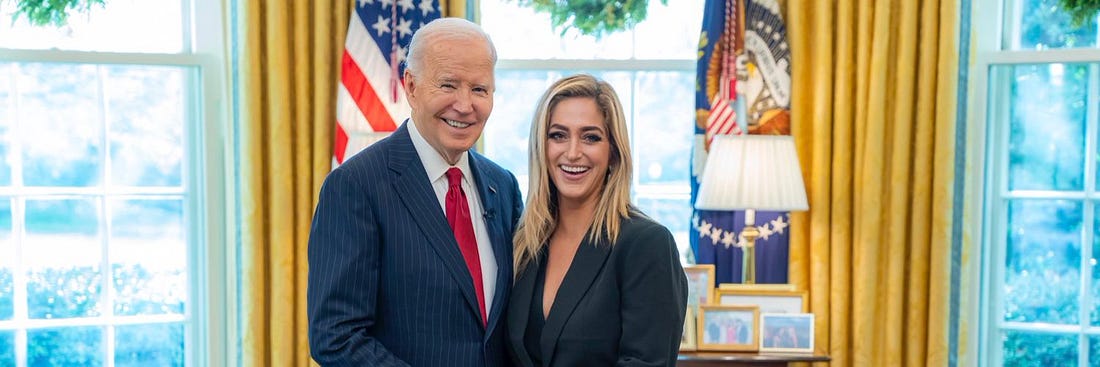
There was something almost unbearably beautiful about that moment, because I had spent years carrying these two good men in adjacent chambers of my heart, one the father who made me and one the president who kept brushing against the place my father’s absence had left behind, and there I was in the Oval Office, crying into Joe Biden’s shoulder while telling him about Dad, feeling for a few impossible seconds as though I had finally introduced them.
And now Joe’s son is telling me his dad is suffering.
There are certain doors grief leaves unlocked forever, and Hunter’s words walked straight through one of mine.
I’ve admired Joe for decades, and if there is one person in public life I’d want my kids to study as they grow, it’s him, because I can think of few better lessons to hand them than the life of a man who never confused strength with cruelty, never mistook decency for weakness, and understood public service as exactly that: service.
And this weekend, I saw that contrast rendered almost obscenely clear in two photographs posted side by side: Joe Biden on one side, living with stage IV cancer and looking like a million bucks, carrying himself with that same quiet dignity and fundamental human grace he has always possessed; and on the other, that stupid, evil piece of shit who occupies the Oval Office now, looking like absolute fucking garbage.
One of those men is enduring a brutal disease and still radiates a decency Donald Trump couldn’t manufacture if you gave him another eighty years and every finishing school in Europe.
The other is Donald fucking Trump, a malignant, morally putrefied abomination of a human being who has spent years mocking Joe, demeaning him, sneering at his age and treating another person’s vulnerability as carrion for his own ravenous cruelty.
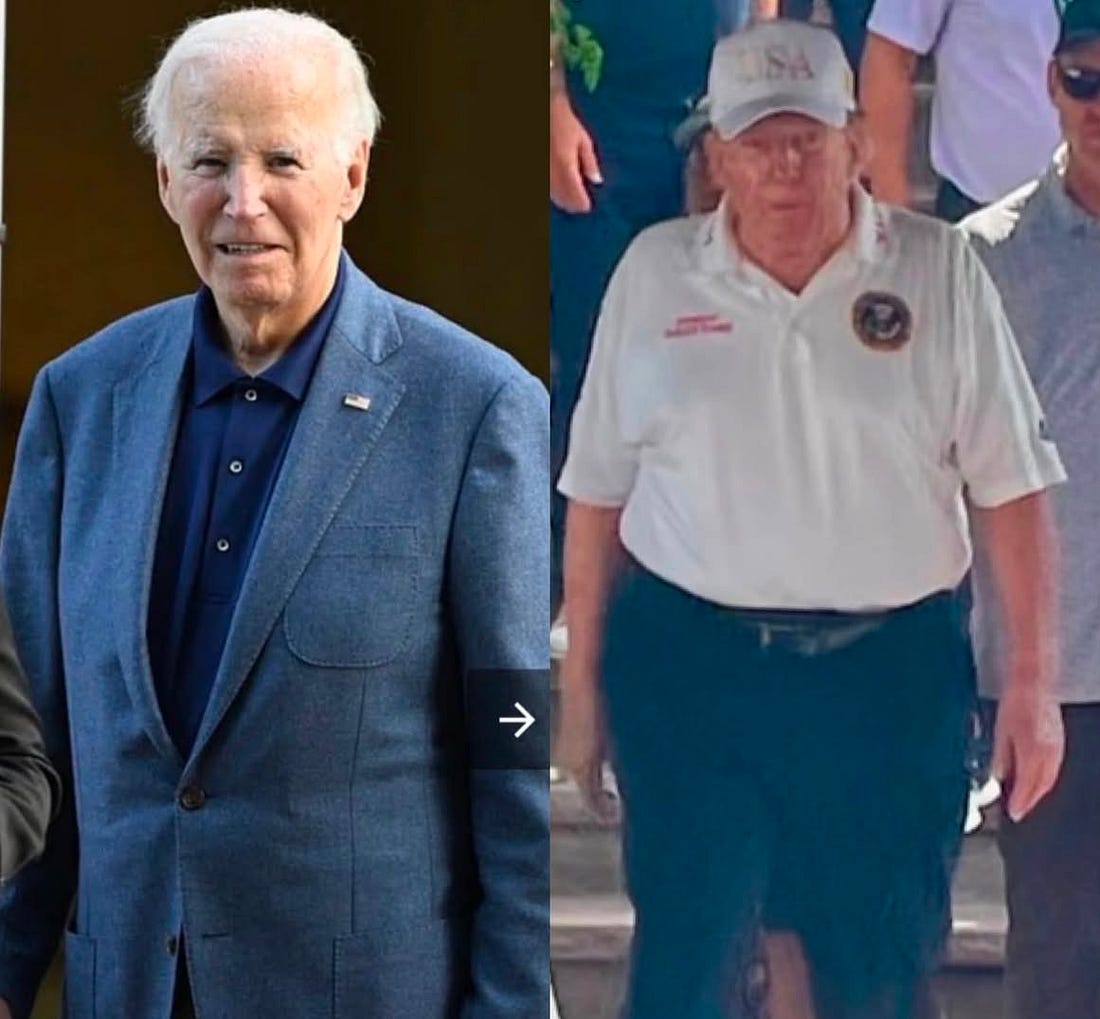
Looking at those photographs fills me with a rage so visceral I can feel it in my teeth, because Trump cannot fucking hold a candle to Joe Biden, not as a president, not as a public servant, and certainly not as a man; Joe, sick and carrying suffering none of us can see, possesses more dignity in one slow step across a sidewalk than that vulgar, venal, empathy-bereft piece of human garbage has managed to summon in his entire miserable life.
And I hate fucking living with the knowledge that someone as abhorrent as Donald Trump even exists, let alone that he gets to occupy the office Joe Biden honored with such reverence, because there is something almost intolerably perverse about watching cruelty rewarded with power while a man whose instinct has always been to comfort, to serve, to reach toward people is being asked to carry this too, and I cannot change any of it, cannot make the world fairer by wanting it hard enough, cannot reach inside Joe’s body and wrest the cancer out with my bare hands.
So all I can send toward him is every bit of love I have.
I hope treatment gives him back pieces of himself in increments, a day that begins with less pain, a steadier step, an appetite, a deep and dreamless night of sleep, until one day he realizes there are more things in his day that feel like living than like being sick.
I hope there are moments when the room around him is so full of familiar voices and laughter that illness is forced, however briefly, to become the least important thing in it, long dinners and grandchildren making too much noise, ice cream and football and stories everybody has already heard, quiet hours so beautifully uneventful that nobody thinks to remember them until years later when they realize those were the moments that mattered most.
And I hope among that immense, incalculable community of people pulling for him there is room for one loudmouthed girl from Jersey who once stood in the Oval Office crying while she introduced him to her dad.
Because Joe, my father taught me that when something is hard, you figure out what comes next and then you keep going, and that is what I’m going to believe for you now: the next easier morning, the next night your body lets you rest, the next laugh that comes before you have time to remember you’re sick, the next hand reaching for yours when the dark feels especially long, the next ordinary hour that asks nothing of you except to be alive inside it, and all of us out here loving you through every one.
He has no idea what those three embraces gave me, how each one reached into that father-shaped absence I carry everywhere and made it feel, for a few precious seconds, less empty, less cold, less final.
There are moments from those meetings I return to the way some people return to prayer: the warmth of his arm around me, the sound of his voice, the way he leaned in when I spoke, the simple, overwhelming relief of being held by a good man when I missed another good man more than I knew how to say.
And that is what I want for Joe now. I want the love he has spent a lifetime giving away to make its way to him wherever he is, in whatever room he is sitting in, in whatever hour is hardest, and leave that hour a little lighter.
May medicine find its mark, may his body remember ease, may sleep come without negotiation, may there be mornings when nothing inside him demands attention before he has even opened his eyes, and may this good, tender, deeply beloved man who has always reached people in their darkest hours, sat beside them, taken their hands and reminded them there was still light somewhere ahead, feel all of us beside him now.
All those folks, all those hands, all that love, finally finding its way home.
And with that, I’ll leave you with this:
1 comments
Mark: Thank you for sharing JoJo’s essay with us. Joe Biden behaves the way a President should behave. Or rather, he behaves as all of us should behave. He’s right! We should all be strongest in the broken places. This post is quite poignant, considering how you are struggling with cancer. Know that this reader sends love to you with gratitude for the fact that you continue to share your thoughts through this blog.