They’re slaughtering wild horses.
Of fucking course they are.
Because this endlessly evil regime cannot leave beauty alone. It cannot encounter anything wild, vulnerable, ancient, communal, unowned or gloriously beyond its control without reaching for a blade, a bulldozer, a budget cut, a branding iron, a buyer.
Wild horses, these sovereign, almost mythical beings of the American West, born under enormous skies and built for distance and instinct and survival, moving through wind-scoured ridges, shadowed cuts in the land, high meadows silvered with frost and strange red-rock country glowing rust and copper beneath the sun.
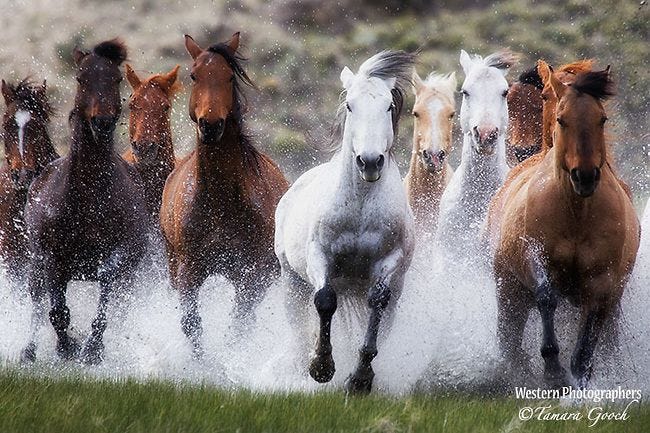
Mothers keep their young close, stallions pivot toward danger, whole herds gather and break into motion at once, hooves pounding hard earth, manes whipping, nostrils flaring, dust blooming gold behind them, breath clouding in the cold, the sound of them rolling across the open ground like thunder you can feel in your ribs, all that sinew and speed and wild intelligence moving together until for a few seconds the land doesn’t look occupied by them so much as alive because of them.
They are magnificent.
And this fascist wrecking crew looked at all that living splendor and found a way to turn it into inventory.
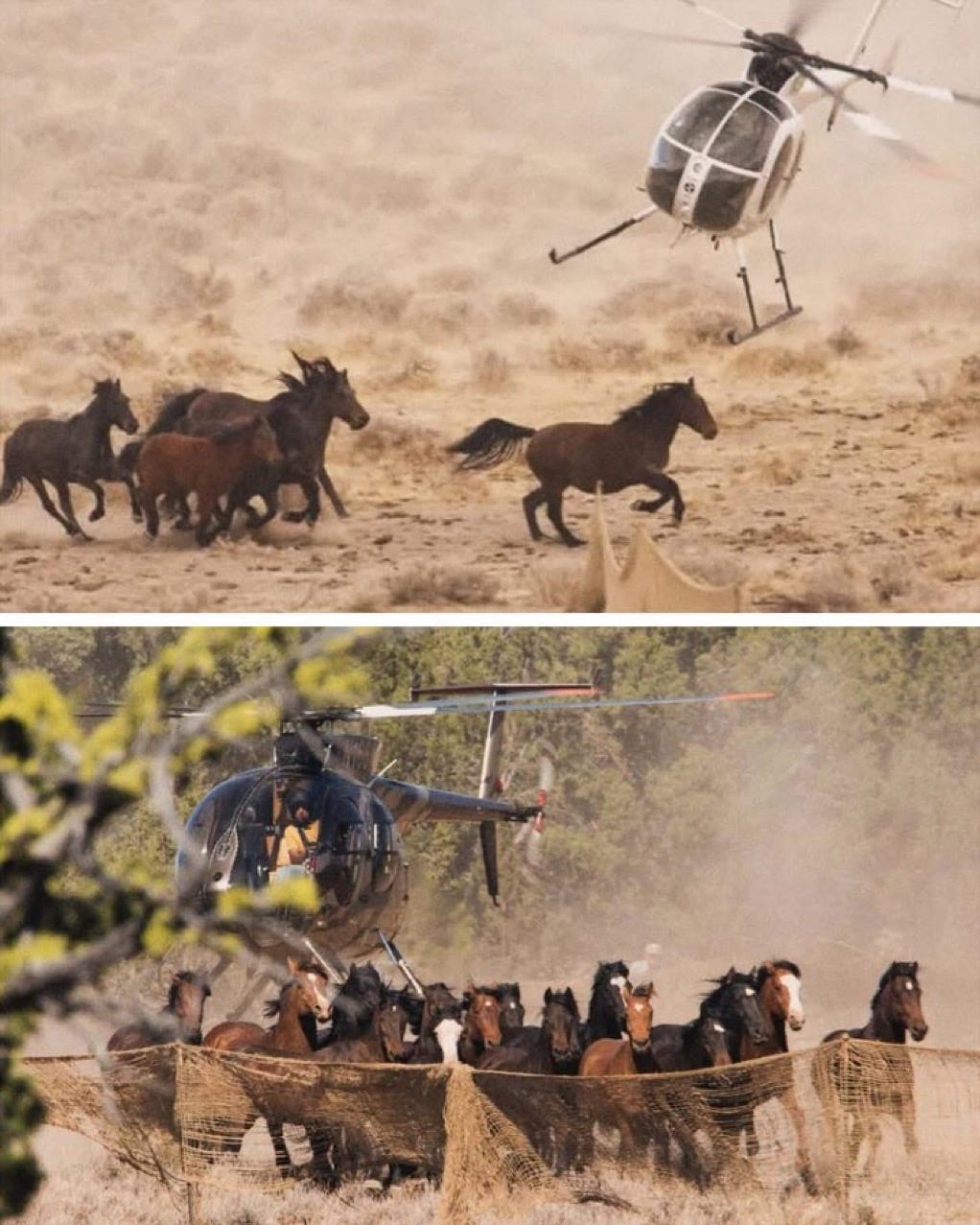
Sixty-eight of those wild mustangs, just one group among thousands sold off by the government, were chased down by helicopters, torn from the desert country their bodies understood, confined for years in an Idaho feedlot while the government claimed to be searching for “loving homes,” and then, this March, sold to an Ohio livestock trader for twenty-five dollars apiece.
Twenty-five dollars for a living being that survived drought, hunger, injury, scorching summers, frozen ground and every pitiless test nature could throw at it, only to encounter the one predator capable of inventing a purchase order.
Us.
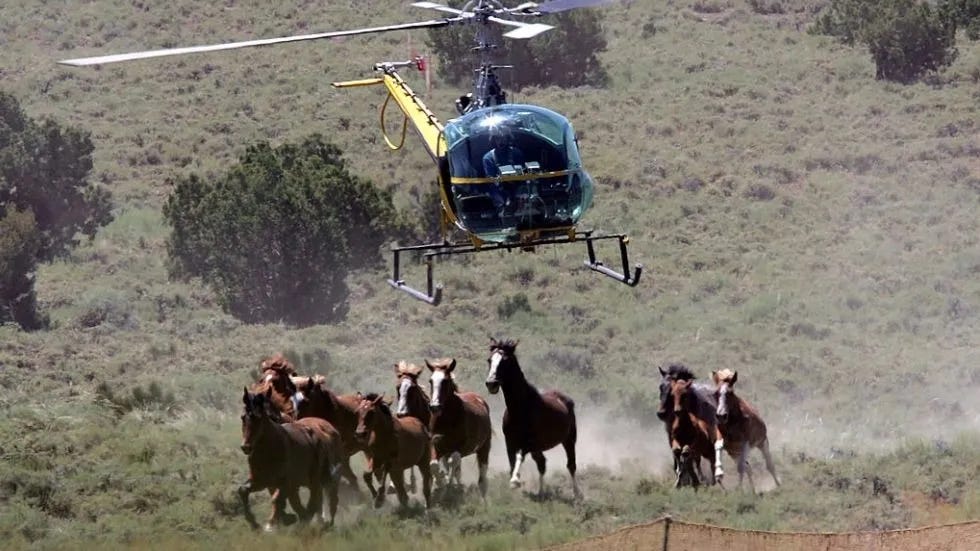
They were packed into cavernous haulers and carried 1,800 miles east, away from the vast ground they knew, until two double-decker cattle trucks arrived around midnight, ramps clanging open beneath hard artificial light, frightened bodies crowding together while hoofbeats boomed through steel and darkness closed around them.
The buyer won’t say where they went. They never surfaced at public auction. Other federally sold mustangs have turned up bound for Canadian killing floors, where horses can be exported alive, butchered and sold as meat abroad.
The cruelty almost disappears inside the vocabulary. That’s the whole grotesque fucking trick. Years of captivity become “care.” A midnight disappearance becomes “placement.” A terrified horse becomes a transaction, and somewhere far enough down the chain for everybody responsible to avert their eyes, death waits with a price attached.
So spare me the antiseptic official bullshit about “placement,” “disposition” and “transfer,” those anesthetized little words buffed smooth until nobody can hear the panic or picture a horse bracing against the walls around it.
Wild horses are being funneled into a death pipeline.
And it is so perfectly, hideously Trump.
There is a predatory pathology underneath all of this that feels sickeningly familiar. Grab the woman. Grab the land. Grab the horse. Take what you want because you want it, because you can, because consent and stewardship and restraint are merely inconveniences standing between appetite and acquisition. The same man who bragged about grabbing women presides over a government that treats the country itself like something to be seized by the fistful.
Everything goes into the grinder: forest, shoreline, canyon, prairie, wildlife, human being. Anything precious eventually collides with some grasping, gouging, gluttonous bastard clutching a calculator and asking what it is worth once stripped, sold, excavated, exploited, pulverized or dead, because this fascist criminal enterprise sees trees and thinks timber, ridgelines and thinks minerals, public acreage and thinks private profit, suffering and thinks savings, and a wild horse and thinks twenty-five dollars.
The legal shell game is revolting. A federally protected mustang gets posted on an adoption website. No takers after three one-week listings? The government can designate that horse “unadoptable” and sell it. Same heartbeat. Same watchful eyes. Same warm breath. A different box gets checked, federal safeguards evaporate, and something that belonged to the American landscape becomes ordinary livestock on paper.
That is how wildness gets laundered through paperwork until the blood becomes somebody else’s technical responsibility.
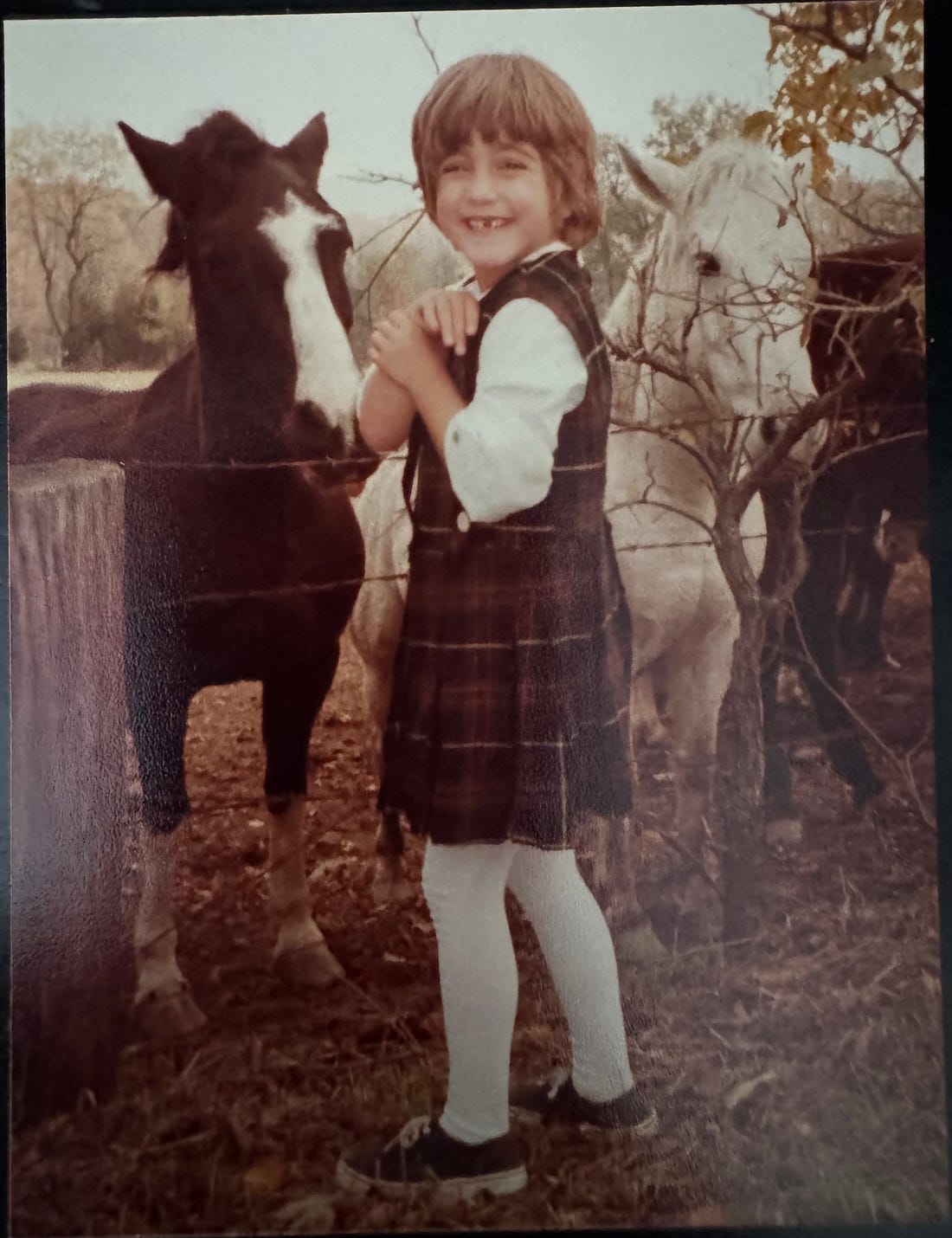
I’ve loved horses since I was a little girl. I grew up on a rural road in New Jersey, and nearby were horses neglected so badly they eventually slipped into a strange wild existence of their own, wandering and grazing, keeping close to one another, disappearing and returning according to rhythms entirely their own.
Sometimes they chose me.
I’d bring carrots and celery and stand there with my little hand stretched flat, waiting through that quiet appraisal, ears swiveling toward sounds beyond my range, one heavy hoof shifting against the dirt before that enormous head finally lowered, warm breath spilling across my fingers, velvet muzzle brushing my palm, the carrot disappearing with that clean, satisfying crack between teeth.
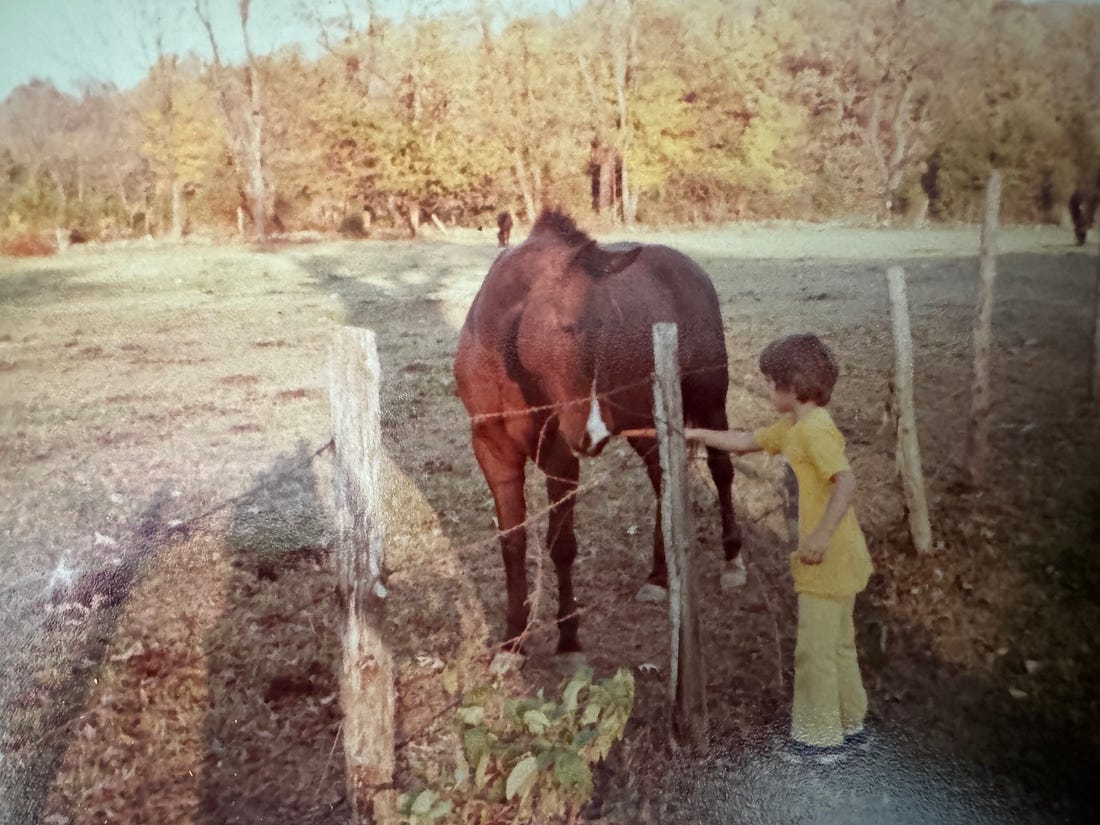
There was something in them I felt before I knew how to name it, some deep, quiet presence behind those enormous searching eyes that made me feel as though I wasn’t simply looking at a horse but being regarded by another soul.
I remember the smell of grass and earth and sun on their hides, the extraordinary intimacy of standing beside all that strength and realizing it had chosen softness with me.
Horses taught me early that power didn’t have to wound, and trust from something you could never overpower was never yours to take.
It was theirs to give.
I thought that was magic.
I still do.
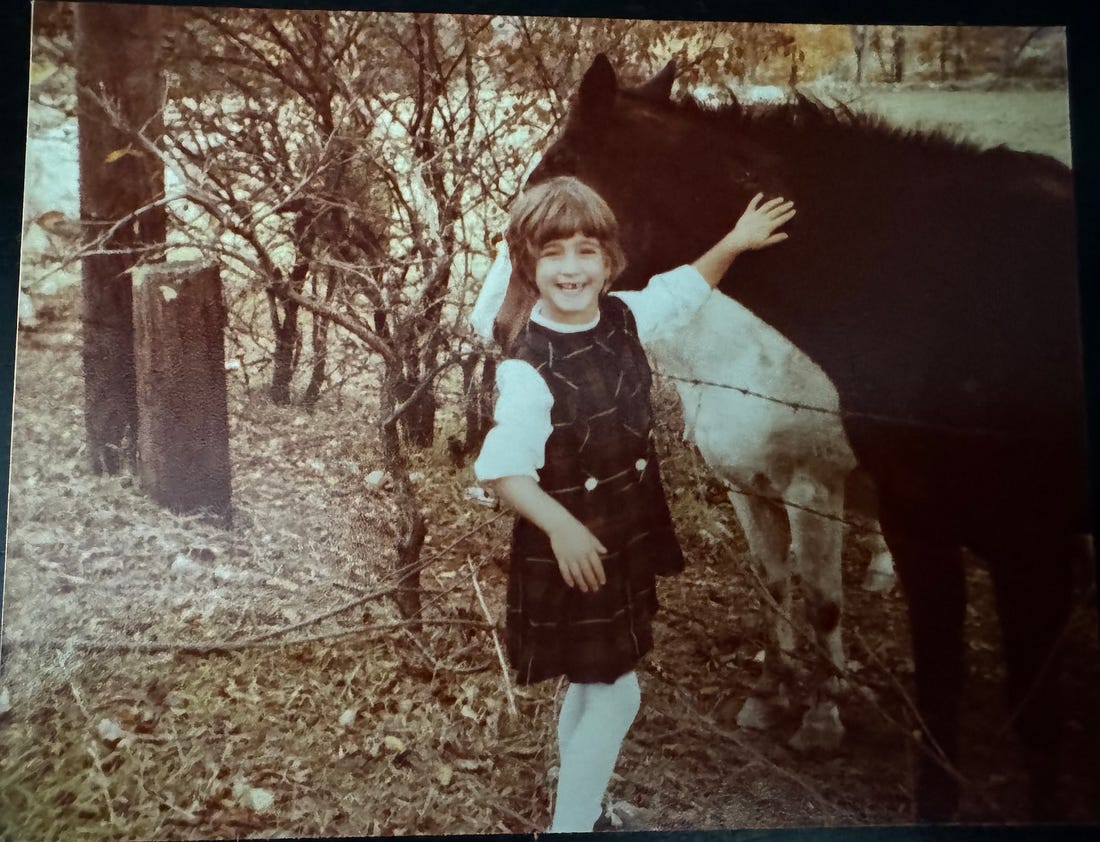
Maybe that is why horses reached me so early and stayed with me for so long. I grew up learning that the person who was supposed to make me feel safest could also be the person who hurt me, and that kind of betrayal rearranges a child’s understanding of love before she is old enough to understand what has happened.
But the horses were different.
They were the first creatures I remember experiencing as powerful without being frightening, enormous without being threatening, capable of hurting me and choosing not to.
They did not demand anything from me. They did not punish tenderness or turn trust into a weapon. They simply stood there, warm and watchful, and when one lowered its great head toward my little hand and accepted what I offered, I felt safe in the presence of strength.
I did not know then how much that mattered.
So this one got through. Straight through whatever emotional armor I’ve been trying to grow just to survive the news, because Jesus Christ, can we just make it stop?
Can we please just make it STOP?
Every morning another obscenity, another assault, another piece of wonder shoved face-first into the machinery, another stomach-dropping moment wondering which refuge, which species, which family, which child, which institution, which fragment of America we have to throw our bodies across now because some sadistic little apparatchik decided it could be sacrificed.
They ravage and raze, poison and pillage, strip and sell, gut and grind, and before one atrocity has settled into your bones another is crawling across the chyron.
It’s bleak and relentless and exhausting.
And I hate them.
I hate these people.
I hate what they’re doing to this country, to living things, to every decent instinct we’re supposed to cultivate in one another instead of crushing it beneath cruelty and greed.
And I don’t want to feel this way.
I don’t want to discover at noon that my jaw has been clenched since breakfast. I don’t want to look down and realize my hands have curled into fists. I don’t want that sick acceleration in my chest when another alert hits my phone, that split second when I’m almost afraid to open it because there is a decent chance I’m about to learn somebody is dead, a family has been blown apart, an animal has been brutalized, some irreplaceable piece of America has been carved open, and somebody in authority is already preparing the bloodless explanation for why none of us should care.
I don’t want hatred living this close to my heart. I don’t want these people colonizing my nervous system, taking something soft and human in me and keeping it perpetually braced for impact.
And I hate them for that too.
And DO NOT tell me this is about money.
Don’t fucking dare.
The numbers are obscene. The government can spend more than $3,000 capturing a mustang, sell that same horse for twenty-five dollars, and leave somebody farther down the chain able to make as much as $750 from its body. In 2025 alone, the government unloaded 3,700 horses and called the resulting $56 million reduction in future costs a savings.
Spend thousands wrenching them from the land. Sell them for almost nothing. Shed the responsibility. Call it efficiency.
And Project 2025 looked at these extraordinary beings and decided the real problem was the cost of keeping them alive, recommending that Congress allow the government to “dispose humanely” of excess wild horses and burros.
Dispose.
A cold little word for making a living thing disappear.
Too expensive.
They said the HORSES were too expensive.
Meanwhile Coupon-Code Caligula can conjure a UFC spectacle onto the White House lawn, turn Washington into an IndyCar track, tear apart the East Wing for a gargantuan ballroom, commission a multimillion-dollar granite helipad, inspect the work, dislike it, and have part of the thing ripped back apart and DONE AGAIN.
There is always money for marble and motors, spectacle and self-worship, hospitality suites and presidential pageantry, always another corporation with fortunes tied to federal power eager to underwrite some gleaming shrine to Donald Trump’s diseased appetite for himself.
But keeping a horse alive?
NOW comes austerity.
Now, beneath an open Western sky beside beings whose only offense is costing money to keep breathing, this malignant little kleptocracy suddenly discovers fiscal restraint.
You have got to be fucking kidding me.
Can’t they leave one thing alone?
Can’t they leave one goddamn pure, beautiful fucking thing alone?
Leave the high country where first light spills slowly over stone, wetlands waking beneath pale ribbons of mist, badlands burning copper and crimson as evening comes down, great unfenced plains where wind can run for miles without striking a wall. Leave the places where stars crowd the heavens until the sky feels bottomless, where silence has weight and dawn arrives across untouched ground in long washes of gold, where the horizon still belongs to itself.
Leave the horses.
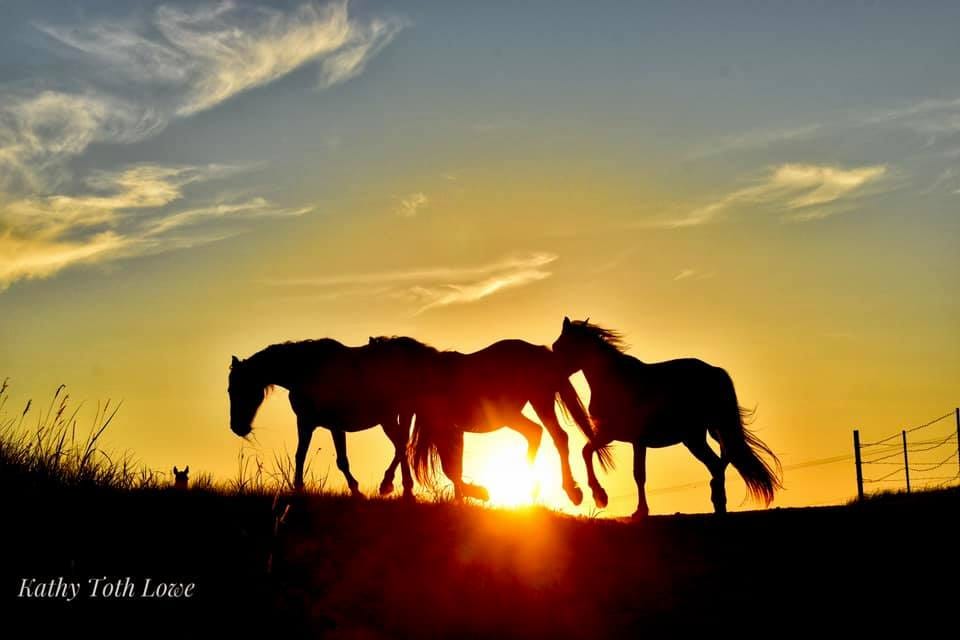
Because these aren’t isolated little acts of ugliness anymore. They’re scars. Physical scars gouged into the land, institutional scars carved through agencies and safeguards and public trust, moral scars etched into all of us from waking up day after day and watching people entrusted with this country dispose of it piece by piece because to them everything is transactional, everything is consumable, everything has a price and nothing has inherent worth once it has ceased to serve the only thing they truly revere: themselves.
They are cutting pieces out of America, hacking into the wild places and public places and fragile places, tearing through things we inherited from people who understood that preservation was a promise made forward, an obligation to people they would never meet. They are leaving wounds that won’t close when that motherfucker is finally gone one way or the other, damage that won’t disappear with a new president or a new Congress or the ceremonial scrape of his name off whatever he managed to glue it to on the way out.
Our children and their children will inherit these injuries. It may take decades to restore what can be restored, generations to regrow what can be regrown, and there are lives being extinguished right now that no election, apology, appropriation, investigation or act of contrition will ever bring back.
Human beings are dying. Animals are dying. Children around the world are dying, and we are living through it in real time, absorbing one fresh horror before the last has found somewhere to settle, carrying this accumulation of grief and rage and helplessness inside our bodies while the people inflicting it move briskly along to the next atrocity.
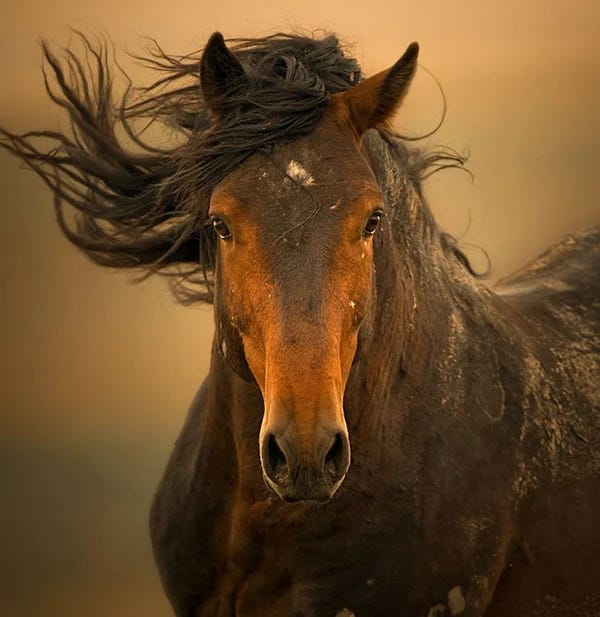
And my heart is absolutely breaking for these horses, for beings whose whole lives were made of open country and changing seasons, hidden water and hard ground, summer heat shimmering above stone, the herd gathered close after sundown and mornings arriving pale across an unobstructed horizon, until human greed reached across all that distance and dragged them into a world of fences, forms, freight and confinement.
They knew freedom.
We gave them fear.
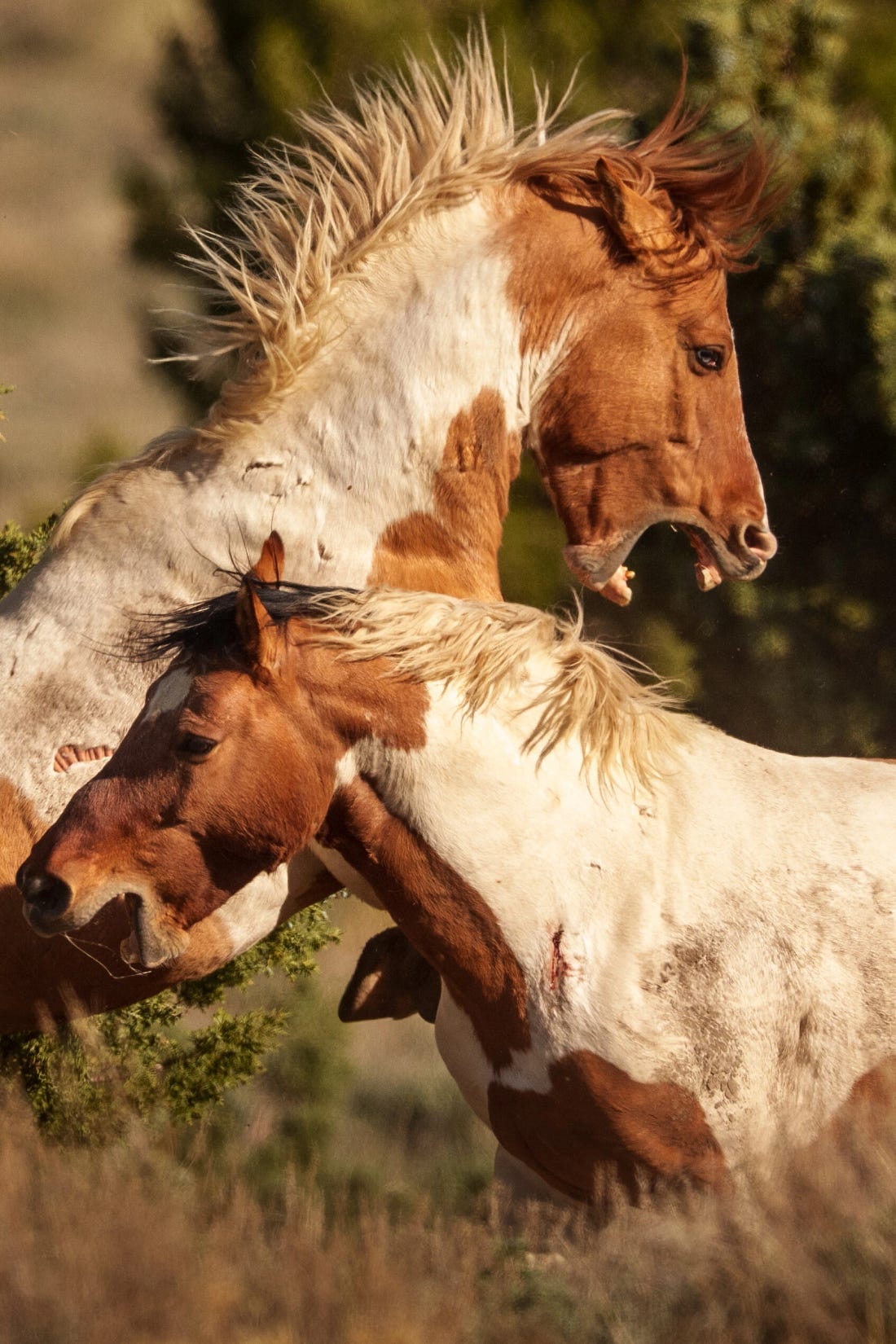
And we have to remember that. We have to remember all of it, what they bulldozed and butchered, what they poisoned and despoiled, what they sold and scarred and sacrificed, the people they hurt, the families they devastated, the places they wounded and the creatures that had no vote, no lobbyist, no lawyer, no way to defend themselves from the people who were supposed to protect them.
Not the bleached, sanitized version that will someday be compressed into a chapter called “the Trump years.” Not a collection of dates and executive orders and election results scrubbed clean of what it actually felt like to live through this.
Remember waking up afraid to look at your phone. Remember the clenched jaw and balled fists and pounding heart. Remember what it felt like to watch cruelty become governance, callousness become currency, destruction become routine, empathy treated like some embarrassing weakness that serious people had finally evolved beyond.
Because forgetting would be one final cruelty inflicted on everything and everyone they harmed.
Some of these scars will fade. Some will take generations. Some never will.
We cannot get these horses back.
We cannot resurrect the dead, unbreak the terrified child, reassemble every shattered family, coax every ancient living thing back from ruin or return every frightened animal to the life it knew before somebody decided its existence cost too much.
But we can remember exactly what it looked like when cruelty was given power, exactly what it sounded like, exactly what it cost, and carry that memory forward like a promise to the people who come after us that no matter how much time passes, no matter how carefully somebody tries to sand down the edges of this history, we will tell them what happened here.
We will tell them what was done.
We will tell them what was lost.
And we will tell them why we must never, ever fucking let it happen again.
But there is some good news:
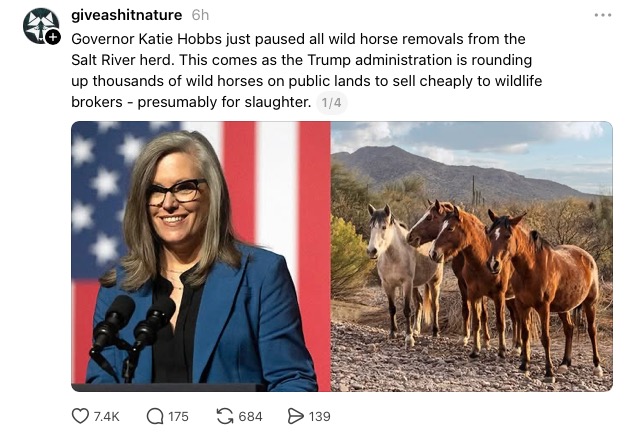
So proud of my governor.
1 comments
Such a tragedy.